President John Dramani Mahama has unveiled sweeping economic changes that will fundamentally alter how Ghana trades its key resources, announcing plans to finance cocoa purchases locally and halt exports of unprocessed minerals within the decade.
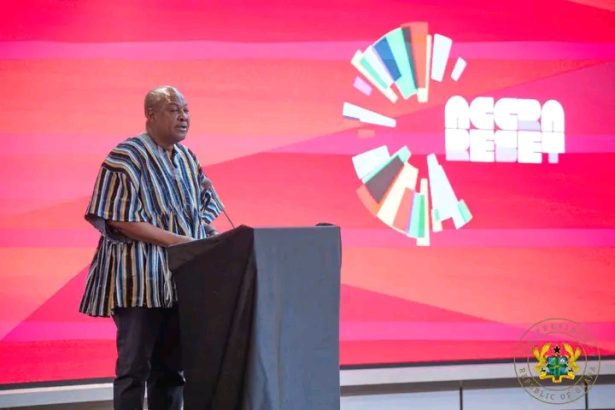
The announcement was made at the close of his high-level side event, “Accra Reset’s Addis Reckoning,” held during the 39th African Union Assembly of Heads of State.
“One of the key decisions we’ve made is to stop accepting foreign funding for the purchase of our cocoa. We are going to raise domestic bonds. We have enough Cedis in Ghana to pay for our cocoa,” President Mahama declared.
He explained that recent turbulence in the cocoa market exposed structural weaknesses in Ghana’s long-standing financing model. Government fixed producer prices when global cocoa traded at $7,200 per tonne and the cedi stood at 11.5 to the dollar, but losses followed when prices dropped to $4,200 while the cedi strengthened to 10.7.
The President said the deeper challenge lay in the financing arrangements themselves, revealing that cocoa beans are pledged as collateral to lenders.
More Read
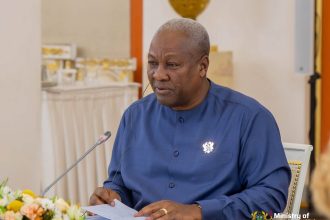
“You know what the collateral for the funding is? Our own cocoa beans. You collateralise the beans with the financier, buy them, ship them, and they pay you the international market price,” he explained.
“You know the interesting part? We have the capacity to process 400,000 tons of those beans in Ghana, but because they are collateralised, we cannot even allocate them to local processors. We must ship all the beans outside.”
Under the proposed policy, Ghana will issue domestic bonds in cedis to purchase cocoa directly from farmers, removing the need to pledge beans to foreign financiers and freeing an estimated 400,000 tonnes annually for local processing.
President Mahama also set a firm industrialisation deadline, stating that exports of raw minerals will end by 2030.
“I say by 2030, there won’t be any raw mineral ores leaving Ghana. You’re not going to ship raw manganese ore out of Ghana. You’re not going to ship raw bauxite ore out of Ghana. You’re not going to ship raw iron ore out of Ghana. You must process all that locally,” he stated emphatically.
He linked the policy direction to job creation pressures and youth expectations across the continent.
“That is the only way we can provide opportunities for our young people. Our young people are less patient than our generation. They want to see that progress and prosperity today,” he said.
He further tied the urgency to irregular migration.
“That is why Accra Reset needs that urgency to stop our young people from braving the dangers of the Sahara and the Mediterranean as they try to reach Europe in search of opportunity.”
Calling for faster continental implementation, the President urged willing African states to move ahead even if others hesitate.
“We come with the decisions. We agree. We do the frameworks. What is missing is urgency and implementation. We take time. And we behave like time is waiting for us,” he said.
“That is why Accra Reset is a good idea. But let’s implement urgently. If parts of the continent are not ready, let’s form a coalition of the willing to move this as quickly as possible. And let all the others follow and join.”
The initiative forms part of his Accra Reset agenda, which promotes local value addition, industrialisation and resource sovereignty across Africa.
“From Addis, we must stop talking and start implementing,” President Mahama concluded.