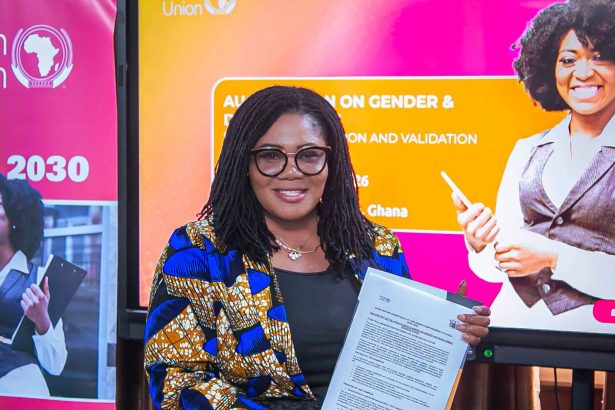
Ghana has received the final 2026–2028 Work Plan for the African Union Champion on Gender and Development, setting out a framework for advancing gender equality and women’s empowerment across Africa.
The document was formally presented by the Director of the African Union Commission’s Women, Gender and Youth Directorate, Prudence Nonkululeko Ngwenya, at the close of a three-day Strategy Co-Creation and Validation Workshop in Accra.
The work plan is expected to guide Ghana’s efforts as the country prepares to assume a leadership role within the African Union and seeks to translate the mandate of the AU Champion into concrete programmes and interventions.
Ms Ngwenya said participants had deliberately sought to define an innovative and impactful role for the Champion, particularly in anticipation of Ghana’s upcoming AU leadership.
She said gender equality remained central to the African Union’s Agenda 2063, economic growth and social development, stressing the need for the Champion to mobilise political support and advocate for gender equality and women’s empowerment at the highest level.
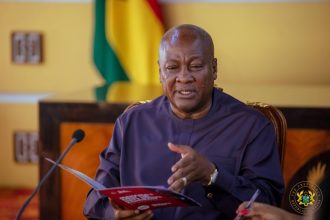
Receiving the document on behalf of President John Dramani Mahama, the Minister for Gender, Children and Social Protection, Agnes Naa Momo Lartey, said the work plan should be viewed as a roadmap for action rather than an end in itself.
She said its success would ultimately depend on whether it could be translated into concrete interventions, stronger policies, adequate resources and measurable improvements in the lives of women and girls across Africa.
Dr Lartey reaffirmed Ghana’s commitment to supporting the AU Champion and pointed to recent measures taken by the country to strengthen gender equality.
These include the Affirmative Action (Gender Equity) Act, 2024 (Act 1121), the National Gender Policy (2025–2034) and Parliament’s approval of the African Union Convention on Ending Violence Against Women and Girls.
The three-day engagement examined the Champion’s comparative advantage, vision and theory of change, strategic priorities, proposed presidential initiatives, implementation arrangements and partnerships.
Participants also considered investment, monitoring and accountability mechanisms needed to ensure the effective implementation of the plan.
The validated work plan is expected to provide a coordinated framework for Ghana and the African Union Commission to pursue gender equality and development priorities across the continent.
The initiative comes at a time when African countries are seeking stronger political commitment, investment and institutional action to address persistent inequalities affecting women and girls and ensure that gender equality remains central to the continent’s development agenda.