….As Mahama launches ‘Big Push’ to modernise Ghana’s road network across all 16 regions
The Minister for Roads and Highways, has lamented about a colossal GH¢40 billion debt owed to road contractors, which he said he inherited at the Ministry. Yet, according to him, is difficult to show tangible results of what the money was spent on, despite his travels across all 16 regions of the country.
Kwame Governs Agbodza, made the revelation yesterday, Tuesday, September 16, 2025, at the launch of President John Dramani Mahama’s flagship infrastructure initiative, the Big Push programme, aimed at boosting Ghana’s road infrastructure.
The initiative is projected to cost GH¢13.8 billion in 2025 alone, with some sources describing it as a US$10 billion programme spanning 2025 to 2028.
“Mr President, if you come to the Ministry of Roads and Highways, we owe probably GH¢40 billion in debt to contractors,” Mr Agbodza disclosed. “But when we went around the country, the 16 regions, it was difficult to see what the money was spent on.”
More Read
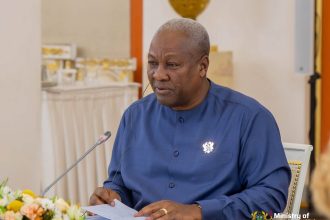
Despite the significant debt overhang, the Minister, said the government was determined to deliver results.
The Adaklu MP, described the Big Push as a “bold intervention” that transcends politics and lauded President Mahama for initiating what he called the single largest intervention in Ghana’s road sector.
“Despite all that, Mr President, you made a bold commitment to institute an intervention that will go down in history as the President who gave the biggest dose of intervention at a single time on our roads,” he declared.
“The Big Push is not a campaign promise; it is a bold intervention by your government.”
Mr Agbodza dismissed fears of delays in implementation, stressing confidence in the contractors selected. “When we say we can do this project within 24 months, we mean business. The people of Greater Accra and Ga-Dangme, don’t be worried. The contractor on this stretch, I believe, can complete the project in less than 24 months.”
The government has earmarked GH¢13.85 billion (US$892.9 million) for the programme in 2025.
The sod-cutting ceremonies began in Greater Accra and concluded in the Volta Region with the Ho–Denu–Aflao road, a vital route expected to significantly boost connectivity, trade, and development.
The Big Push was first promised during the 2020 election campaign and revived after President Mahama’s re-election in 2024 to tackle Ghana’s crippling infrastructure deficit, especially in roads.
At the sod-cutting for the Dodowa–Afienya–Dawhenya road project, President Mahama announced a 24-month completion deadline.
He praised Oswal Investment Limited, the contractor, as one of Ghana’s best.
“So, I want to assure the people of Dodowa–Afienya–Dawhenya that you have one of the best Ghanaian contractors doing your road. We have given him 24 months to finish, but he has whispered in my ear that he will do it in less than 24 months,” the President said.
According to him, the Big Push will create economic opportunities, strengthen food distribution, improve inter-regional travel, and drive industrial growth.
Outlining priorities, he explained that the first focus is on inter-regional roads linking regional capitals. “Our priority was to take roads that connect one regional capital to another… for example, from Accra to Ho, or Accra to Cape Coast.”
The second focus is linking district capitals, while the third targets road infrastructure in food-growing and industrial zones.
President Mahama emphasised that only qualified and experienced contractors would execute the programme, warning against unqualified operators he described as “wheelbarrow contractors”.
“There are a few wheelbarrow contractors who have come to me saying, ‘Oh, I hear they are distributing projects under the Big Push. I want one.’ I say, ‘My friend, this is not for wheelbarrow contractors.’”
He explained that both local and foreign contractors already working on active projects had been retained and repackaged under the initiative to ensure speedy completion.
The Minister of Roads and Highways, expressed optimism that local contractors are capable of executing all the works under the Big Push initiative.
He pointed out that First Sky Group, contractors presently working on the 117.4 kilometres road from Atimpoku-Asikuma-Anyrawasi-Ho-Denu-Aflao, is competent and results-oriented. Mr Agbodza expressed profound gratitude to the President for his leadership in championing the pivotal ‘Big Push’ initiative.
“We at the Ministry have been guided to always prioritize the dignity and well-being of Ghanaians. This road, and the entire ‘Big Push’ programme, is a testament to that very principle. We are optimistic that this project will be completed within the 24-month timeframe,” he said.
The Minister detailed the government’s comprehensive strategy to ensure the success of the programme, built on a foundation of transparency and accountability.
He announced a robust framework that includes the public disclosure of contractor names and their beneficial owners to ensure full public scrutiny.
Furthermore, all contractors will be required to hold fit-for-purpose insurance to cover any potential defects, safeguarding the public investment.
To accelerate development, the Minister revealed that the Ministry had been directed to align its activities with the government’s 24-hour economy policy, ensuring that projects are executed around the clock to meet deadlines.
Mr Agbodza also charged the contractors with a dual responsibility: to not only deliver quality work on time but also to actively mentor young Ghanaian engineers by taking on graduates and nurturing them to become the next generation of industry leaders.
“This ‘Big Push’ is more than just infrastructure; it is about building capacity, fostering transparency, and working tirelessly to transform our nation for the better,” the Minister said.
James Gunu, the Volta Regional Minister, on behalf of the chiefs and people of the Volta Region, extended heartfelt gratitude to President Mahama for this timely and much-needed intervention, which will significantly improve road infrastructure and accelerate development in the region.