
The Chief Executive Officer of the Ghana Cocoa Board (COCOBOD), Dr Randy Abbey, has revealed a deep-rooted financial and operational challenge he inherited upon assuming office, describing the institution’s current position as the most precarious in its nearly 80-year history.
COCOBOD is currently facing bankruptcy, with total debt of GH¢32.9 billion covering cocoa roads, jute sacks, insecticides, fertilisers, among other items, prompting President John Dramani Mahama to convene an emergency Cabinet meeting to address challenges in the cocoa sector.
The sector is facing challenges, including delayed payments to farmers, unsold cocoa beans at ports, and financing constraints affecting Licensed Buying Companies. The Minister of State in charge of Government Communications, Felix Kwakye Ofosu, has announced a meeting scheduled for today, Wednesday, 11 February 2026.
Interestingly, most of the owed parties, including companies linked to politicians from the previous government that carried out major procurement deals at COCOBOD, have been paid. However, insiders have attributed this to the lack of procurement audits and the absence of retribution within the Mahama administration of the key state institutions that managed large sums of money during the Akufo-Addo administration.
Although the GH¢32.9 billion occurred under the Akufo-Addo government, with known New Patriotic Party (NPP) elements as beneficiaries of those contracts, the opposition party has been at the forefront of inciting cocoa farmers against the Mahama government, reminding it of promises made by the Agric Minister, Eric Opoku, Finance Minister Ato Forson, among others, to make cocoa farmers, during the 2024 electioneering campaign.
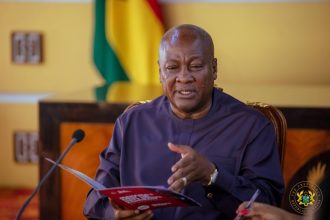
The NPP has also been quick to cite certain vehicle procurements by COCOBOD management, as well as claims of a renovation of the Chief Executive’s official residence, as among the reasons farmers have not been paid.
In an interview on The Point of View on Channel One TV on Monday, February 9, 2026, Dr Abbey confirmed that COCOBOD was burdened with a total debt of GH¢32.9 billion as at the end of 2024, alongside a negative equity position of about GH¢3.8 billion, meaning the organisation’s liabilities exceeded its assets.
COCOBOD’s financial burdens affecting its current operations included jute sack procurement with the last exercise costing US$48 million, making new procurement unnecessary, Cocoa roads, which cost GH¢ 26 billion, with GH¢21 billion incurred between the 2018/19, 2019/20 and 2020/21 seasons, despite no budgetary allocations for cocoa roads in those periods.
There is also a $350 million rehabilitation fund intended to restore 156,400 hectares, of which only 40,000 hectares have been delivered, alongside an additional GH¢700 million drawn and a total outstanding debt stock of GH¢32.9 billion, further constraining COCOBOD’s financial flexibility.
According to the COCOBOD boss, this marked the first time in COCOBOD’s history that the board recorded negative equity. He contrasted the situation with 2016, when COCOBOD posted a positive equity position of approximately GH¢1.8 billion.
“Year-end 2024. That is when I took over. What I inherited, I mean, COCOBOD had a debt of GHC32.9 billion. COCOBOD had a negative equity of GH¢3.8 billion. At the end of 2016, COCOBOD had a positive equity of about GH¢1.8 billion.
“2024 year-end, negative equity of GHC3.8 billion, almost GH¢3.9 billion, which presupposes that COCOBOD’s liabilities were more than its assets, but close to GH¢4 billion. The first time in the history of the 79-year-old company. Next year [2027], COCOBOD will be 80 years old. So this is what we inherited,” he said.
A major contributor to the financial strain, Dr Abbey disclosed, is COCOBOD’s exposure to cocoa road contracts, estimated at GH¢26 billion. He explained, however, that only GH¢4.4 billion of this amount is currently recorded as debt, as it relates to certified works awaiting payment.
“So this is what we inherited. We inherited a cocoa road exposure of GH¢26 billion,” he disclosed.
“So only GHC4.4 billion of this exposure was part of the debt, because the GH¢ 4.4 billion were certificates that were sitting at our cash office, but the GH¢26 billion were contracts, road contracts that COCOBOD had awarded, GH¢26 billion. But the GH¢32.9 billion includes only GH¢4.4 billion of these GH¢26 billion contracts awarded,” he explained.
Beyond infrastructure commitments, the COCOBOD CEO also pointed to persistent procurement inefficiencies, particularly in the acquisition of jute sacks used in cocoa packaging.
Without meaning names, Dr Abbey said the board continued to procure jute sacks annually without clearing existing stock, resulting in repeated, avoidable expenditure estimated at about $48 million.
“Then you also had a situation where COCOBOD kept procuring jute sacks and were not clearing these jute sacks, but yet were procuring every single year and not clearing, and spending $48 million,” he said.
Dr Abbey noted that the combined impact of legacy debts, uncrystallised contract obligations and procurement lapses accounts for the GH¢32.9 billion debt burden he inherited, underscoring the scale of the reforms required to stabilise COCOBOD’s finances and restore confidence in the cocoa sector regulator.
Earlier, on February 6, 2026, the COCOBOD head acknowledged that there were difficulties with payments and that “Cocoa farmers deserve an apology.” Mr Abbey, who said this at a media briefing, added that COCOBOD, the Ministry of Finance and the government were working to address the issues.
Industry players have said thousands of farmers have experienced delays in receiving payment for cocoa delivered since November 2025.
The Minority Caucus in Parliament has said COCOBOD owes Licensed Buying Companies more than GH¢10 billion for cocoa already delivered.
Mr Abbey had at a press conference said that although COCOBOD has sold more than 530,000 tonnes this season, about 50,000 metric tonnes remain at the ports without buyers.
The challenges relate partly to pricing conditions on the world cocoa market. Ghana pays farmers about GH¢58,000 per tonne, while world prices were around $4,200 per tonne as of February 6, 2026, representing a 57 per cent decline from the same period last year. Ghana’s total production and export costs stand at about $6,300 per tonne.
Ghana’s cocoa financing system has changed in recent seasons. The traditional syndicated loan arrangement was not available for the 2024 2025 season, prompting the use of alternative financing models, including a 60:40 arrangement and, later, an 80:20 model for the current season.
On COCOBOD’s procurement of a number of vehicles despite the current challenges faced by the board in paying farmers from whom it has purchased cocoa beans. The Board clarified that the vehicles were procured strictly for operational purposes and were not funded from resources meant for farmers.
It added that the funding came from a residue fund, classified as internally generated funds (IGF) of the Board. The investment was justified because nearly 70% of COCOBOD’s operational vehicle fleet is over 10 years old, reducing efficiency and service delivery.
According to Fiifi Boafo, a former Public Affairs Officer at COCOBOD, the board has purchased four Land Cruisers for its chief executive, Dr Randy Abbey, and his deputies.
Fiifi Boafo also claimed that COCOBOD management has purchased 110 Toyota Hilux pickups and saloon cars for its directors.
“At the time when COCOBOD is struggling to pay cocoa farmers, management has reportedly procured four Land Cruisers for the chief executive and his deputies, along with 110 Toyota Hilux pickups and saloon cars for directors,” he wrote on social media on Feb. 5, 2026.
The allegations against COCOBOD come on the back of public criticisms over delays in payment to farmers for the 2025-26 cocoa season, pushing Cocoa farmers across the country to threaten to go on demonstration over the delays in payments, but the COCOBOD boss asked the farmers to remain patient as the government works to clear all arrears owed to them.
Dr Abbey explained that the recent challenges faced by cocoa farmers and COCOBOD regarding payments and arrears in the cocoa sector stem from the collapse of the long-standing syndicated loan agreement, which has crippled financing for cocoa purchases.
Today’s Cabinet meeting is expected to consider payment options, review pricing arrangements and examine longer-term financing measures for the cocoa sector.
COCOBOD outlined the financial and structural challenges facing the cocoa sector, including shifts in financing models, delayed payments to some Licensed Buying Companies (LBCs), and pressures from the sharp decline in international cocoa prices.
Traditionally, Ghana relied on syndicated loans to finance cocoa purchases, ensuring steady liquidity throughout the season regardless of market conditions. However, in the 2024/25 season, Ghana was denied access to syndicated financing due to its failure to honour contractual obligations in the 2023/24 season, when the country failed to supply the agreed 800,000 metric tonnes of cocoa. The shortfall of 333,767 metric tonnes was subsequently rolled over into future contracts.
COCOBOD’s financial difficulties were further compounded by the Domestic Debt Exchange Programme (DDEP), which weakened the Board’s financial position and eroded international confidence. As a result, international banks declined to provide syndicated facilities, effectively shutting Ghana out of traditional cocoa financing structures.
In response, off-takers and international buyers adopted a new financing arrangement in which they directly funded cocoa purchases. Under this model, buyers financed the acquisition of cocoa beans on the condition that Ghana would service the rolled-over 333,767 metric tonnes at the original contract price of $2,600 per tonne and also supply new-crop cocoa under newly signed contracts. The buyers also determined which LBCs would receive funding for purchases.
The 2024/25 season operated under a 60/40 financing model, with 60% paid upfront and 40% paid upon shipment. This structure required COCOBOD to service both the rolled-over contracts and new crop obligations simultaneously. COCOBOD’s operational funding, including margins and payments to LBCs and hauliers, depended largely on the 40% tranche, constraining its liquidity.
In the 2025/26 season, management continued with this model, acknowledging it was not sustainable but necessary to stabilise COCOBOD’s financial books. To prioritise farmer welfare, the structure was adjusted to an 80/20 split, providing more upfront liquidity to ensure prompt payment. So far, COCOBOD has serviced over 235,000 tonnes of the rolled-over contract at an estimated $500 loss per tonne, due to the gap between the 2023/24 contract price of $2,600 and the 2024/25 farmgate price of $3,100 per tonne.
Addressing claims that farmers have not been paid since November, COCOBOD clarified that under the new financing model, several LBCs that received direct funding from off-takers made payments for cocoa purchased. However, LBCs without off-taker funding had to source their own funds before submitting cocoa through the Cocoa Marketing Company (CMC). While COCOBOD acknowledges outstanding obligations, it confirmed that payments have been made between November and February, contradicting claims of a complete payment freeze.
The international cocoa market has also experienced a sharp downturn, with prices falling from nearly $12,000 per tonne in 2024 to about $4,000 per tonne, where they have largely stabilised. This has placed significant pressure on producing countries such as Ghana and Côte d’Ivoire. Although Côte d’Ivoire has not officially announced a price reduction, reports suggest cooperatives are selling at lower prices.
Ghana’s cocoa has become relatively expensive on the international market due to production and logistics costs, estimated at at least $6,300 per tonne from farmgate to shipping, well above prevailing global prices. This mismatch has led buyers to delay signing new contracts, affecting both Ghana and Côte d’Ivoire. Despite these challenges, 580,000 tonnes out of the projected 650,000 tonnes for the 2025/26 season have already been bought, graded and sealed.
COCOBOD stressed that cocoa prices in Ghana are not set unilaterally but by the Producer Price Review Committee, which includes representatives of farmers, the Ministry of Finance, the Bank of Ghana, transporters, LBCs, and COCOBOD. Until this committee meets and reviews prices, the current farmgate price remains in force. Government and COCOBOD, the Board said, remain committed to securing the best possible outcomes for farmers, with announcements expected in due course.
COCOBOD maintains that, while the current financing model is not ideal, it is a transitional strategy aimed at stabilising the sector, restoring confidence, protecting farmers, and rebuilding the financial integrity of Ghana’s cocoa industry amid unprecedented global and domestic economic pressures.