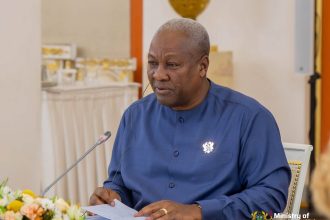
President John Mahama has urged African nations to make decisive investments in skills, industrial capacity, and continental unity, warning that failure to act could leave the continent trailing in an increasingly competitive global economy.
Addressing political and business leaders at the World Economic Forum in Davos on Thursday, January 22, President Mahama highlighted the urgency for Africa to respond proactively to global economic shifts. He noted that the continent’s young population is closely observing the pace of development, growing impatient with slow progress.
“Our young people are watching. They’re brilliant, they’re hungry, and they’re running out of patience,” the President told the audience.
President Mahama outlined five key priorities for African governments: targeted skills development, industrialisation, regional unity in negotiations, local production of critical goods, and accountable governance.
On skills development, he stressed that education alone is insufficient, advocating for training aligned with the demands of the modern economy. “We must invest in skills. Not just education, but skills that match real jobs in the real economy,” he said, citing digital technology, green energy, and manufacturing as vital areas. According to Mahama, Africa needs a generation capable of producing and building, not merely consuming.
More Read
He also emphasised regional industrialisation as essential for sustainable growth, pointing out that no single African country can achieve meaningful industrial development in isolation. He called for shared manufacturing zones, integrated energy grids, and coordinated digital infrastructure to provide scale for businesses and better opportunities for workers.
Unity in international negotiations emerged as another central theme. President Mahama said African nations must present a consolidated front on trade, minerals, and climate finance, warning that fragmented efforts leave the continent at a disadvantage. “Unity should not be a slogan; it must be the strategy,” he said.
Local production of key goods was another priority. Mahama warned that reliance on external markets for essential products, from vaccines to semiconductors to solar panels, leaves Africa perpetually dependent. He rejected claims that industrial policy is outdated, arguing that such strategies are critical for survival and self-sufficiency.
Finally, the President addressed the need for accountable governance and reform, noting that corruption and weak systems erode investor confidence. “We cannot ask the world to invest in us if we tolerate corruption, waste, and systems that don’t work. Reset means reform. And reform means results,” he said.
President Mahama also highlighted what he described as Africa’s “triple dependency”: reliance on external powers for security decisions, donor dependence for health and education, and the export of critical minerals with minimal local value capture. He warned that this dependency undermines true sovereignty.
“In my quiet moments, as I try to find solutions, here’s what I’ve learned: Crisis creates clarity. The clarity is this: We must build our own capacity to act,” he said.
The speech reinforced Mahama’s vision for a self-reliant Africa, urging leaders to prioritise skill development, industrial capacity, regional cooperation, local production, and governance reforms as pillars for long-term growth and sovereignty.