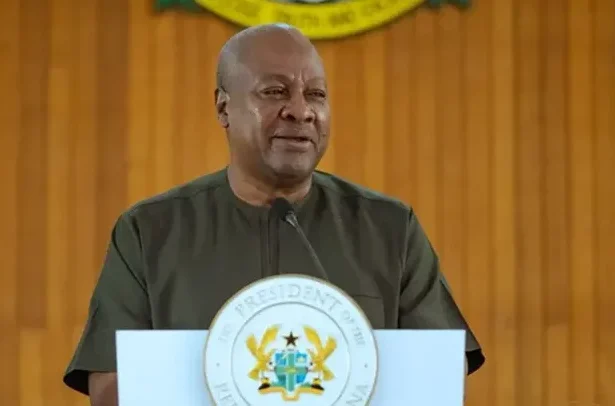
President John Dramani Mahama has announced the establishment of a 24-Hour Economy Authority, describing it as the engine that will power a new phase of industrial growth and productivity in Ghana.
Addressing participants at the Presidential Dialogue with the Private Sector in Accra, the President positioned the initiative as a strategic intervention aimed at transforming the country’s manufacturing landscape through continuous production.
President Mahama explained that the policy framework is structured to enable factories and key industries to operate three shifts daily, maximising the use of installed machinery, factory plants, labour and infrastructure.
According to him, Ghana cannot achieve rapid industrial growth if expensive machinery and factory plants remain idle for long hours.
He argued that a shift-based production model would increase national output, lower unit production costs and strengthen the competitiveness of locally manufactured goods both on the domestic market and abroad.
The President stressed that productivity, not just macroeconomic stability, must define the next stage of Ghana’s economic transformation.
To facilitate the transition, President Mahama outlined a series of support measures designed to ease operational burdens on manufacturers.
These include shift-based operational incentives, off-peak electricity tariffs to reduce the cost of night-time production, enhanced industrial security systems, and targeted tax exemptions on machinery and equipment to encourage factory expansion.
He further indicated that the 24-Hour Economy Authority would work closely with key state institutions, including the Bank of Ghana, sector ministries and investment promotion agencies to address bureaucratic delays that often impede industrial growth.
The President linked the initiative to Ghana’s strategic role under the African Continental Free Trade Area (AfCFTA), whose secretariat is headquartered in Accra.
He noted that round-the-clock production would position Ghanaian manufacturers to meet increased demand across African markets, scale up exports and compete more effectively within the West African sub-region and beyond.
President Mahama assured industry players of government’s commitment to ensuring policy certainty, stable power supply and the necessary infrastructure to sustain the 24-hour production model.
He called on businesses to seize the opportunity by investing in expansion, strengthening workforce skills and maintaining high production standards.
“The Ghana we seek will not be built by rhetoric,” he emphasized. “It will be built by factories operating at scale; day and night producing for Ghana, Africa and the world.”