President John Dramani Mahama has renewed calls for global equity in the fight against climate change, insisting that Africa must not continue to bear the harshest consequences of a crisis it did little to create.
Addressing world leaders at the World Governments Summit in Dubai, the Ghanaian President argued that international climate discussions must move beyond rhetoric and commitments to action that reflects fairness, responsibility and justice.
According to him, climate change has evolved into one of the most defining challenges of the modern era, cutting across economic stability, environmental sustainability and social cohesion. He warned that any emerging global alliance that sidelines climate concerns risks undermining its own future relevance.
“No alliance of the future can ignore the climate crisis. While Africa contributes the least to global emissions, it suffers disproportionately from climate impacts.
“Climate action must therefore be matched by climate justice, and the global community must honour its commitments on climate finance, adaptation support, and equitable energy transitions,” he stated.
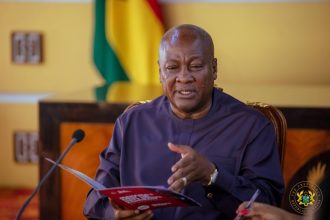
President Mahama pointed out that Africa’s vulnerability is compounded by limited access to climate finance and adaptation resources, even as industrialised economies remain the biggest contributors to greenhouse gas emissions.
He cited the Ghana–United Arab Emirates partnership as a model of what responsible global cooperation should look like, describing it as a practical demonstration of how shared interests can be aligned with sustainable development goals.
Under the partnership, Ghana has secured a US$30 million grant aimed at supporting climate action programmes, protecting biodiversity and promoting inclusive development. Mahama said initiatives of this nature illustrate how climate justice can be advanced through mutual commitment rather than charity.
“The President said such collaborations demonstrate how shared responsibility and mutual benefit can shape a more sustainable and resilient global future.”
Africa’s contribution to global greenhouse gas emissions remains marginal, estimated at between 2 and 4 per cent, despite accounting for nearly 17 per cent of the world’s population. Emissions on the continent are largely concentrated in a handful of countries, including South Africa, Egypt and Algeria, primarily driven by fossil fuel consumption.
President Mahama’s remarks add to growing pressure on developed nations to honour long-standing pledges on climate financing and to support developing countries in transitioning to cleaner energy systems without compromising economic growth.