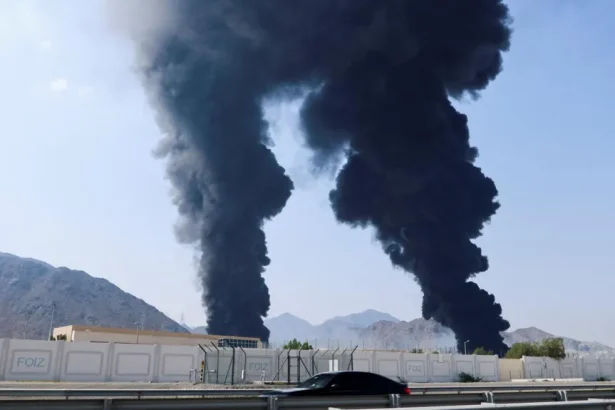
Fresh drone attacks targeting key transport and energy facilities in the United Arab Emirates (UAE) have heightened security concerns in the Gulf as tensions linked to the ongoing conflict involving Iran continue to escalate.
Authorities confirmed that a drone-related incident near Dubai International Airport triggered a fire on Monday, forcing a temporary suspension of flight operations at the world’s busiest airport for international passengers.
The disruption led to delays and cancellations of several flights, marking the third security-related incident recorded near the airport since the start of the conflict involving the United States, Israel and Iran.
At the same time, another drone strike ignited a fire at the industrial and oil storage complex in Fujairah, home to one of the region’s largest oil storage and export facilities.
The port city, located on the Gulf of Oman along the UAE’s eastern coastline, plays a strategic role in the global oil supply chain because ships accessing the port do not have to pass through the Strait of Hormuz.
More Read

Energy infrastructure in Fujairah also came under attack earlier when a drone struck an oil storage tanker on Saturday, while another strike on Monday caused additional fires within the facility, forcing a temporary halt to oil loading activities as authorities assessed the damage.
Meanwhile, a separate rocket strike targeting a vehicle killed a Palestinian national on the outskirts of Abu Dhabi, according to the city’s Media Office. The incident occurred in the Al Bahia area.
The UAE Ministry of Defence said the country’s air defence systems intercepted six ballistic missiles and 21 drones during Monday’s attacks.
Officials say Iran has launched more than 1,900 missiles and drones toward the UAE since the wider regional conflict began.
Security analysts warn that the repeated targeting of oil facilities in Fujairah underscores the vulnerability of critical energy infrastructure across the Gulf.
According to Dubai-based oil analyst Matt Stanley of commodities data firm Kpler, Fujairah’s importance lies in its location outside the Persian Gulf, allowing the UAE to bypass the Strait of Hormuz when exporting oil.
“The UAE’s state oil company Abu Dhabi National Oil Company has its oil tankers there, and the crude grade exported from the facility is in high demand among Asian buyers,” he explained.
Another regional analyst, Justin Harper, editor of CEO Middle East, noted that the port plays a critical role in maintaining global oil supplies when tensions threaten shipping routes through the Strait of Hormuz.
“If tensions with Iran disrupt the chokepoint, the UAE can still export oil through Fujairah via pipelines from the oilfields in Abu Dhabi,” he said.
Fujairah is also a major refuelling and supply hub for international shipping routes linking the Middle East to Asia, particularly India, Singapore and China.
Despite the attacks and rising regional tensions, analysts say business activity in Dubai has remained largely resilient.
Harper noted that restaurants and retail outlets in the city are continuing operations, with malls and entertainment venues still drawing crowds.
Last week, Lana Nusseibeh, Minister of State for International Cooperation in the UAE, said the country remained confident in its ability to withstand the economic effects of the conflict.
In an interview with the BBC, she stated that the UAE economy would “bounce back” from the disruptions, describing it as resilient in the face of regional instability.