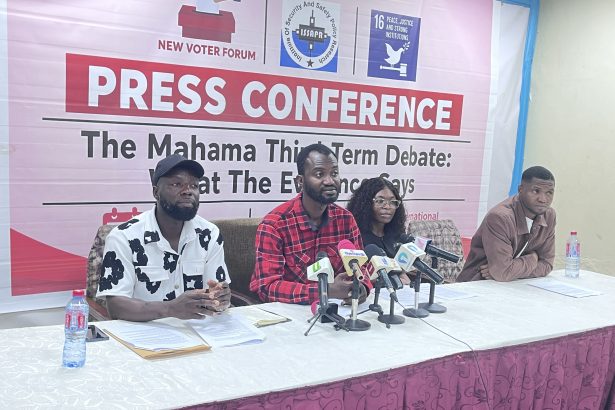
A group of civil society organisations has called for a national debate on amending Ghana’s 1992 Constitution to allow President John Dramani Mahama to seek a third term in office.
The groups, comprising Ghanaians for Progress (GHAPRO), New Voter Forum and the Institute of Security and Safety Policy Research, made the call at a joint press conference at the International Press Centre on Monday, August 10, 2026.
The organisations argued that the Constitution was not “cast in stone” and could be amended through the procedures outlined in Article 290.
According to them, an amendment approved by Parliament and endorsed through a national referendum could provide a legal pathway for exceptional circumstances where citizens demand presidential continuity.
They said their position was based on what they described as the need for experienced leadership, continuity in government and the completion of ongoing national projects.
More Read
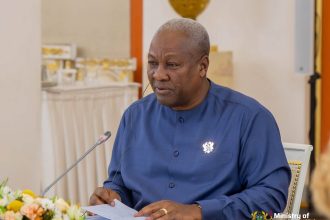
The CSOs argued that President Mahama left office in 2017 with major infrastructure projects, social interventions and reforms still ongoing.
They said the economic shocks experienced globally in recent years had further affected national development and argued that changing leadership could disrupt progress already made.
“Ghana needs steady, tested hands at this moment,” the groups said.
They also pointed to Mr Mahama’s previous experience as President, his knowledge of Ghana’s political and economic environment and his diplomatic experience as reasons they believe he could provide continuity.
The organisations said his familiarity with both local and international affairs could be beneficial to Ghana at a time of economic pressure and regional instability.
The groups said public opinion should form part of the national conversation, although they acknowledged that views on a possible third term remain divided.
They cited research by CFF-Ghana involving 2,223 respondents, which they said found that 39.2% supported a third presidential term for Mr Mahama, while 29.2% opposed it and 31.6% had no opinion.
The CSOs said the figures demonstrated that the issue required further public discussion rather than being dismissed outright.
They stressed, however, that any change to the presidential term limit must follow constitutional procedures and receive the participation and approval of Ghanaians.
The organisations called on Parliament, the Council of State, the Judiciary and other stakeholders to begin an open national conversation on whether the Constitution could be amended to permit Mr Mahama to serve another term.
They said any such process must be transparent, lawful and subject to a national referendum.
The groups maintained that their position did not amount to a call for the Constitution to be violated, arguing instead that the Constitution itself provides a mechanism for amendment.
They cited Article 290 as the basis for their argument that constitutional provisions can be reviewed when national circumstances and the will of citizens require changes.
The CSOs also appealed to the media to exercise caution in reporting the third-term debate.
They urged journalists to distinguish between statements that have been made, reports that have been published, speculation and information that has been independently verified.
They said headlines suggesting that President Mahama had decided to seek a third term should only be published where credible evidence exists.
“The media has a constitutional and democratic responsibility to inform citizens, not to manufacture political certainty where none exists,” they said.
The groups further called on the governing National Democratic Congress (NDC) and opposition parties to avoid exploiting the debate for partisan mobilisation.
They said the governing party must demonstrate that its commitment to constitutional democracy extends beyond the fortunes of the current administration, while the opposition should not turn an unconfirmed political scenario into a permanent campaign issue.
“Ghana’s democracy is bigger than the fortunes of the NDC, the NPP or any individual politician,” the organisations said.
The CSOs also urged President Mahama to provide clarity on the issue when necessary and concentrate on delivering the mandate for which he was elected.
They said his legacy should ultimately be judged by the quality of governance, institutional reforms, economic transformation, democratic accountability and improvements in the lives of Ghanaians.
Although President Mahama has publicly rejected calls for a third term, the organisations argued that the matter should remain part of a broader national constitutional conversation.
They maintained that if there is significant public demand for a change, the appropriate constitutional processes should be allowed to determine the matter.
The groups concluded that Ghana’s democracy should not be built around individual personalities but around strong institutions, constitutionalism, accountability and respect for the will of the people.