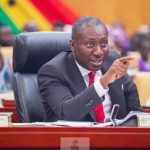
The minority in Parliament has accused the Mahama administration of failing to fulfil key campaign promises, raised concerns over inconsistencies in the 2026 Mid-Year Budget Review and urged President John Mahama not to assent to the proposed Tribunal Bill, arguing that it could undermine Ghana’s justice system.
Speaking during his closing remarks before Parliament adjourned sine die on Friday, 31 July, the minority leader said the government had failed to deliver on several flagship programmes while also raising concerns about what he described as political persecution and selective application of justice.
The minority first questioned figures contained in the Mid-Year Budget Review presented by the Finance Minister on 23 July.
According to the minority Leader, the budget contained conflicting inflation figures for June as well as discrepancies in expenditure and capital spending data.
He cited concerns raised by the Centre for Policy Scrutiny, whose Executive Director, Dr Adu Owusu Sarkodie, also highlighted inconsistencies in the fiscal figures.
More Read
The minority called on the Finance Minister to return to Parliament to provide a corrected and consistent set of figures, arguing that budgets form the basis of government policy and must be accurate.
The minority leader also accused the government of failing to implement several campaign promises.
He questioned the progress of initiatives including the 24-hour economy, One Job, Three Shifts, the Women’s Bank, cost-free first-year university education, employment opportunities for trained nurses and teachers, procurement reforms and measures to combat illegal mining.
According to him, Ghanaians voted based on these commitments and deserve updates on their implementation.
The minority also criticised Parliament’s passage of the Tribunal Bill and appealed to President Mahama to withhold his assent.
The minority leader argued that although Ghana’s Constitution provides for tribunals, the Constitutional Review Committee chaired by Professor H. Kwasi Prempeh recommended replacing the tribunal system with ordinary courts.
He warned that allowing tribunal panels to include members without formal legal training could create risks in the administration of justice and recalled historical concerns over public tribunals in Ghana.
The minority further alleged that members of the opposition, including Minority MPs, have been subjected to harassment through state investigative and prosecutorial institutions.
According to the caucus, recent judicial decisions have created the perception that different standards of justice are being applied depending on political affiliation.
The minority leader also criticised the country’s bail regime, arguing that some bail conditions imposed on opposition figures effectively amount to punishment before trial.
He called on Parliament to review existing laws to ensure bail protects constitutional rights instead of restricting liberty.
On freedom of expression, the Minority disclosed that it has introduced a bill seeking to repeal Sections 207 and 208 of the Criminal Offences Act, 1960, which criminalise “false news” and insulting public officials.
The minority argued that such matters should be addressed through civil litigation rather than criminal prosecution.
The caucus also accused the government of applying different standards in the fight against illegal mining.
The minority leader referenced President Mahama’s earlier remarks acknowledging that supporters of all political parties engage in illegal mining and questioned why no investigations had allegedly been initiated against individuals associated with the governing National Democratic Congress (NDC).
He argued that anti-galamsey enforcement should be impartial and apply equally to all persons regardless of political affiliation.
The minority nevertheless welcomed the Supreme Court’s recent decision upholding the constitutionality of the Office of the Special Prosecutor (OSP), describing the institution as an important safeguard against corruption.
However, it expressed concern over the Attorney General’s continued use of the power of nolle prosequi, arguing that the authority should not be used selectively to discontinue prosecutions.
The minority also raised concerns over recent judicial administrative decisions, including changes to case allocation and the handling of cases involving opposition figures.
As Parliament adjourned sine die, the minority leader thanked the Speaker, Members of Parliament, parliamentary staff and the media for their work during the meeting, while insisting that the Minority would continue to hold the government accountable when Parliament reconvenes