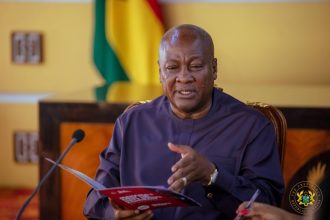
President John Dramani Mahama has given presidential assent to the Value for Money Office Bill, paving the way for a new institutional framework aimed at tightening oversight of government procurement and curbing inflated public contracts.
The development, announced by Finance Minister Dr Cassiel Ato Forson on Monday, 11 May, is being described as a key reform in the government’s drive to strengthen fiscal discipline and improve accountability in public expenditure.
Dr Forson said the signing of the Bill marks a decisive shift in how government contracts—particularly single-source procurements—will be handled going forward.
“Today is a good day. His Excellency the President this morning signed into law the Value for Money Office Bill,” he stated.
He explained that once operational, the new office will be mandated to review all single-source procurement arrangements to ensure that government obtains fair value for every cedi spent.
According to him, the move addresses long-standing institutional gaps in the assessment of value-for-money proposals, which were previously handled by the Legal Division of the Ministry of Finance—an arrangement he said lacked the specialised technical capacity required for such evaluations.
“The responsibility previously rested with the Legal Division of the Ministry of Finance, which did not have the specialised expertise to properly assess value-for-money issues,” Dr Forson noted.
The establishment of the Value for Money Office is part of the government’s broader public financial management reforms and also fulfils a key campaign promise by President Mahama to improve transparency in state contracting processes.
Dr Forson further disclosed that steps are underway to provide the new institution with the necessary logistical and financial resources, as well as recruit a technical leadership team to oversee its operations.
He indicated that the office is expected to become fully functional by January 2027.
“I want to use this opportunity to assure the people of Ghana that the manner of public sector contracting and overinflation of contracts will be curtailed by this signature,” he emphasised.