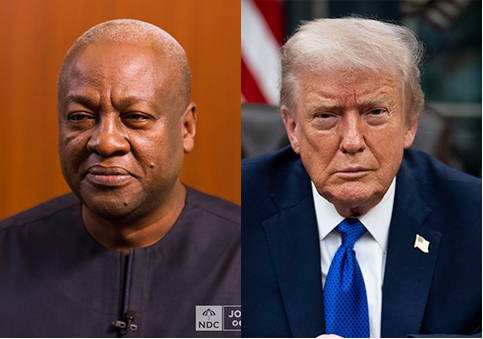
Ghana has rejected a proposed bilateral health agreement with the United States after negotiations broke down over demands for access to sensitive health data.
The “America First Global Health Strategy” has increasingly come under scrutiny, with critics questioning whether its terms are exploitative, including the US’s demands for access to some countries’ natural resources. Washington has encountered resistance since rolling out the policy in September 2025.
The deal, first reported by Reuters, formed part of Washington’s broader strategy introduced under former President Donald Trump. The framework seeks to restructure foreign aid and encourage recipient countries to assume a larger share of funding and responsibility for disease control programmes, including HIV/AIDS, malaria, tuberculosis and polio.
Negotiations, which began in November 2025, would have provided approximately $109 million in U.S. health assistance to Ghana over five years. However, discussions stalled after Accra objected to provisions requiring the sharing of sensitive national health data, which officials considered unacceptable.
“They were pretty normal dealings and negotiations in the beginning, and then increasingly there was a lot more pressure, especially at the end,” a source said, adding that Washington had set an April 24 deadline for finalising the agreement.
The breakdown marks a setback for U.S. efforts to reconfigure global health partnerships and follows similar disputes elsewhere. A comparable issue derailed negotiations with Zimbabwe earlier this year, while an agreement with Kenya was temporarily suspended by a court pending a legal challenge.
Notable African signatories to similar memorandums of understanding include Rwanda, Liberia, Uganda, Lesotho, Eswatini, Mozambique, Cameroon, Nigeria, Madagascar, Sierra Leone, Botswana, Ethiopia, Côte d’Ivoire, Burkina Faso and the Democratic Republic of Congo.
Ghana has not publicly commented on the matter. Spokespersons for the Ministry of Foreign Affairs and the government did not respond to requests for comment.
The U.S. State Department said it does not disclose details of bilateral negotiations but reaffirmed Washington’s commitment to continued cooperation with Accra.
“We continue to look for ways to strengthen the bilateral partnership between our two countries,” a spokesperson said.
According to official data, the United States disbursed about $219 million in foreign assistance to Ghana in 2024, including $96 million earmarked for health programmes. Under the proposed agreement, Ghana would have received $109 million over five years, although the extent of its financial obligations remains unclear.
The restructuring of U.S. foreign aid has included the dismantling of the United States Agency for International Development earlier this year.
As of Monday, the State Department said 32 agreements had been signed under the new strategy, representing $20.6 billion in total funding, $12.8 billion from the United States and $7.8 billion in co-investment from recipient countries.
As of early 2026, the United States has signed or negotiated at least 17 bilateral health agreements with African countries, focusing on disease control and pandemic data sharing. However, resistance has emerged over concerns about sovereignty, data privacy and the linkage of aid to access to critical resources.
Kenya was the first country to sign a Health Cooperation Framework in December 2025, a five-year deal valued at about $1 billion. However, a Kenyan High Court suspended the agreement in April 2026 following a lawsuit by consumer groups, who argued that it compromised national security and sovereignty by granting the United States access to citizens’ health data.
Zimbabwe, under President Emmerson Mnangagwa, rejected a similar proposal outright, citing concerns over sovereignty and mandatory pathogen data sharing. The United States is now reportedly winding down its health assistance to the country.
At the centre of the controversy are provisions seeking near real-time access to national health systems and pathogen databases. The agreements also often require recipient countries to contribute funding and, in some cases, provide access to raw materials such as copper and cobalt.
The strategy aims to replace traditional aid models with an emphasis on “health sovereignty” and “self-reliance”, while shifting away from non-governmental organisation-led delivery towards direct government-to-government support.
Previously, many African countries received health funding through USAID and initiatives such as the President’s Emergency Plan for AIDS Relief, with significant portions channelled through NGOs. The current approach reflects a broader shift towards bilateral arrangements and reduced reliance on intermediary organisations.
Despite the scale of the proposed investments, analysts say the funding, on average, represents a reduction from previous U.S. health assistance levels. In return, recipient countries are expected to assume a greater share of financing for their health systems over the duration of the agreements.
For example, the agreement with Kenya commits the United States to invest about $1.63 billion, while Kenya is expected to increase its health spending by approximately KES115 billion (about $890 million). Nigeria, the largest beneficiary, is set to receive $2.1 billion while committing roughly $3 billion of its own resources.
U.S. Secretary of State Marco Rubio has defended the strategy, arguing that enhanced access to global health data would improve early detection of disease outbreaks and strengthen American and global health security.
However, critics argue that the arrangements risk creating unequal partnerships. Zimbabwe’s Information Secretary, Nick Mangwana, said the proposed terms would have required the country to share biological data without guarantees of access to resulting medical innovations.
“In essence, our nation would provide the raw materials for scientific discovery without any assurance that the end products would be accessible to our people,” he said.
Concerns have also been raised about provisions linking health cooperation to access to natural resources and broader geopolitical objectives.
Analysts say the policy reflects a shift away from multilateral frameworks such as the World Health Organization towards more transactional bilateral arrangements, with implications for global health governance.
While some experts caution against outright rejection of the strategy, they note that African governments face difficult choices amid declining global aid flows and competing development priorities.