The Minority in Parliament has expressed strong concerns over the government’s Gold for Reserves policy, highlighting what it describes as poor coordination between the Gold Board and the Bank of Ghana (BoG).
The caucus warned that the policy’s weaknesses could result in substantial financial losses for the state and further encourage illegal mining operations, which continue to pollute Ghana’s rivers and water bodies.
According to an International Monetary Fund (IMF) report, Ghana recorded losses of approximately US$214 million under the programme as of September 2025. The Minority attributed these losses to unclear roles and responsibilities between the Gold Board, which acts as both regulator and operator, and the BoG, which is expected to safeguard public funds.
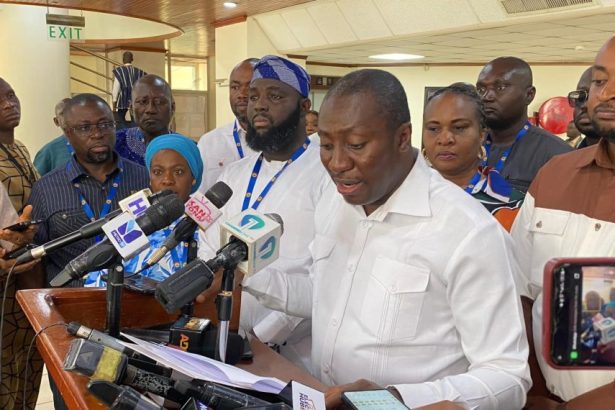
Addressing journalists at a press briefing in Parliament, Minority Leader Alexander Afenyo Markin began by clarifying the Minority’s stance on the policy, emphasising that it supported the overall objectives of Gold for Reserves but had serious concerns about its execution:
“We are not in any way opposed to that policy because the policy was started by us. However, we have two major concerns. The establishment of the Gold Board as a regulator and operator is in a way directly encouraging galamsey activities. Our water bodies have been polluted.”

He further highlighted the perceived lack of genuine government commitment to tackling illegal mining, saying that the administration appeared more focused on optics and short-term gains than addressing the underlying issues:
“This government has failed to provide tangible evidence of its commitment in the fight against galamsey. All we know is that they are talking about their success story, yet they fail to tell us whether there are measures to fight against illicit gold.”
Turning to the financial losses associated with the programme, Mr Afenyo Markin noted that responsibility should not rest solely with the Gold Board, calling on the Central Bank to acknowledge its role in safeguarding public funds:
“There seems to be some confusion between the Gold Board and the Central Bank, but we want to tell the Central Bank: participating in the activities and then shifting blame will not wash. The IMF says the losses came because the Bank of Ghana failed to protect our funds.”
He also referred to recent meetings between the Central Bank and the Gold Board, which resulted in adjustments to the artisanal mining model. While welcoming the changes, he cautioned that financial risks remained:
“A joint board meeting concluded that the artisanal mining model should now go for 9.75 for bullion and 9.55 for unprocessed gold, down from 15%. Much as this is commendable, we still think there are losses that would have to be considered.”
In concluding remarks, Mr Afenyo Markin stressed the need for the government to protect Ghana’s economic and diplomatic independence, particularly in a rapidly changing global financial environment:
“Ghana can no longer depend on traditional narratives of mutual benefit, as global economic structures are increasingly being used as tools of political and financial pressure.”
The Minority said it would continue monitoring the policy’s implementation to ensure that public funds are protected and that efforts to combat illegal mining are strengthened.