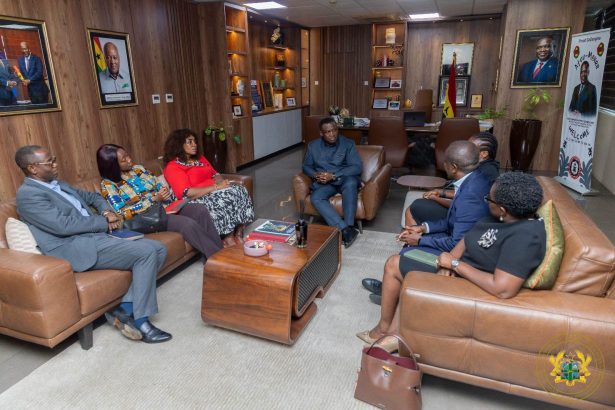
The Ministry of Communication, Digital Technology and Innovations has entered discussions with the Development Bank Ghana (DBG) to craft a unified national approach aimed at de-risking, mentoring and scaling Ghana’s emerging technology startups as government intensifies efforts to build a resilient digital economy.
The high-level engagement, held in Accra, brought together officials from the Ministry and a delegation from Development Bank Ghana to explore financing models that move beyond traditional lending towards long-term, innovation-sensitive capital support for startups.
Leading the DBG delegation, Deputy Chief Executive Officer Michael Mensah-Baah said the bank’s approach focuses on addressing structural bottlenecks in the ecosystem by providing flexible risk management tools and long-term financing packages spanning 10 to 15 years.
He stressed that Ghana’s innovation landscape required capital that understands the long gestation period of technology-driven enterprises rather than short-cycle commercial returns.
Minister for Communication, Digital Technology and Innovations, Samuel Nartey George, commended DBG’s approach, describing it as a shift away from conventional banking models that often fail to appreciate the realities of early-stage innovation.
More Read

He emphasised that Ghana’s digital transformation agenda must deliberately prioritise high-impact sectors such as Agritech, Healthtech and Edtech, which he said hold the key to long-term national development.
“While Fintech has matured remarkably, patient and scalable capital must aggressively target critical sectors like Agritech, Healthtech, and Edtech. Tech capital cannot be priced like real estate capital. It must be patient capital because it takes time for these innovations to mature,” the Minister stated.
He further highlighted a major structural gap in the ecosystem—the lack of structured business development support for young startups.
“There is no business development support that goes to those young tech startups, and that’s where the problem is. We give them money, but there is nobody there to hold their hands, build structures, and guide them on how to run a business sustainably,” he added.
To address these challenges, the Minister outlined plans under the upcoming Ghana Innovation and Startup Bill, which seeks to formally define startups, introduce targeted tax incentives and establish transparent, government-backed co-investment mechanisms for early-stage ventures.
The proposed framework is also expected to introduce structured pitch platforms where startups can access both financing and technical support, while enabling institutions such as DBG to move beyond lending into active mentorship and ecosystem development.
Under the proposed model, development finance institutions will be expected to play a dual role—providing capital while also supporting startups with governance, structure building and long-term sustainability guidance.
Officials say the discussions form part of broader government efforts to strengthen Ghana’s digital ecosystem, reduce investment risk and build a pipeline of globally competitive technology companies capable of driving innovation-led growth.
The Ministry continues to collaborate with institutions such as the Ghana Investment Fund for Electronic Communications, National Communications Authority, Ghana Meteorological Agency, and the Ghana-India Kofi Annan Centre of Excellence in ICT to strengthen the country’s digital infrastructure and innovation ecosystem.
Stakeholders believe that aligning patient capital with strong policy frameworks will be critical in positioning Ghana as a leading innovation hub in Africa, capable of nurturing startups from idea stage through to global scale.