By Patrick Biddah
Minister for Foreign Affairs, Samuel Okudzeto Ablakwa, has disclosed that the governments of the Netherlands and Germany have committed to returning cultural artifacts taken from Ghana, following growing international support for a landmark United Nations resolution on reparative justice spearheaded by Ghana.
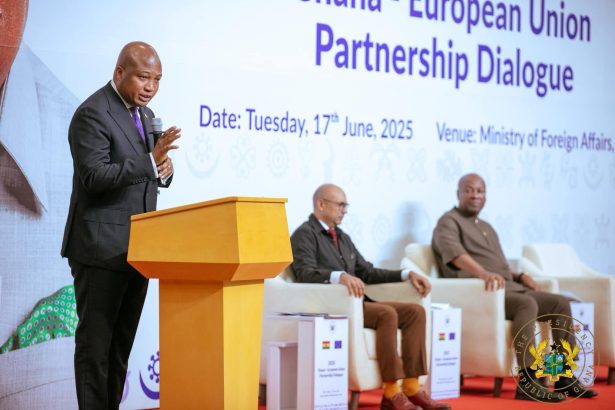
Speaking at the Ghana–European Union Partnership Dialogue in Accra on Thursday, June 11, 2026, Mr. Ablakwa said the commitments from the two European countries demonstrate the positive outcomes of Ghana’s leadership in advancing global discussions on historical injustices linked to slavery and the trafficking of Africans.
The Foreign Affairs Minister said Ghana has worked constructively with its European partners since the adoption of the UN General Assembly resolution, which declared the trafficking of enslaved Africans and the racialized chattel enslavement of Africans as crimes against humanity.
According to him, contrary to concerns expressed by some observers that the resolution could strain relations between Ghana and its European partners, the process has instead strengthened dialogue and cooperation.
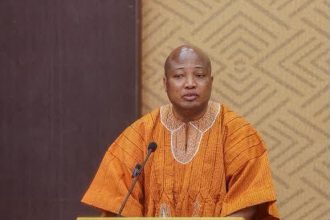
He noted that several European countries have shown goodwill and a willingness to engage with Ghana on issues relating to reparative justice.
Mr. Ablakwa revealed that the Dutch government has already presented Ghana with a catalogue of artifacts identified for repatriation.
He said the Netherlands has formally committed to returning the items, describing the move as a significant step toward addressing historical wrongs and promoting cultural restoration.
The Minister expressed particular excitement about some of the artifacts expected from Germany, noting that several of them originate from the Volta Region, his home region.
He said he looked forward to seeing the objects returned to their rightful place in Ghana.
Mr. Ablakwa also highlighted other encouraging developments since the adoption of the UN resolution.
He said some international institutions and religious bodies have publicly acknowledged their historical roles in the transatlantic slave trade and related injustices.
He cited statements from the Catholic Church and the Church of Scotland, which have expressed support for efforts aimed at confronting historical injustices and promoting reconciliation.
According to him, these developments show that the international community is increasingly willing to engage in honest conversations about the legacy of slavery and colonial exploitation.
The Minister commended President John Dramani Mahama for what he described as a conciliatory and constructive approach to the reparative justice campaign.
He said Ghana’s position has consistently been that the process is not intended to create divisions or tensions but rather to foster healing, understanding and stronger partnerships based on truth and mutual respect.
He stressed that Ghana’s engagement with the European Union remains one of its most important strategic partnerships, pointing to growing trade volumes, enhanced cooperation in security and defence, climate action, governance and economic development.
Turning to migration and consular issues, Mr. Ablakwa responded to remarks by the European Union Ambassador to Ghana, Rune Skinnebach, who had welcomed Ghana’s introduction of visa-free entry and electronic visa services for African nationals while urging the government to reconsider visa fees for non Africans.
The Foreign Affairs Minister said he was prepared to take up the challenge posed by the EU Ambassador but indicated that any discussion on reducing Ghana’s visa fees must be accompanied by reciprocal action from European countries.
He noted that many Ghanaians continue to face high visa charges when applying to travel to Europe.
“As soon as the Ambassador raised the issue, the Interior Minister began discussing with me the fees charged at European embassies,” Mr. Ablakwa remarked, drawing laughter from participants at the dialogue.
He said Ghana would be willing to engage in discussions on visa fee reductions and assured EU partners that if European countries demonstrate a willingness to lower their visa charges for Ghanaians, the government would engage Parliament under the Fees and Charges Act to consider corresponding measures on Ghana’s side.
He said such reciprocity would further strengthen people-to-people relations and deepen the longstanding partnership between Ghana and the European Union.