…But tough-talking Sam George summons Ambassador
The Ministry of Gender, Children and Social Protection has come under mounting criticism for what observers describe as a cautious and evasive response to a scandal involving a Russian national, who has been identified as Yaytseslav, who allegedly recorded and distributed intimate videos of Ghanaian women without their consent.
In a statement issued on Saturday, 14 February, the Ministry said it had “taken note of reports involving a foreign national who allegedly engaged in sexual activities with some Ghanaian women and recorded and circulated those acts without consent.”
However, the statement conspicuously failed to identify the individual as Russian, despite widely circulated videos showing a white foreign man, believed to be Russian, filming sexual encounters with several Ghanaian women after brief meetings. The footage, which has trended across multiple social media platforms, was uploaded online by the Russian for financial gain without the women’s consent.
Yaytseslav is reported to have travelled to other African countries and made similar videos there.
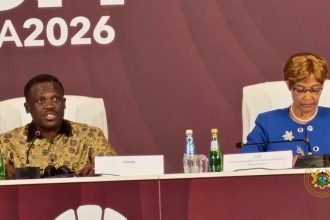
Ministry of Communication, Digital Technology and Innovation appears ready to bite, saying it has initiated processes to extradite a foreign national accused of secretly recording and distributing intimate videos of Ghanaian women without their consent. He has since summoned the Russian ambassador to Ghana over the sex videos.
The Minister, Samuel Nartey George, said authorities will pursue the suspect through diplomatic and legal channels to ensure he faces prosecution in Ghana under the Cybersecurity laws, including the Cybersecurity Act, 2020 (Act 1038).
“We want the gentleman to come to Ghana, to be brought back to Ghana, extradited to Ghana, for him to face the rigours of our law,” Minister for Communication, Digital Technology and Innovation, stated.
Critics argue that the Gender Ministry’s reluctance to state the nationality of the suspect reflects an attempt to soften the public impact of the revelations, particularly as outrage grows over the exploitation of Ghanaian women and the country’s image abroad.
Notably, the Gender Ministry’s statement did not disclose whether any preliminary investigation had been undertaken. There was no indication that officials had contacted the Ghana Immigration Service to verify the suspect’s identity, immigration status, or travel history. Nor did it confirm whether any effort had been made to determine where the recordings were made, including the identity of any hotel or private premises involved.
According to the Ministry, preliminary information suggests the individual “may not currently be within the country’s jurisdiction”. It nonetheless insisted that this “does not reduce the seriousness of the alleged conduct or the State’s responsibility to pursue accountability.”
The Ministry reiterated that the non-consensual recording and distribution of intimate images constitutes a criminal offence and a grave violation of privacy and dignity.
Yet for many, the response has raised more questions than answers. The statement offered no timeline for investigations, no confirmation of suspects being questioned, and no details on specific legal steps being taken.
Instead, the Ministry emphasised ongoing collaborations with the Ministry of Communication and Digital Innovations to tackle image-based sexual abuse more broadly. It said digital safety interventions, engagement with online platforms, and reporting and takedown mechanisms were already in place and were now being applied to the case.
The Ministry also confirmed that it was working with the Ghana Police Service, other security institutions and unnamed international partners to explore “all lawful options available, including cross-border cooperation and mutual legal assistance.”
Support services, including psychosocial care and legal assistance, are being coordinated for affected persons through confidential channels, the statement added. The Ministry further publicised its toll-free helplines — 0800-800-800, 0800-900-900 and 0800-111-222 — for complaints and reports of abuse.
While some social media commentary has harshly criticised the women involved, framing the matter in moral terms, gender rights advocates have warned against victim-blaming. They argue that the central issue remains consent, exploitation and the unlawful distribution of intimate material.
For now, the Ministry’s carefully worded statement appears to have done little to quell public anger. With the suspect reportedly outside Ghana’s jurisdiction, attention is turning to whether authorities will move decisively or whether the matter will fade amid bureaucratic caution and diplomatic sensitivities.
However, on the same Saturday, Mr George disclosed that he had already directed his ministry to formally engage the Russian Ambassador as part of diplomatic efforts to secure cooperation from Russian authorities.
“Yesterday, I caused the ministry to send an invitation to the Russian Ambassador. I intend to see him this week and have a conversation with him,” he said, adding that the Mahama government is taking “a very strong view” of the matter in an effort to protect the rights of every Ghanaian.
According to the Minister, the matter is not about moral judgment or adults’ private choices, but about criminal behaviour.
“What the cyber security authority is interested in, and my ministry is interested in, is in the non-consensual sharing of the videos that were posted online. That is a crime,” he stressed.
He explained that although consenting adults are free to make personal choices, recording someone without their knowledge and distributing such material is a criminal offence under Ghana’s Cybersecurity Act.
“It is a crime to record a person without their consent… and you go and post it on a website for financial gain,” he said.
The Communications Minister stated that Ghana will utilise all available legal and international cooperation mechanisms, including working with Interpol, to ensure the suspect is returned.
“My team at cyber security is building a full docket… we will make a representation before the courts, trial him in absentia and get judgment if he fails to show up. But we will not let this go,” he assured.
Mr George further pledged that the rights of Ghanaian citizens will be protected regardless of the circumstances surrounding the incident.
“Ghanaian citizens, irrespective of their decision-making, will be protected by their government,” he said.
He also referenced a statement issued by the Minister for Gender, Children and Social Protection, noting that many of the victims are women and that the matter is being addressed with urgency.
While reassuring the public of decisive legal action, Mr George urged citizens to exercise caution in their personal interactions, especially in an era when digital tools can be easily misused.