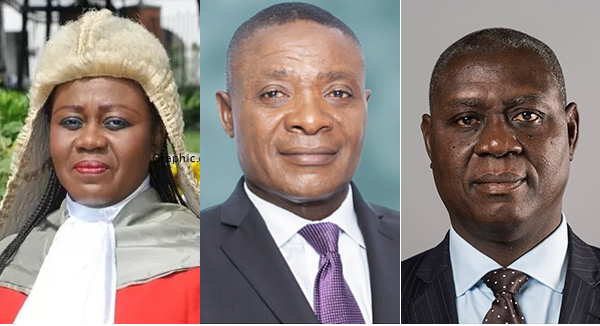
The Herald’s investigation into the dismissal of Chief Justice Gertrude Araba Esaba Torkornoo, continues to uncover intriguing facts, including the roles played by financial institutions and prominent Ghanaian personalities in the bitter feud with the businessman, who eventually engineered her downfall as the country’s third female Chief Justice.
The Herald’s findings revealed that, the dispute dates back nearly 17 years, contrary to claims by the opposition New Patriotic Party (NPP) that President John Dramani Mahama and his governing National Democratic Congress (NDC) orchestrated Justice Torkornoo’s removal.
The prominent Ghanaian businessman, Afare Apeadu Donkor, was said to have approached Daniel Ofori to buy out his shares in Ecobank, in order to wage a boardroom battle against Frank Adu of CAL Bank. However, Mr Adu reportedly leveraged his connections at the Bank of Ghana to prevent the intended meeting, where the transaction was to take place, thus frustrating Afare Donkor’s ambitions to control CAL Bank.
The fight, which began in 2008, saw Ecobank Ghana ordered by the courts to pay some GHC96 million to Daniel Ofori, a shareholder in the bank, for breach of a customer-client relationship.
Mr Ofori, who had instructed how proceeds from the sale of his Ecobank shares should be distributed, including GHC6 million to Zenith Bank, was surprised when Ecobank refused to honour his signed instructions. This, The Herald learnt, was because someone had tipped the bank off about Frank Adu’s last-minute success in securing a Bank of Ghana directive that blocked Afare Donkor’s move.
Reports suggest that Afare Donkor subsequently asked Ecobank not to pay Mr Ofori the proceeds of his share sale on the Ghana Stock Exchange, claiming the transaction had been cancelled. This was despite Ecobank having received Mr Ofori’s duly signed instructions.
Ecobank then filed a fraud lawsuit against Daniel Ofori over dividend payments on the shares, but lost repeatedly, despite being represented by several top lawyers, including Ace Anan Ankomah, Vincent Kizito Beyuo, Samuel Okudzeto and Emmanuel Yonny Kulendi, who was then in private practice. The Herald has been informed that there are as many as five Supreme Court rulings against Ecobank in relation to the alleged fraud.
Interestingly, Mr Ofori had retained lawyer Thaddeus Sory to defend him, later adding Tsatsu Tsikata and Prince Noel Danquah to his legal team. These lawyers also participated in the Article 146 Committee of Inquiry chaired by Justice Gabriel Scott Pwamang, with ex-Attorney-General Ayikoi Otoo, Kwabena Adu-Kusi, Prof. Bondzie Simpson and Gloria Gyang-Duah representing Justice Torkornoo.
Throughout the litigation, Justice Torkornoo was the sole judge who dissented, siding with Ecobank against Daniel Ofori, who, The Herald learnt, had sunk deep into debt as a result of Ecobank’s preference for Afare Donkor in what was widely described as a breach of the banker-customer relationship.
When Justice Torkornoo later rose to become Chief Justice, Ecobank sought to revive its fraud claims against Mr Ofori by taking the matter, including prior Supreme Court judgments, before a High Court. However, the trial judge dismissed the case, leaving Justice Torkornoo allegedly enraged. Sources claim she threatened the judge, who subsequently left the country, citing her husband’s ill health and the need to attend to a child abroad.
The case was then quickly reassigned to another High Court judge, who began granting the reliefs Ecobank sought—moves seen as being orchestrated with the Chief Justice monitoring events closely to protect the bank’s interests.
This development reportedly infuriated Mr Ofori, prompting him to petition for Justice Torkornoo’s removal, citing arbitrary rulings and financial impropriety.
The Herald’s investigations suggest that Justice Torkornoo’s downfall stemmed not from partisan politics but from a long-standing feud with Daniel Ofori, owner of White Chapel Limited and a major shareholder in Ecobank Ghana PLC.
Her dismissal on 1 September 2025 was based on accusations that she had acted capriciously and had exercised power arbitrarily, disregarding judicial principle and restraint. Allegations included instructing subordinates to ignore court orders, demanding benefits for her husband and daughter to which they were not entitled, and effecting arbitrary transfers of judicial staff.
The feud between Justice Torkornoo and Mr Ofori travelled through multiple layers of Ghana’s judicial system, even reaching the Supreme Court. At one stage, then Chief Justice Kwasi Ani-Yeboah presided over a panel that removed her, then a Supreme Court justice, from the Ecobank case on grounds of bias.
The Herald’s findings indicate that Justice Torkornoo had consistently sided with Ecobank, arguing that protecting the bank’s interests was necessary to safeguard jobs. Mr Ofori and his lawyers strongly disagreed, contending that his investments also deserved protection and accusing her of open bias against him.
Critics argue that her repeated rulings in favour of Ecobank undermined public confidence in her impartiality. According to insiders, what sealed her fate was not political manoeuvring by the Mahama administration, but her entanglement in a corporate dispute that exposed her to charges of misconduct.
Parts of Mr Ofori’s petition alleged that: “The Chief Justice, in bad faith, arbitrarily and unreasonably transferred execution proceedings initiated on the directions of the Supreme Court, before the High Court (Commercial Division 7) Accra presided over by His Lordship Justice Lodoh in a suit entitled Daniel Ofori v Ecobank Ghana Limited, numbered CM/MISC/0829/2021, from that High Court to the High Court (General Jurisdiction 8) Accra, presided over by Her Ladyship Justice Ellen Mireku. This was simply to achieve a result that she had unsuccessfully sought as a member of the Supreme Court panel in Daniel Ofori v Ecobank (Suits J8/114/2020 and J7/13/2020, dated 24 March 2021).”
The petition further alleged that: “The Chief Justice abused her power by transferring the case Ecobank v Daniel Ofori (Suit GJ 0902/23) from the High Court (General Jurisdiction 6) presided over by Her Ladyship Justice Buansi Amponsah to the High Court (General Jurisdiction 8) presided over by Her Ladyship Justice Mireku, simply because she did not like Justice Buansi Amponsah’s decision dismissing the suit. That ruling ran counter to her dissenting opinions as a member of the Supreme Court panel in Daniel Ofori v Ecobank (Suits J8/114/2020 and J7/13/2020, dated 24 March 2021).”