Ecobank Ghana PLC has put a strong face, assuring customers and stakeholders that its financial position remains strong and that its operations remain unaffected following a fresh setback at the Supreme Court in its long-running legal battle with businessman Daniel Ofori.
The businessman is to be paid several million Ghana cedis, with severe implications for the multinational bank. However, in a media statement issued on May 16, the bank said it was aware of the recent court ruling involving claims against it and would continue to respect the judicial process while upholding the rule of law.
“As a responsible financial institution, Ecobank Ghana PLC respects the judicial process and will continue to uphold the rule of law,” the bank stated.
The bank further sought to allay customer concerns, emphasising that its financial position remains strong and resilient despite the legal developments.
“We wish to reassure our customers that the Bank’s financial position remains strong and resilient and our services continue without disruption,” the statement added.
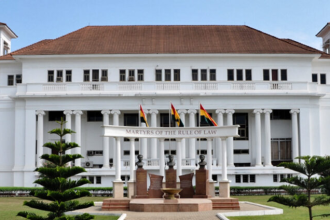
The assurance follows a major legal victory for Daniel Ofori after the Supreme Court of Ghana dismissed Ecobank’s latest attempt to overturn an earlier judgment in his favour in a dispute linked to a 2008 investment transaction.
In its ruling delivered on May 6, 2025, the apex court reaffirmed that Mr Ofori is entitled to 30 per cent monthly compounded interest on an investment amount of GH¢6.16 million from June 2, 2008, to July 25, 2018, the date of the court’s original judgment.
The court also ordered the bank to pay post-judgment interest at 13.5 per cent per annum until the debt is fully settled, in addition to GH¢50,000 in legal costs awarded to Mr Ofori.
The case originates from a disputed share transaction involving CAL Bank PLC shares nearly two decades ago.
The latest ruling effectively reinforces earlier Supreme Court decisions in favour of Mr Ofori and closes another chapter in a prolonged legal battle that has gone through multiple hearings, reviews and applications since the initial judgment in 2018.
The case was instrumental in last year’s removal of former Chief Justice Gertrude Araba Esaaba Sackey Torkornoo, according to The Herald’s investigations.
According to The Herald’s findings, a protracted and bitter feud existed between Justice Torkornoo and businessman Daniel Ofori, owner of White Chapel Limited and a major shareholder in Ecobank Ghana PLC. The dispute reportedly predates the Mahama administration.
At the centre of Justice Torkornoo’s dismissal on September 1, 2025, were allegations that she had conducted herself capriciously as Chief Justice, exercising power in an arbitrary manner with little regard for judicial principle or restraint. Claims against her included instructing subordinates to disregard court orders, demanding benefits for her husband and daughter to which they were allegedly not entitled, and carrying out arbitrary transfers of judicial staff.
The feud between Justice Torkornoo and Mr Ofori travelled through various levels of Ghana’s judicial system, including the Supreme Court. At one point, the then Chief Justice, Kwasi Anin-Yeboah, presided over a panel that removed her, then a Justice of the Supreme Court, from the case on grounds of bias.
The Herald’s findings indicated that Justice Torkornoo had consistently sided with Ecobank Ghana against Daniel Ofori, taking steps which allegedly frustrated his claims against the bank, which was incorporated in 1989 as a private limited liability company under the Companies Code. She was said to have argued that the bank’s interests needed to be protected in order to safeguard the jobs of the many Ghanaians it employed.
Mr Ofori and his lawyers, however, strongly disagreed, insisting that his investments in the bank also required protection. They accused Justice Torkornoo of acting openly against his interests in favour of Ecobank, deepening perceptions of bias.
Critics argue that such rulings, coupled with her handling of the Ecobank case, eroded public confidence in her impartiality and independence.
Mr Ofori’s petition stated that the “Chief Justice, in bad faith and arbitrarily and unreasonably transferred the execution proceedings initiated on the directions of the Supreme Court before the High Court (Commercial Division 7), Accra, presided over by His Lordship Justice Lodoh in a suit entitled Daniel Ofori v Ecobank Ghana Limited numbered CM/MISC/0829/2021, from that High Court to the High Court General Jurisdiction – 8 Accra, presided over by Her Ladyship Justice Ellen Mireku, simply to achieve a result that she had sought unsuccessfully to achieve when sitting in the Supreme Court as a member of the panel in Daniel Ofori v Ecobank (Suit Numbers J8/114/2020 and J7/13/2020 dated 24th March 2021).”
The petition further alleged that the transfer followed a petition filed by lawyers for the judgment debtor, without giving lawyers for the judgment creditor an opportunity to be heard.
The businessman also alleged that the “Chief Justice abused the power of the Chief Justice to transfer cases pending before one judge to another judge by ordering a transfer of a suit entitled Ecobank v Daniel Ofori (Suit Numbered GJ 0902/23) from the High Court (General Jurisdiction 6), presided over by Her Ladyship Justice Buansi Amponsah, to the High Court (General Jurisdiction 8), presided over by Her Ladyship Justice Mireku, simply because she did not like a decision given by Justice Buansi Amponsah dismissing the suit.”
In other allegations, Mr Ofori claimed Justice Torkornoo “misappropriated the sum of GHS261,890 of public funds” for private foreign travel involving her husband and daughter, as well as “US$30,000 in per diem allowance” despite them allegedly not being entitled to such benefits.
The petition also alleged that in 2023 the Chief Justice “misappropriated the sum of GHS75,580” for Ethiopian Airlines tickets for herself and her husband during a trip to Arusha, Tanzania.
Further claims alleged that Justice Torkornoo obtained an accountable imprest of US$14,000 from the Judicial Service for travel to Tanzania with her husband, which was allegedly not retired.
Another allegation stated that in July 2023, Justice Torkornoo “without the knowledge of the accused person and his lawyers, unconstitutionally interfered with judicial proceedings” in the case of Republic v Gyekye Quayson by allegedly causing National Security operatives to seize court computers linked to the recording of proceedings.
The Herald’s findings were that businessman Afare Apeadu Donkor had approached Daniel Ofori to acquire his shares in Ecobank in order to pursue a boardroom battle against Frank Adu of CAL Bank. However, Mr Adu reportedly leveraged his connections at the Bank of Ghana to frustrate the intended transaction.
The dispute, which began in 2008, resulted in the court ordering Ecobank Ghana to pay approximately GH¢96 million to Daniel Ofori for breach of the banker-customer relationship.
Mr Ofori had reportedly instructed how proceeds from the sale of his Ecobank shares should be distributed, including a payment of GH¢6 million to Zenith Bank, but Ecobank allegedly failed to honour the signed instructions after receiving information that the intended transaction involving Afare Donkor had collapsed.
Reports suggest that Afare Donkor subsequently requested that Ecobank withhold payment of the proceeds from the share sale on the Ghana Stock Exchange, claiming the transaction had been cancelled despite the bank having received Mr Ofori’s duly signed instructions.
Ecobank later filed a fraud suit against Daniel Ofori over dividend payments on the shares but reportedly lost repeatedly despite being represented by several prominent lawyers, including Ace Anan Ankomah, Vincent Kizito Beyuo, Samuel Okudzeto and Emmanuel Yonny Kulendi, who was then in private practice.
Mr Ofori retained lawyer Thaddeus Sory for his defence and later added Tsatsu Tsikata and Prince Noel Danquah to his legal team in the Article 146 Committee of Inquiry, chaired by Justice Gabriel Scott Pwamang.
Throughout the Ecobank litigation, Justice Torkornoo was reportedly the sole judge to dissent in favour of Ecobank against Daniel Ofori, who, according to The Herald’s findings, had accumulated significant debt as a result of the bank’s actions.
When Justice Torkornoo later became Chief Justice, Ecobank reportedly sought to revive its fraud claims against Mr Ofori before the High Court. However, the trial judge dismissed the case, a development that allegedly angered the then Chief Justice.
Sources told The Herald the judge, out of fear, subsequently fled the country, citing her husband’s ill health and the need to attend to a child abroad.
The case was later reassigned to another High Court judge, who reportedly began granting reliefs sought by Ecobank, developments which critics claimed were closely monitored by the Chief Justice in an effort to protect the bank’s interests.
According to The Herald’s investigations, these developments eventually contributed to Mr Ofori’s petition seeking Justice Torkornoo’s removal from office, citing allegations of arbitrary conduct and financial impropriety.
Justice Torkornoo’s eventual downfall stemmed not from partisan politics, but from her long-running feud with Daniel Ofori and the wider controversy surrounding the Ecobank litigation.