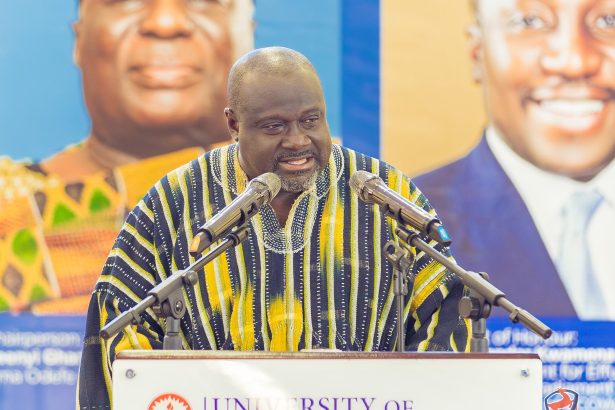
Former New Patriotic Party (NPP) Member of Parliament for New Juaben South, Dr Mark Assibey-Yeboah, has called for a renewed commitment to selfless leadership and public service, stressing that integrity, trust and accountability remain the foundations of sustainable democratic governance and national development.
Delivering the Osahen Excellence Public Lecture in honour of the Minority Leader and Effutu MP, Alexander Kwamena Afenyo-Markin, at the University of Education, Winneba, Dr Assibey-Yeboah said one of the greatest challenges confronting modern democracies was the growing erosion of public trust in leadership.
Speaking on the theme, “Selfless Leadership and Public Service: Building Integrity, Trust and Accountability,” the former Chairman of Parliament’s Finance Committee argued that nations rise when leadership is anchored in integrity, sacrifice and accountability, but struggle when public service becomes disconnected from responsibility and moral purpose.
“Every generation is remembered not just by the wealth it accumulated or the positions it occupied, but by the quality of leadership it produced,” he stated.
According to him, many citizens across the world are increasingly questioning whether leadership still represents service and whether public office continues to reflect sacrifice rather than personal ambition.
He said the restoration of public confidence in leadership and institutions would require leaders who place the national interest above personal gain and remain accountable to the people they serve.
“Leadership is not about occupying office; it is about stewardship. It is about the ability to inspire confidence, unite people around a common purpose, and remain accountable even when authority provides the opportunity to do otherwise,” Dr Assibey-Yeboah said.
The former legislator emphasised that public service should be viewed as a sacred responsibility rather than an avenue for privilege, prestige or political advantage.
“Public office is temporary, but the consequences of leadership decisions can shape generations,” he noted, adding that citizens expect honesty, fairness, transparency and accountability from public officials.
Dr Assibey-Yeboah further argued that accountability should not be viewed as an obstacle to leadership but rather as the source of its legitimacy and credibility.
“True leaders do not fear scrutiny; they welcome responsibility and understand that public trust must be earned continuously through conduct, transparency and consistency,” he said.
Addressing young people, he urged them to embrace values-driven leadership and resist the temptation to equate leadership with status, popularity or personal gain.
“True leadership is not measured by popularity. True leadership is measured by responsibility,” he told students and youth gathered at the event.
The economist and former MP also highlighted the importance of national cohesion, stressing that leadership should unite rather than divide society along political, ethnic or religious lines.
He commended the collaboration between the Effutu Traditional Council, Christian and Muslim communities, and other stakeholders in organising the lecture, describing it as a demonstration of the unity of purpose required for national development.
Reflecting on the life and leadership journey of Afenyo-Markin, Dr Assibey-Yeboah traced the Minority Leader’s rise from humble beginnings in Winneba to national prominence, noting that his experiences exemplified resilience, perseverance and commitment to public service.
He recounted how the Effutu MP supported his family by selling bread as a young boy before pursuing education, law, business, and eventually politics.
According to Dr Assibey-Yeboah, leaders who have experienced hardship often develop a deeper appreciation of the challenges confronting ordinary citizens.
He praised Afenyo-Markin’s parliamentary career, which has seen him serve as Deputy Majority Leader, Majority Leader, and, currently, Minority Leader, describing his journey as one characterised by increasing responsibility and commitment to democratic governance.
Dr Assibey-Yeboah also underscored the importance of strong institutions, arguing that sustainable development depends on systems that outlive individual political leaders.
He said democratic governance thrives when institutions are empowered to scrutinise power, ensure accountability and promote transparency in public administration.
Touching on the role of culture and tradition in nation-building, he noted that communities must preserve their identity and values while adapting to changing realities.
He praised the Effutu Traditional Area for maintaining its rich cultural heritage through the annual Aboakyer Festival, which he described as a symbol of identity, continuity and communal responsibility.
Dr Assibey-Yeboah reminded leaders that political office and power are temporary, but integrity and legacy endure.
“Leadership is temporary, but legacy is permanent. Political office will pass. Titles will change. Power will shift from one generation to another. But integrity endures,” he said.
He urged leaders at all levels to remain committed to service, accountability and ethical governance, arguing that these values remain essential for strengthening institutions, restoring public trust and securing Ghana’s democratic future.
The lecture was attended by traditional rulers, Members of Parliament, religious leaders, faculty members, students and residents of Effutu.