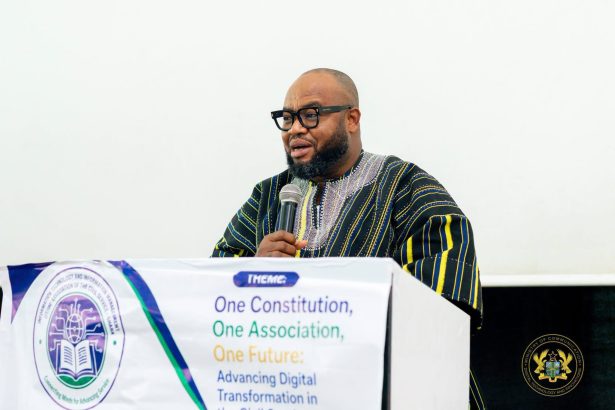
The government is seeking to strengthen the management, security and use of public-sector data as artificial intelligence (AI) and other data-driven technologies become increasingly integrated into government operations.
Deputy Minister for Communication, Digital Technology and Innovations, Mohammed Adam Sukparu, said the growing use of technology in public administration required Information Technology (IT) and Information Management professionals to take on a more strategic role in Ghana’s digital transformation.
Speaking on behalf of the Sector Minister, Samuel Nartey George, at the 7th General Meeting of the Information Technology and Information Management Association of Ghana’s Civil Service, he said effective information management was critical to ensuring that government data was properly managed, protected, shared and used for decision-making.
He said the quality, integrity, accessibility and security of public-sector information had become increasingly important as government expands its use of AI and other technologies.
The Deputy Minister said Ghana was already investing in digital public infrastructure, broadband connectivity, digital financial services, electronic government platforms, cybersecurity and innovation as part of efforts to modernise public administration.
More Read

He said these efforts were being backed by policies and legislation covering the digital economy, data protection and electronic transactions, with government reviewing existing laws and developing new frameworks to keep pace with emerging technologies.
Mr Sukparu also disclosed that government was advancing the implementation of Ghana’s National Artificial Intelligence Strategy, while reviewing sector legislation to respond to emerging digital realities.
He said digital transformation should ultimately result in a fundamental change in how government institutions operate, collaborate and deliver services to citizens.
“Digital transformation succeeds because of people,” he said.
The Deputy Minister said IT and Information Management professionals were therefore not merely technical officers but played a direct role in determining how effectively government digital systems function.
He urged professionals in the field to position themselves as “architects of Ghana’s digital future”, noting that their work affects critical sectors including healthcare, education, agriculture, justice, local government and public financial management.
Mr Sukparu further called for greater collaboration among IT and Information Management professionals across ministries, departments and agencies to establish common standards, improve interoperability and promote best practices across the Civil Service.
He said the Ministry would continue working with the Office of the Head of the Civil Service and the Association to strengthen digital governance, with a focus on cybersecurity, interoperability, AI readiness, digital inclusion, digital skills and resilient digital infrastructure.
He also urged professionals to pursue continuous training, research and collaboration with universities, development partners and other professional bodies to keep pace with rapid technological changes.
The meeting also focused on the Association’s internal governance, including a review of its constitution, election guidelines and election code of conduct.
Mr Sukparu said strong institutions depended on effective governance, accountability, transparency and shared values, and encouraged members to build an association founded on fairness, inclusiveness, professionalism and ethical conduct.