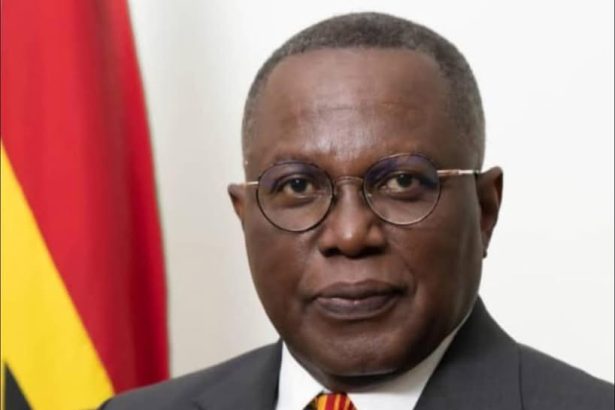
The Chairman of the National Development Planning Commission (NDPC), Dr Nii Moi Thompson, has launched a scathing critique of Ghana’s governance and planning systems, blaming weak institutions, poor enforcement of laws and corruption within state agencies for many of the country’s recurring development challenges.
Speaking on Channel One TV’s Face to Face programme, Dr Thompson argued that Ghana’s greatest problem is not its budget or trade deficits but what he described as a chronic “institutional deficit” that continues to undermine national development.
“We always talk about budget deficits and trade deficits, but the mother of all deficits is institutional deficits. We have very weak institutions; in most instances they do not even exist,” he stated.
“Without building institutions, we are not going anywhere because institutions are the engine of growth, not the private sector.”
His remarks come amid growing public concern over recurring floods, poor urban planning, environmental degradation and Ghana’s continued dependence on international financial support programmes.
Dr Thompson suggested that many of the disasters confronting the country today could have been avoided if existing development plans had been implemented.
According to him, comprehensive national planning documents covering flood management, land use, urban development, infrastructure and coastal protection have existed for years but have largely been ignored by successive authorities.
“Everything we are going through shouldn’t have happened. We thought about all these things in 2017 and put them in a document to guide the people who run the city, but nobody worked with it,” he said.
“The floods didn’t have to happen, and if they did, the damage to property and harm to human lives would have been far less and more manageable than they are now if we had done the right thing over a decade ago.”
The NDPC Chairman reserved some of his strongest criticism for public officials responsible for enforcing planning regulations, arguing that corruption within local government institutions has allowed illegal developments and encroachment on waterways to flourish.
“It’s not just the ill-disciplined citizen who’s encroaching on public land, but also the corrupt officials who allow these things to happen,” he stated.
“We have bylaws, zoning laws and assemblies whose responsibility it is to enforce them, but where individuals within these institutions are corrupt, you are going to have these problems.”
Dr Thompson called for stricter enforcement of planning laws and greater accountability within local government structures to protect public assets and prevent avoidable disasters.
On the economy, he warned that Ghana’s heavy reliance on an informal business sector remains a major obstacle to sustainable growth and wealth creation.
According to him, approximately 92 per cent of businesses operate in the informal economy, limiting productivity, tax mobilisation and industrial transformation.
“If we want to grow this country, we must first transform it, and in order to transform it, you need a vision, which is a long-term national development plan,” he said.
He further argued that the country’s repeated return to International Monetary Fund (IMF) programmes is partly a consequence of the failure to transform the economy into one driven by higher-value productive activities.
The NDPC Chairman also highlighted the untapped economic potential of the Savannah Belt, stressing that significant agricultural opportunities remain underutilised despite persistent poverty in many parts of northern Ghana.
Dr Thompson maintained that Ghana’s future prosperity depends on strong institutions, disciplined implementation of development plans and a clear long-term vision capable of surviving political transitions.
“The only strategy is the transformation of the economy. We need a roadmap for economic transformation and shared prosperity because we cannot continue with business as usual and expect development,” he added.