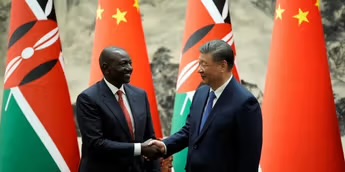
Kenya is strategically positioning itself at the centre of the intensifying rivalry between China and the United States, leveraging both sides to extract trade concessions and infrastructure investments.
The latest move comes after Chinese Vice-President Han Zheng visited Nairobi, culminating in a fresh set of trade and infrastructure agreements.
At the heart of the deal is an “early harvest” Economic Partnership Agreement granting Kenyan exports—tea, coffee and avocados—duty-free access to the Chinese market from May, a development expected to ease the country’s long-standing trade imbalance with Beijing.
President William Ruto has touted the agreements as a major economic boost, but the deeper significance lies in Kenya’s calculated diplomatic balancing act.
While Beijing continues to bankroll mega infrastructure projects, including the multi-billion-dollar Standard Gauge Railway extension, Washington is tightening its grip through strategic partnerships in healthcare, minerals and trade.
A $1.6 billion health deal signed with the United States in December 2025 and ongoing negotiations for a broader trade agreement highlight Nairobi’s dual-track diplomacy.
Yet, the strategy is not without risk.
Kenya reportedly spends about $1 billion annually servicing Chinese debt, raising concerns about sustainability even as new loans and projects continue to flow.
Nairobi’s approach reflects a broader continental trend, where African governments are increasingly exploiting great-power competition to secure favourable deals.
“Kenya is punching above its weight because the great powers are competing for exclusive partnerships,” said Tim Zajontz.
With China keen to retain its foothold and the United States expanding its strategic presence, Kenya’s ability to navigate both sides could define its economic trajectory in the coming years.