In Ghana, many young girls from rural communities, particularly the Northern regions, migrate to Accra in search of work as kayayei, or head porters.
“Sometimes, you have to do things you don’t want to, just to have a place to sleep,” Zeinab said in a local language (Twi), her voice barely audible over the noise of Agbogbloshie Market in Greater Accra.
Zeinab (not her real name), 18, a petite girl, wears a tattered dress with a dirty scarf around her neck. A big pan rests carefully on her head, and the stiffness in her neck shows the strain of balancing it. Her wide eyes flick nervously at everyone passing by, lips pressed tight, afraid someone might overhear.
“The first time it happened, they were three boys. They told me it won’t hurt…I begged them but what they said is that if I didn’t want to sleep outside, I should do as they say. They all had sex with me. Abu (not his real name), was my friend, I never imagined he and his friends could do this to me. This is how I get shelter sometimes…” she sighed, as if her soul had left her body.
From rural hopes to urban hardship
Zeinab’s story is not an isolated case. It echoes the lived realities of countless young girls whose journeys from rural communities to the city, driven by hope, have instead made them silent victims of urban migration.
The term “kayayei” comes from the local words for “load” and “woman,” reflecting their daily struggle of carrying heavy goods on their heads for small pay.
For these girls, moving to the capital offers the hope of earning money to support their families, pay school fees, or save for the future—opportunities that are often scarce in their home communities. Instead, they face stigma, sexual exploitation, lack of social protection, and economic hardship.
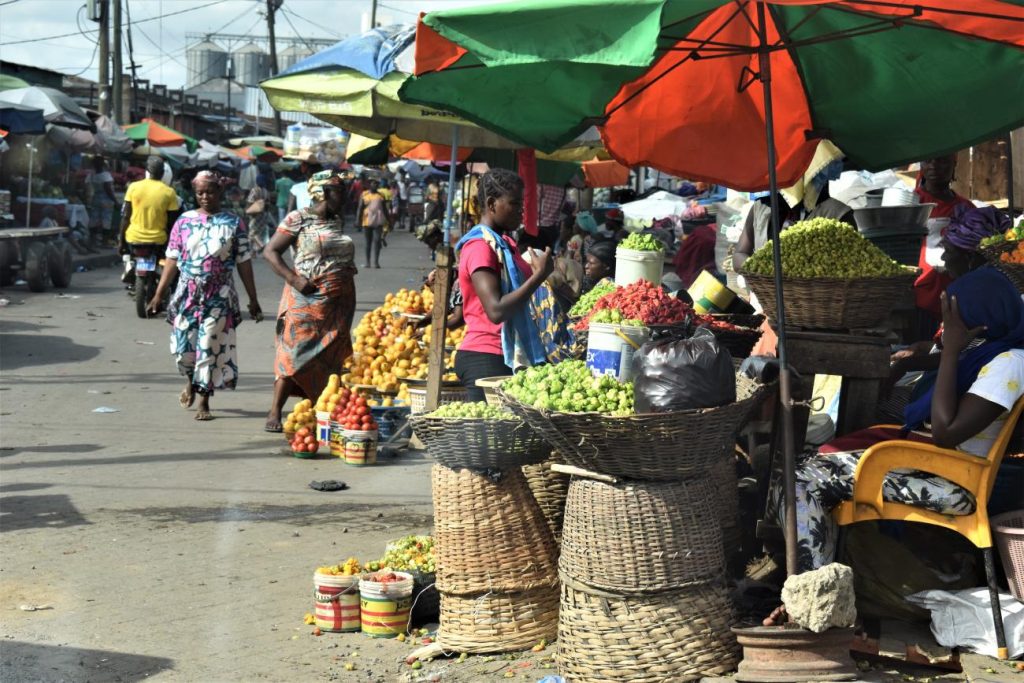
In Accra, kayayei can be found in bustling markets like Makola, Kantamanto, and Agbogbloshie, navigating crowded streets while carrying goods for traders and shoppers.
When a dream becomes a doom
Zeinab is the third child of seven, and the first of three daughters born to her parents in Walewale in the North East Region of Ghana. She recounts how her mother convinced her to follow a friend’s daughter to Accra so she could earn a living for herself and support the family.
“In my case, it was my mother who convinced me to follow her friend’s daughter to Accra to work, because her friend had told her that since her daughter moved to Accra in 2022, she has been the one supporting the family, and that she was working a decent job in the market. Because of that, my mother thought since she was older than me, she would be like a big sister and help me out, but that has not been the case,” Zeinab said with anger in her voice.
“I…I…I can’t take it anymore, it’s too much…”
Adiza (not her real name), who, according to Zeinab, had followed to Accra and should have been her guide, left Zeinab as prey in the marketplace. Zeinab, knowing nothing about life in the city, had to learn the hard way: from carrying heavy loads on her fragile neck, being cheated and shouted at by customers, to being sexually exploited by young men who were supposed to act as brothers—or even as father figures.
“The lady who I followed to Accra left me to take care of myself after a week we got here. She told me that to survive, one had to be strong. Because nobody will work to take care of you, you have to fight and work to take care of yourself. And that is how I have been surviving since.I…I…I can’t take it anymore, it’s too much,” she said.
“It feels like our bodies are the only thing we can trade just to survive..”
With many kayayei, sexual exploitation is not an isolated incident but a routine transaction forced by homelessness and poverty. With little money and nowhere safe to sleep, their bodies become bargaining tools in an unequal exchange they never consented to.
Nearby, Fatima (not her real name), 17, the firstborn of four, leans on a pile of goods. Her dress is thin and worn, and a huge pan sits unevenly on her head. “I came to Accra to help my mother,” she said quietly. “But life here is not easy. I thought life in Accra would be better… but sometimes I feel like the stories I hear about the city are not true.”
“I was asleep when I felt someone touching my breast and a hand entering my pant. When I opened my eyes, it was the landlord. I wanted to shout but he blocked my mouth with his hand. He said it is normal and I would like it and want more…I pleaded with tears and even offered to give him all the money I had earned for the day, but he rejected it. What did I not say? I begged him, I cried, but nothing changed his mind. He forced himself on me, and I couldn’t do anything, not even shout for help because he was stronger than me.”

Fatima looks down, her lips tight. “It feels like our bodies are the only thing we can trade just to survive,” she murmurs.
When law meets reality
Hannah Osei, Human Rights Education and Activism Coordinator at Amnesty International Ghana, states that the stories from Agbogbloshie are not alienated—they expose a protection system failing the very girls it was meant to safeguard.
“The sexual exploitation of kayayei is severe, systemic, and deeply intersectional,” she says. “Their age significantly heightens their vulnerability. Most younger girls lack bargaining power, awareness of their rights, and access to protection mechanisms. In crowded urban markets where income is earned by the load and shelter is negotiated by the week, youth becomes a liability. A 16-year-old carrying goods on her head does not carry equal power in negotiations with a landlord twice her age.”
She argues that harassment is often treated as an occupational ‘risk’ rather than a crime, where exploitation becomes normalised because survivors fear stigma, arrest, or losing their livelihoods.
Osei stresses that tackling this crisis requires more than punishing individual perpetrators. “Girls must be recognised as rights-holders. Safe shelters near markets, with age-appropriate spaces and referral systems for minors, are essential, education pathways and livelihood programmes can reduce dependency on exploitative arrangements. Families and communities must challenge harmful norms that push girls into unsafe labour.
“Awareness and advocacy are key,” she adds. “We must normalise reporting, frame sexual exploitation as a human rights violation, and amplify the voices of kayayei themselves. Only then can we disrupt the cycle of abuse and neglect.”
Rights, laws, and broken enforcement
Legal practitioner, Vitalis Suglo, argues that the plight of kayayei and young girls in urban Ghana is not only a moral concern but a matter of law. He explains that sexual exploitation is a criminal act with serious consequences under Ghanaian law.
“The law is clear: sexual exploitation and abuse are punishable offences,” Suglo says. “There are also mechanisms like protection orders and support funds for survivors.”
However, he emphasises that enforcement remains the real challenge. “Legislation provides the framework for protection, but in practice, many girls fall through the cracks because legal and social systems are not always accessible or responsive.”
Survival as a daily struggle
“When your money is not enough to pay for where you sleep, that is when the problems start,” Zeinab explains. She shifts her weight, the pan tilting slightly. “There are times some of my friends and I have had to sleep with old men—men old enough to be your father or even grandfather. It is not what any of us wished for. But because we are girls and young too, they just take advantage of us.”
Despite everything, there is a quiet strength in their movements. Zeinab adjusts her pan, balances it carefully, and glances up for a moment. “I want to go back to school one day,” she said softly, her voice barely above the market noise.
As the sun sets over Agbogbloshie, Zeinab and Fatima disappear into the crowd, their steps silent but heavy with stories the city does not hear. For them, survival is a daily struggle, and every day is a fight for safety and dignity.