….230 million digital jobs expected by 2030
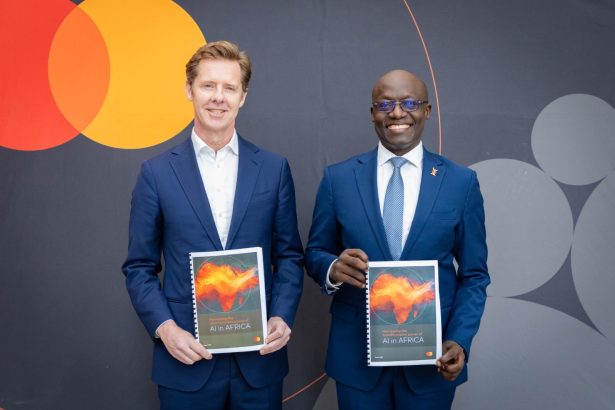
Mastercard, has released a new whitepaper, Harnessing the Transformative Power of AI in Africa, a continent-wide study exploring Africa’s readiness, opportunities and roadmap for responsible Artificial Intelligence (AI) adoption.
The report outlines how AI, if deployed inclusively and responsibly, could unlock transformative outcomes across key sectors, including agriculture, healthcare, education, energy and finance. With Africa’s AI market projected to grow from USD 4.5 billion in 2025 to USD 16.5 billion by 2030, the study calls for coordinated multi-stakeholder investment and collaboration.
Mark Elliott, Division President for Africa at Mastercard, said Africa’s demographics and mobile-first infrastructure uniquely position the continent as an active player in shaping global AI innovation. “Africa’s engagement with AI is already reshaping lives, not just in labs, but in farms, clinics and classrooms. To unlock its full potential, we need investment in infrastructure, data, talent, and policy. At Mastercard, we believe responsible, locally rooted AI can drive inclusive growth and connect more people to opportunity,” he stated.
The whitepaper identifies potential gains in digital infrastructure, governance, research and development, local language processing and investment. It also forecasts that AI could help create up to 230 million digital jobs by 2030, while boosting financial inclusion through innovations such as AI-driven credit scoring and fraud prevention.
More Read

Greg Ulrich, Mastercard’s Chief AI and Data Officer, emphasised the importance of trust in AI adoption. “AI is only as powerful as the trust behind it. At Mastercard, we’re committed to building AI that’s responsible, inclusive, and built to bring value to our customers, partners and employees. This isn’t just innovation, it’s innovation with integrity,” he said.
On regional highlights, South Africa: The country secured USD 610 million in AI-focused venture capital in 2023, with total AI investment expected to hit USD 3.7 billion by 2030. With the highest infrastructure readiness on the continent, South Africa is positioning itself as a leader in AI research and application through initiatives such as the Artificial Intelligence Institute of South Africa. National strategies aim to support 300 AI start-ups and train 5,000 AI professionals by 2030.
Kenya: Leveraging its “Silicon Savannah” reputation, Kenya is using AI in financial services and healthcare. Tala deploys mobile data for credit scoring, while Jacaranda Health’s UlizaLlama chatbot provides maternal health advice in five local languages. The country’s new National AI Strategy (2025–2030) seeks to establish Kenya as a regional leader in AI-driven innovation and commercialisation.
Nigeria: With USD 218 million in venture capital secured in 2023, Nigeria hosts the second-largest number of AI start-ups in Africa. Applications range from personalised learning tools such as Rising Academies, to Kudi.ai’s microfinance delivery and AI systems monitoring public spending. Nigeria’s AI market is projected to reach USD 1.4 billion by 2025.
Morocco: Emerging as a North African hub, Morocco is advancing AI across healthcare, agriculture, energy and finance. Institutions such as Mohammed VI Polytechnic University are spearheading innovation, while the MoroccoAI Annual Conference is shaping policy debates. Under its Digital 2030 strategy, Morocco aims to attract USD 1.1 billion in investment and create 240,000 digital jobs, though the report cautions that data fragmentation and inconsistent regulation could deepen inequality.
The report concludes that AI will play a pivotal role in accelerating financial inclusion and driving Africa’s economic growth. Strategic collaboration between governments, fintechs and global partners will be essential to unlocking AI’s full potential.
The whitepaper draws on insights from African policymakers, academics, technologists and entrepreneurs, including contributions from UNESCO, the African Center for Economic Transformation, and fintech leaders across the region.