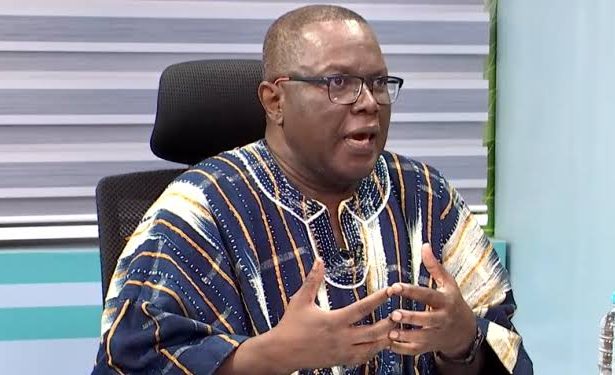
Chairman of the National Development Planning Commission (NDPC), Dr Nii Moi Thompson, has cautioned that Ghana’s recurring dependence on currency depreciation as an economic strategy will continue to fail unless it is accompanied by deep structural and institutional reforms.
Speaking on Good Morning Ghana on Metro TV on Thursday, January 15, 2026, Dr Thompson argued that the long-held belief that a weaker cedi automatically boosts exports has not worked for Ghana, despite decades of implementation under various IMF-supported programmes.
“Ghana has been following this prescription since the early 1980s. If a weak currency alone could make a country competitive, we should by now be leading global exports,” he remarked.
He explained that while economic theory suggests that depreciation can stimulate exports, the conditions required for that outcome do not exist in Ghana’s economy. High inflation, low industrial capacity and structural weaknesses, he said, undermine any potential gains.
“In theory, depreciation works under certain assumptions, one of which is very low inflation. Do we have that? Clearly, we don’t,” he stated.
Dr Thompson further observed that Ghana’s position in global trade limits the benefits of a weaker currency, since the country mainly exports primary commodities whose prices are determined on international markets.
“When you export cocoa, gold and other raw materials, you don’t control the price. You are a price-taker. That is very different from countries that manufacture and set their own prices,” he explained.
He disclosed that Ghana’s manufactured exports account for only about five per cent of total merchandise exports, compared with an average of about 60 per cent for lower middle-income countries.
According to him, this poor performance exposes the failure of currency depreciation to drive industrial growth, even after years of cedi weakening.
“Even with all the depreciation we have experienced, our manufacturing exports have not responded in any meaningful way. That should tell us something,” he said.
Dr Thompson also criticised the tendency to equate IMF-supported stabilisation programmes with long-term development, warning that macroeconomic stability alone does not transform an economy.
“Stabilisation is not development. After stabilisation, you must grow, expand productive capacity and structurally transform the economy. That is where the real work is,” he noted.
He argued that Ghana’s development challenge goes beyond fiscal targets and exchange rate management and must focus on building strong institutions, improving productivity and restructuring the economy.
“The IMF is not designed to fix structural weaknesses. Their benchmarks are often about short-term adjustments, not long-term transformation,” he added.
The NDPC Chair further insisted that the Commission must play a central role in national economic planning, stressing that sidelining it in major policy discussions undermines Ghana’s development agenda.
“The NDPC is the constitutional body responsible for national development planning. No serious development conversation can exclude the Commission,” he said.
He revealed that he recently expressed concern to the IMF’s country representative after learning that key consultations had taken place without NDPC’s participation.
Beyond macroeconomic policy, Dr Thompson identified weak institutions and inefficient systems as Ghana’s most fundamental obstacles to progress.
“You can give any president a decade in office, but if the institutions responsible for delivering development are weak, very little will change,” he warned.
He concluded that Ghana’s economic recovery will remain fragile unless leaders shift focus from short-term policy fixes to long-term structural reforms that strengthen governance, productivity and service delivery.
“Until we confront these structural and institutional challenges head-on, the results will remain the same,” he stated.