By Patrick Biddah
The Vice-President, Prof. Naana Jane Opoku-Agyemang has raised pressing concerns about whether Ghana is truly benefiting from its long-standing diplomatic relations, urging a strategic reset to ensure the country derives more tangible economic gains.
Focusing on trade and economic diplomacy, she challenged the Ministry of Foreign Affairs to reassess how effectively it promotes Ghana’s interests abroad.
She emphasized that diplomacy must go beyond political ties and translate into measurable economic outcomes.
“Trade is an important part of your responsibility,” she noted, calling for a more deliberate approach across all agencies and directorates under the Ministry to ensure Ghanaian investments and businesses expand meaningfully beyond the country’s borders.
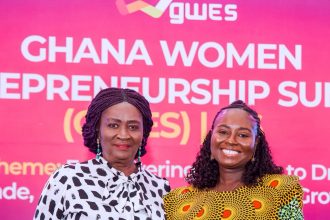
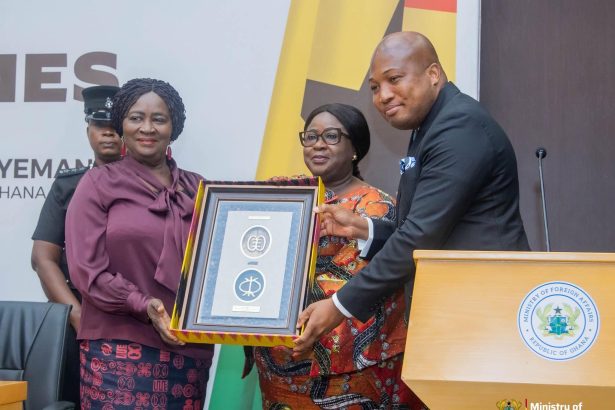
Speaking during a visit to the Ministry of Foreign Affairs as part of scheduled ministerial tours, the Vice President questioned the balance of benefits in Ghana’s international relationships, pointing out that many foreign embassies have operated in Ghana for decades and have benefited substantially in trade.
She therefore asked whether Ghana has received equivalent value in return in the countries it has operated diplomatic misisons.
“Can we honestly say that whatever they have taken from Ghana is what we have?” she asked, highlighting the apparent disparity between foreign business success in Ghana and the limited presence of Ghanaian enterprises abroad.
She further enquired about how many Ghanaian businesses is there in those countries and why wondered why it is the case.
In her view , there is the need for a more assertive and results-driven foreign economic policy.
The Vice President stressed that Ghana must not remain passive, but instead actively support its businesses to penetrate foreign markets.
She urged stakeholders within the country to collaborate with those abroad to ensure Ghanaian enterprises thrive internationally.
She acknowledged and expressed optimism about efforts to strengthen accountability within the foreign service.
However, she maintained that much more needs to be done to achieve real impact.
“We must reset this country in very serious ways,” she declared, emphasizing that every ministry including the Ministry of Foreign Affairs has a critical role to play in repositioning Ghana for greater global competitiveness.
Despite her concerns, she commended the Ministry’s leadership under Foreign Affairs Minister Samuel Okudzeto Ablakwa for demonstrating commitment and progress, particularly in addressing institutional and operational challenges.
She also praised the Ministry’s attention to the welfare of its workers, noting that a motivated workforce is essential for delivering on Ghana’s diplomatic and economic objectives.
Earlier, the Foreign Minister had outlined plans for a major international conference on reparatory justice scheduled for June 18–19 in Accra, following directives from President John Dramani Mahama.
He explained that the conference would bring together global stakeholders including UNESCO, the Congressional Black Caucus, the NAACP and the Non-Aligned Movement to develop a unified global framework on reparatory justice, marking what he described as an unprecedented step toward collective action.
This upcoming conference is a follow up to the successful passing of Ghana’s tabling of the resolution at the United Nations for reparatory justice.