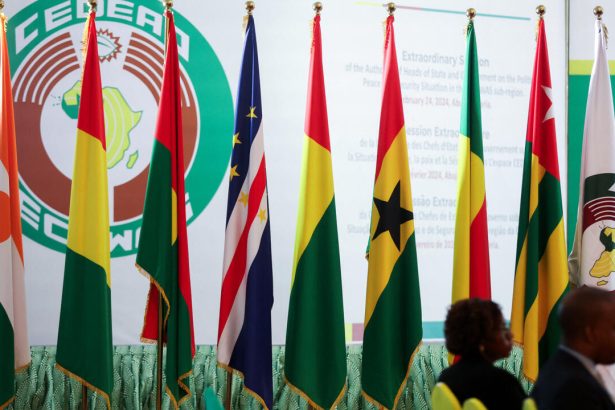
The Africa Centre for Security and Counterterrorism (ACSCT) has issued a stark warning that institutional hypocrisy within the Economic Community of West African States (ECOWAS) is a primary driver of the region’s “coup contagion.”
In a press statement dated December 8, 2025, the Accra-based security policy institute argues that the bloc’s “selective enforcement of democratic standards” has eroded public confidence and created conditions for military takeovers.
The statement follows Benin’s successful suppression of a military coup attempt on December 7, which the ACSCT says underscores a “regional institutional failure” despite Benin’s own “institutional resilience.”
The ACSCT presented data showing a sharp democratic decline in the region. “In 2017, all 15 ECOWAS member states had civilian governments. Today, four are under military rule; three have withdrawn from the bloc. Six successful coups have occurred in the past 4 years,” the statement read.
It attributed this pattern directly to ECOWAS’s inconsistent approach. “ECOWAS imposes harsh sanctions and threatens military intervention against military coups, yet disregards constitutional manipulation by elected leaders: term-limit extensions, electoral rigging, and arbitrary detention of opposition figures.”

The think-tank highlighted a pointed contradiction, citing World Bank governance metrics: “Burkina Faso, now under military rule, outperforms ‘democratic’ Nigeria in political stability, government effectiveness, rule of law, and control of corruption. However, ECOWAS imposes sanctions on Burkina Faso while Nigeria chairs the bloc.”
The ACSCT outlined a transparent “causal chain” fuelling instability:
- Elected governments fail on security and accountability.
- ECOWAS takes no action as long as the leader is civilian.
- Military actors position themselves as alternatives.
- ECOWAS imposes broad sanctions that punish citizens, validating the junta’s “national sovereignty” narrative.
- More coups succeed.
“In Mali, Burkina Faso, and Niger, initial public support for coups reflected not enthusiasm for military rule but exhaustion with elected governments that could not deliver security,” the statement noted, adding that subsequent ECOWAS sanctions “deepened anti-ECOWAS sentiment.”
The centre contrasted recent coup states with Benin, where the military remained loyal. “Professional institutions, civilian oversight, and over three decades of democratic tradition created cohesion that withstood pressure,” the release stated. It concluded that “democracy is secured through institutional substance… not through ECOWAS rhetoric about ‘zero tolerance for coups.’”
The ACSCT recommended an urgent five-point reform agenda for ECOWAS to regain credibility and stabilise the region:
- Reform Standards: Apply consistent penalties for all threats to democratic order, including electoral manipulation and constitutional overreach, not just coups. Establish an independent Governance Commission.
- Integrate Governance & Security: Link ECOWAS counterterrorism support to measurable improvements in governance, corruption control, and institutional effectiveness.
- Professionalise Militaries: Create regional standards for military education, transparent promotion, and welfare to build institutional norms against political intervention.
- Re-engage Junta-Led States: Initiate dialogue with Mali, Burkina Faso, and Niger on conditional transition timelines, moving past “unconditional sanctions” that have failed.
- Rebuild Credibility: Establish transparent, consistent enforcement mechanisms independent of major member states’ interests.
The statement concluded with a grave warning. “Without fundamental institutional reform, coups will continue… Populations will lose faith… Military alternatives will proliferate. Ordinary West Africans will bear the cost through regional fragmentation, economic disruption, and human suffering.”
It presented ECOWAS with a binary choice: “continue as an elite compact protecting leaders’ regime survival” or “undertake urgent reform to become a credible defender of democracy for West African peoples.”
“The region’s stability,” the ACSCT stated, “depends on which path leadership chooses.”