…..Amid ASP promotion exams controversy
The Ghana Police Service has come under renewed pressure to release the official list of officers who passed the recent promotional examinations from Chief Inspector to Assistant Superintendent of Police (ASP), following allegations of examination leakage, bribery and manipulation of the selection process.
Critics say the Police Administration is hiding behind the reputation of the University of Cape Coast (UCC) while refusing to address several other concerns raised over the conduct of the examinations.
Interestingly, reports suggest this is not the first time controversy has surrounded police promotion examinations involving the UCC, with questions being asked as to who actually sets the examination. There are also claims that some Chief Inspectors, ahead of the paper, were attending preparatory classes at the same university for the examinations.
What has further heightened concerns is the allegation that the UCC list, containing the names of more than 7,000 candidates who passed and those who failed the promotional examination, differs from the list reportedly circulated by the Police Administration to Regional Commanders through its Human Resources Directorate.
The pass mark was reportedly pegged at 53 per cent, with the highest score reportedly 75 per cent. There are allegations that names may have been inserted into the final list, with many arguing that the document handed to Regional Commanders differs from the original UCC results, indicating those who passed or failed the examination.
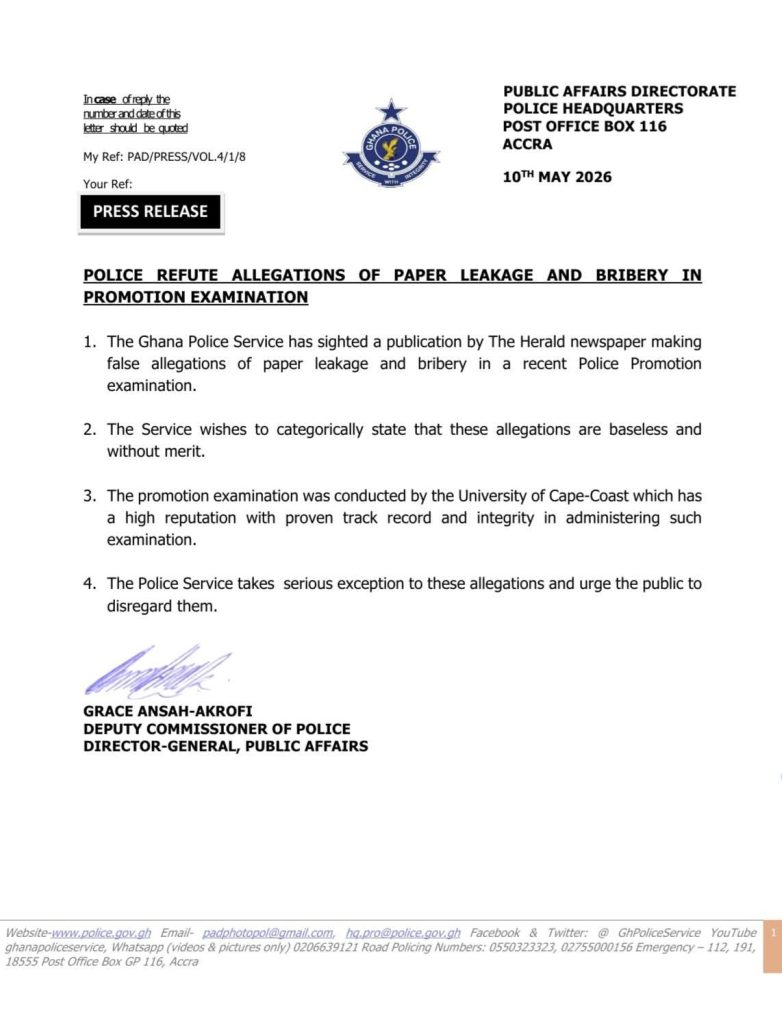
The controversy follows a statement issued by the Police Administration dismissing allegations published by The Herald newspaper regarding exam paper leakage and bribery in the promotion exercise conducted for officers seeking admission to the Police Academy.
In the statement signed by Deputy Commissioner of Police and Director-General of Public Affairs, Grace Ansah-Akrofi, the Service described the allegations as “baseless and without merit”.
“The promotion examination was conducted by the University of Cape Coast, which has a high reputation with a proven track record and integrity in administering such an examination,” the statement said, urging the public to disregard the claims.
However, critics insist that the Police Administration addressed only the alleged paper leakage, ignoring broader concerns about the entire promotion exercise.
Some officers are now demanding that the names of successful candidates submitted by the UCC be made public to establish whether the allegations dismissed as false by the Police Administration are indeed unfounded.
Further details emerging from within the Service suggest growing tension and unease among personnel over the manner in which the examinations were conducted.
Sources told The Herald that although only 700 vacancies were available for successful candidates, more than 7,000 Chief Inspectors were made to sit the examinations.
According to the sources, the situation was worsened by the decision to allow both junior and senior Chief Inspectors to write the same examinations, a development many officers believe undermined fairness and significantly increased the number of candidates, setting the stage for some officers to be favoured unfairly.
Under normal circumstances, the sources claimed, only about 3,000 senior Chief Inspectors should have participated in the exercise. The inclusion of junior officers, some of whom reportedly became Chief Inspectors through the Inspector-General of Police’s (IGP) “special recommendations”, is said to have pushed the figure beyond 7,000.
Some officers fear the arrangement enabled junior Chief Inspectors to overtake their seniors in promotion, further deepening dissatisfaction within the Service.
Ordinarily, junior Chief Inspectors are expected to sit the promotional examinations only after spending four years at the rank, commonly referred to as attaining “Point Four”, with each year representing a point. However, sources claim this procedure was not followed.
Officers who spoke to The Herald argued that if the government is genuinely interested in investigating the matter, it should obtain the original list of successful candidates directly from the university and compare it with the final list to be released by the Police Administration.
The officers said such a step would help determine whether the integrity of the process had been compromised.
Despite the concerns, some personnel within the Service have dismissed the allegations as mere complaints from officers who failed the examinations and are seeking to discredit the process.
The latest controversy comes amid mounting reports of widespread dissatisfaction over the conduct of the promotional examinations, which were intended to determine officers’ progression within the Service.
Sources within the Police Service alleged that some examination papers were leaked to selected officers ahead of the exercise, while others allegedly paid substantial sums to influence the outcome.
According to insiders, amounts ranging from GH¢70,000 to GH¢100,000 were allegedly demanded from some officers in exchange for assistance with passing the examinations and securing placement at the Police Academy.
There are also claims that certain female officers were assured of success even before the examinations were conducted, raising further concerns over transparency and fairness.
The Herald has also gathered that the Police Administration engaged retired senior police officer, David Ajeem Agyemang, to supervise aspects of the exercise.
However, some officers have questioned his involvement, alleging that he favoured certain preferred candidates during the process.
Sources indicated that COP Agyemang reportedly retired shortly after the exercise was completed.
The allegations have reportedly fuelled frustration among officers who believe candidates had already been selected before the examinations were conducted, making the process a mere formality.
Information available to The Herald indicates that several petitions have already been lodged at the Police Service registry demanding investigations into the conduct of the examinations and the allegations surrounding the exercise.
The petitions are reportedly calling for a comprehensive review of the promotion process amid fears that the credibility and integrity of the Police Academy selection system may have been compromised.
Some officers have warned that failure to thoroughly investigate the allegations could further erode confidence within the Service and negatively affect morale among personnel who prepared genuinely for the examinations.