…“We are all hurting inside”: Cops speak out as morale crumbles
The Herald has uncovered troubling developments within the Ghana Police Service, suggesting growing discontent and waning morale, particularly at the Police Headquarters, over what appears to be a disregard for established procedures on career progression and retirement.
Sources within the Service indicate that the Inspector-General of Police (IGP), Christian Tetteh Yohuno, is revising long-standing rules and practices concerning retirement, without formally announcing such changes. The IGP is reportedly retaining some senior officers in active service despite their eligibility for terminal leave, in contravention of existing regulations.
According to service rules, officers due for retirement are expected to proceed on terminal leave in the months leading up to their 60th birthday. However, The Herald has learned that several senior officers, close associates of the IGP, remain actively in service. In contrast, those perceived to be outside his inner circle are being compelled to comply with the established procedures.
Insiders further reveal that upon assuming office, IGP Yohuno contemplated issuing a circular to abolish terminal leave altogether. Although he was reportedly advised against it, the IGP appears to have informally implemented the policy by keeping select officers at post, particularly at the Police Headquarters.

This apparent inconsistency in applying the rules is said to be breeding frustration among officers. “We are all hurting inside but afraid to speak up,” a source at the Headquarters confided.
The immediate past IGP, Dr George Akuffo Dampare, was widely praised for enforcing the rules strictly, sending home officers upon reaching retirement age. His approach is being contrasted with the current situation, which some officers describe as chaotic and demoralising.
“Some have turned 60 yet continue to wear the uniform and report to duty. That was one thing Dampare got right. Three months before retirement, you went on terminal leave, simple, transparent and fair.”
A flurry of candid messages shared among disgruntled officers paints a picture of disillusionment and disarray: “Maybe someone at Jubilee House has promised them something.”
“People are not happy in the system at all – and they don’t care!”
“This wouldn’t happen under Dampare.”
“Has the government’s suspension of post-retirement contracts been lifted, or is the police exempt?”
“I saw one of them walking into the office today with vim—as if he just got promoted!”
“There’s too much indiscipline in the system now.”
“Even commanders are refusing transfers. What do you expect?”
“If your boss, who’s due for retirement, is seriously lobbying for an extension, what do you expect others to do?”
“I was at the HQ, the level of frustration among officers is palpable.”
There are even suggestions that some officers have already been granted extensions beyond the mandatory retirement age, raising further questions about transparency and fairness in the Service.
As murmurs of dissatisfaction grow louder, it remains to be seen whether the Police Council, chaired by the Vice-President, Prof. Jane Naana Opoku-Agyemang, or the President himself will intervene to restore discipline, consistency, and morale within the ranks.
Last week, The Herald revealed how tension is brewing within the Ghana Police Service, following the controversial extension of service for Commissioner of Police (COP) Michael Nketia Frempong, Director-General of Finance, in apparent defiance of President John Dramani Mahama’s directive against post-retirement contract appointments for civil and public servants.
COP Nketia, who was scheduled to begin his terminal leave on July 19, 2025 and officially retire sometime in August 2025, has been granted a two-year post-retirement contract through a letter issued on July 16, 2025, just three days before his scheduled mandatory terminal leave pending his departure from the service.
The letter, signed by Mr Yohuno, confirmed the appointment, stating that the contract would take effect from the end of his leave and expire on July 19, 2027.
The move has raised eyebrows both within the service and among political watchers, as it directly contradicts President Mahama’s stated policy that no civil or public servant should be retained on contract after reaching their mandatory retirement age.
The President’s directive aimed to ensure career progression and smooth succession within public institutions, a goal the Akufo-Addo administration faced severe criticism for not respecting, as it was allegedly used primarily as a reward for officers who were sympathetic to his party, the New Patriotic Party (NPP).
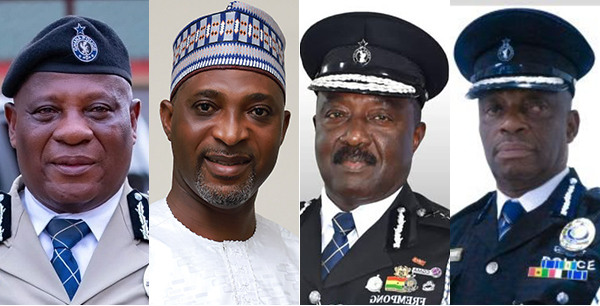
Observers now question whether this decision will pave the way for similar contract extensions for other top officers due for retirement soon, including Commission of Police (COP) Sebastian Atsu Wemegah, who is scheduled to retire on August 6, 2025, and COP Martin Kwaku Ayiih, who is expected to exit on June 28, 2025.
COP Okyere Darko Asumadu, is also due to start his retirement on October 11, 2025.
For years, the Ghana Police Service was burdened with issuing contract extensions to retiring officers, a practice that led to indiscipline, unfairness, and institutional decay. The NDC, which was in opposition, took advantage of this and made political capital out of it, promising reforms. The abrupt deviation from this vow, led by the President himself, has stirred speculation of internal lobbying and political interference.
There are claims that the IGP, who himself is due for retirement on 27 December 2025, is setting the stage for his post-retirement contract from the Mahama government.
A copy of IGP’s contract letter to COP Nketia reads in part: “It should be noted that the period of your limited engagement is essentially to afford you the opportunity to enable you continue to impact and bring your rich professional and management experiences to bear in the Service.
The terms of your appointment, including salary, allowances and other conditions of service, shall, with the necessary modifications, be the same as those applicable to the rank of Commissioner of Police.
The extended service appointment shall be governed by the provisions of the Police Service Act, 1970 (Act 350), the Civil Service Act 2001 (Act 600), and all relevant pieces of legislation of the Ghana Police Service, as well as existing administrative rules and regulations on discipline in the Service.”
The letter, which was widely circulated within the Police hierarchy, was copied to key stakeholders, including the Minister for the Interior, all members of the Police Management Board (POMAB), the Quartermaster-General, the Chief Internal Auditor, and the Staff Officer in charge of Establishment.
Meanwhile, members of Parliament’s Committee on Defence and Interior, as well as the Committee on National Security and Intelligence, are reported to have scheduled a closed-door meeting with the IGP and sector ministers to demand clarity on the decision and its implications for succession planning within the Service.
With several other senior officers, including COP Okyere Darko Asumadu, due for retirement in October, expected to exit soon, many are watching closely to see whether the President will reassert his authority or allow what critics call a dangerous precedent to fester.