….Queries GH¢100 million judgment-debt in 2027 budget months after his US$250 million road project, GH¢1.05 billion military barracks & specialist hospital sole-sourcing contracts accusations
The Member of Parliament (MP) for Okaikwei Central, Patrick Yaw Boamah, has renewed his parliamentary offensive against the Minister for Finance, Dr Cassiel Ato Forson, questioning a GH¢100 million allocation in the 2027 Budget Statement for the payment of judgment debts, demanding explanations for the government’s anticipated financial liabilities.
The opposition New Patriotic Party (NPP) legislator has also called for a parliamentary investigation into a directive issued by the Ministry of Finance suspending monthly sitting allowances for board members of more than 164 state-owned enterprises and public institutions.
His latest intervention comes barely a few months after he accused Dr Forson of complicity in the alleged sole-sourcing of three major government projects in his Ajumako-Enyan-Essiam Constituency in the Central Region, suggesting a conflict of interest against the minister. These include a US$250 million road construction contract, a GH¢200 million military barracks and a GH¢850 million specialist hospital, raising questions about the government’s commitment to transparency, competitive procurement and prudent public expenditure.
Mr Boamah, who has increasingly emerged as a vocal critic of the Finance Minister’s handling of public expenditure, raised fresh concerns yesterday, Thursday, November 19, 2026, during parliamentary debate on the 2027 Budget Statement and Economic Policy.
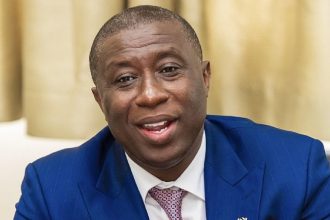
The budget, presented by Dr Forson on November 12, projects government expenditure of approximately GH¢389.2 billion for the 2027 financial year, with the administration promising tighter expenditure controls, improved revenue mobilization and measures to strengthen public financial management.
However, Mr Boamah questioned whether the government’s fiscal projections adequately addressed outstanding liabilities, potential judgment debts and the financial consequences of decisions taken by public institutions.
Drawing Parliament’s attention to Appendix 4A of the budget document, the legislator challenged the Finance Minister to explain the basis for allocating GH¢100 million to settle judgment debts.
“The Minister made an allocation of 100 million Ghana cedis as a line in the budget for the payment of judgment debts. A whopping 100 million Ghana cedis,” he told the House.
He subsequently posed a pointed question to Dr Forson: “What is the minister anticipating?”
The allocation, captured on page 195 of the 2027 Budget Statement under General Government Services, appears alongside a separate GH¢50 million provision for land compensation.
Although budgetary provisions for judgment debts are not unusual, Mr Boamah argued that the amount raised important questions about the scale of outstanding claims against the state and the government’s preparedness to settle court-ordered financial obligations.
He maintained that judgment debts continued to hang around the neck of successive governments, potentially undermining fiscal stability and diverting scarce public resources from essential development programmes.
The MP cited a judgment debt involving the Ghana Revenue Authority (GRA), which he said exceeded GH¢680 million, as an example of the substantial financial liabilities confronting the state arising from a contractual dispute with Safaritech.
The attributed the debt to the government’s failure to honour contractual obligations and warned that such cases could expose the state to further financial liabilities.
Boamah argued that the government should rather focus on preventing the accumulation of judgment debts by ensuring that state institutions honour agreements they enter into with private entities.
“As you speak, there are a lot of judgment debts that are hanging around the neck of government. As I speak to you, GRA is saddled with a judgment debt of over GH¢680 million from Safaritech, adding, “the government must respect the contracts that they enter into. State institutions must respect contracts to prevent the occurrence of judgment debt”.
He also referred to litigation involving Ghana Water Company and Tullow Oil Ghana, including proceedings in London involving the oil company and the Ghanaian state, saying these cases demonstrated the need for greater transparency in the management of government litigation and the settlement of court judgments.
His concerns centred not merely on the GH¢100 million allocation but also on the broader question of how the government intends to manage existing and potential judgment debts without exposing public institutions to further financial difficulties.
Mr Boamah also challenged the government’s proposal to amend the State Proceedings Act, 1998 (Act 555), to prevent judgment creditors from attaching funds held in the Consolidated Fund and the Contingency Fund.
The proposed amendment forms part of measures outlined in the 2027 Budget to protect critical government resources from enforcement actions arising from court judgments.
However, the Okaikwei Central MP questioned the implications of restricting creditors’ ability to enforce judgments against the state.
“If you owe me, you cannot attach the contingency fund or the consolidated fund. It means you are telling me to look elsewhere to attach other government properties,” he argued.
His remarks raised concerns about how successful litigants would recover money owed to them by the government if access to the two funds were restricted.
The government, however, has defended the proposed amendment as necessary to prevent what it describes as indiscriminate attachment of public funds and bank accounts belonging to government institutions.
According to the budget statement, the attachment of the Contingency Fund during flooding in June prevented the government from accessing resources intended to respond to the emergency.
The Finance Ministry also cited instances in which accounts belonging to government institutions, including the ministry itself, had been frozen following enforcement proceedings initiated by judgment creditors.
Such developments, the government maintains, can disrupt essential public services and undermine the effective functioning of state institutions.
The budget further warns of substantial judgment claims against the state, with more than 80 per cent of their value denominated in foreign currencies.
This exposure presents additional financial risks, particularly where exchange-rate movements increase the cedi value of liabilities owed to creditors.
To address the problem, the government has proposed stronger central monitoring of litigation involving public institutions and improved coordination in managing legal claims against the state.
Nevertheless, Mr Boamah’s intervention has brought renewed attention to the delicate balance between protecting public funds and ensuring that the government honours legally enforceable financial obligations.
Beyond judgment debts, the NPP legislator also challenged a Finance Ministry directive suspending monthly sitting allowances for members of boards of state-owned enterprises and other public institutions.
He called on Parliament to investigate the directive, arguing that it could undermine effective corporate governance and weaken the oversight responsibilities of boards entrusted with supervising state institutions.
According to Mr Boamah, the directive was contained in a letter dated October 12, 2026, issued by a Deputy Minister for Finance acting on behalf of Dr Forson.
He said the communication was addressed to more than 164 state-owned companies and public institutions.
“These are state companies, these are statutory institutions that require regular board meetings to help grow those companies. But this is a directive by the Minister of Finance asking for board allowance not to be paid,” he told Parliament.
“And this is a very serious matter that must be looked into by the House,” he added.
Mr Boamah argued that boards play critical roles in the administration of public institutions, including providing strategic direction, supervising management, reviewing financial performance and ensuring accountability.
He expressed concern that withholding sitting allowances could affect board members’ willingness or ability to discharge their responsibilities effectively.
“If public boards are being written not to pay monthly board allowance to board members, then we have a problem in supporting companies where government also has interest in,” he maintained.
The directive comes against the background of the Mahama administration’s efforts to strengthen financial discipline and improve the performance of state-owned enterprises.
In September, President John Dramani Mahama told executives of state enterprises at a conference organised by the State Interests and Governance Authority (SIGA) that executive remuneration, board appointments and government financial support would increasingly be linked to institutional performance.
The President’s position formed part of broader efforts to reduce inefficiencies, improve accountability and ensure that state enterprises deliver measurable value to taxpayers.
Earlier in February, members of the Ghana Cocoa Board (COCOBOD) voluntarily waived their sitting allowances as part of measures intended to support reforms in the cocoa sector.
Mr Boamah’s concerns, however, suggest that the government may face questions about whether expenditure-reduction measures are being implemented in a manner that preserves effective governance and respects existing obligations.
His latest criticism also follows his opposition earlier this month to a proposal for Members of Parliament to travel to Ho in the Volta Region for a post-budget workshop.
The Okaikwei Central MP argued that holding the workshop outside Accra would impose avoidable costs on the state at a time when the government was demanding financial restraint from public institutions.
He maintained that Parliament should demonstrate leadership in expenditure control by avoiding activities that could be undertaken at a lower cost.
During Thursday’s debate, Mr Boamah also questioned the government’s strategy for supporting Ghanaian businesses and ensuring that domestic enterprises benefit from the country’s economic development agenda.
He argued that the 2027 Budget had not sufficiently explained how indigenous businesses would be supported to expand, create employment and contribute meaningfully to national development.
“No foreigner would develop this country for us. We have to develop this country ourselves,” he declared.
The MP’s comments appeared to be directed at the government’s economic development strategy, which places considerable emphasis on attracting foreign investment, expanding productive sectors, and encouraging private-sector participation.
He insisted that Ghanaian businesses must be placed at the centre of the country’s development efforts rather than relying excessively on foreign investors.
His intervention came a day after the First Deputy Speaker of Parliament urged legislators to subject the 2027 Budget to rigorous scrutiny and contribute meaningfully to the examination of government expenditure proposals.
Mr Boamah’s latest confrontation with Dr Forson has revived memories of his earlier accusations against the Finance Minister during parliamentary debate on the 2026 Mid-Year Budget Review.
On that occasion, the NPP legislator accused Dr Forson of presiding over procurement arrangements that he alleged were inconsistent with the government’s declared commitment to competitive tendering, transparency and value for money.
At the centre of his allegations were three major infrastructure projects with a combined stated value of US$250 million and GH¢1.05 billion.
The projects included the proposed reconstruction of the 111-kilometre Mankessim–Ajumako–Swedru road, estimated at US$250 million; a military barracks at Ajumako, valued at GH¢200 million; and a specialist hospital, also proposed for Ajumako, with an estimated cost of GH¢850 million.
Mr Boamah questioned why the government was promoting stricter procurement regulations while the projects were allegedly being pursued through non-competitive procurement procedures.
“Mr Speaker, I’m going to demonstrate to this House three very key projects that he’s gone against what he’s reporting to this House,” he declared during the earlier debate.
He specifically challenged the procurement arrangements for the Mankessim–Ajumako–Swedru road.
“One, the Mankessim–Ajumako–Swedru road is 111 kilometres. It’s going to cost this country about $ 250 million. Single-source procurement,” he alleged.
He subsequently turned his attention to the proposed military barracks.
“Secondly, he’s going to build military barracks in Ajumako at 200 million Ghana cedis,” the MP stated.
“The Ajumako military barracks is also a single-source procurement procedure that was used,” he alleged.
The Okaikwei Central MP then questioned the procurement arrangements and proposed location of the specialist hospital.
“The specialist hospital, instead of siting it in Cape Coast, bringing it to Ajumako at 850 million Ghana cedis, almost 80 million dollars, on a restricted tender basis, Mr Speaker,” he said.
His remarks raised questions about the justification for locating the proposed hospital in Ajumako rather than in Cape Coast, the Central Region’s capital, as well as the procurement process reportedly selected for the project.
Mr Boamah maintained that the alleged arrangements undermined the credibility of the Finance Minister’s assurances that the government was strengthening procurement discipline.
“So if the Minister comes to tell us that he’s tightening procurement rules and regime, then I don’t believe in what he’s talking about,” he declared.
Under Ghana’s Public Procurement Act, 2003 (Act 663), as amended, single-source procurement and restricted tendering are permitted under specified circumstances, subject to statutory conditions and applicable approvals. The use of either method does not automatically constitute a breach of procurement law.
The Finance Minister’s response to those specific allegations was not included in the parliamentary account available to The Herald, while the relevant procurement documents were not independently available to establish the status of the contracts.