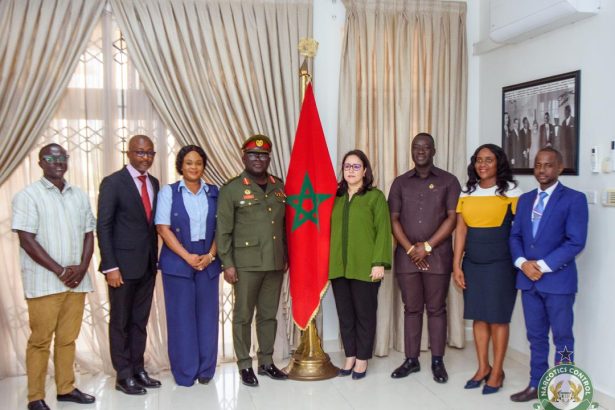
As part of efforts to operationalise Ghana’s cannabis licensing regime, the management of the Narcotics Control Commission (NACOC) visited Imane Quaadil, Ambassador of the Kingdom of Morocco, at her office in Accra on Wednesday, 16 July 2025.
The visit formed part of NACOC’s broader strategy to foster international partnerships in implementing Ghana’s cannabis regulation framework, with Morocco cited as a key model for best practices in cannabis control and licensing.
Director-General of NACOC, Brigadier General Maxwell Obuba Mantey, commended the Moroccan government for its longstanding support towards Ghana’s development since independence.
He disclosed that NACOC intends to engage with regulatory agencies in Morocco to learn from their experiences in activating and managing the cannabis licensing system.
During the meeting, Brig. Gen. Mantey appealed to the Ambassador to facilitate networking opportunities between NACOC and key Moroccan institutions responsible for drug control, particularly those involved in cannabis regulation.
More Read
“NACOC is committed to exploring avenues that will build and enhance the capacity of our staff while encouraging the exchange of ideas,” he stated.
In her response, Ambassador Quaadil expressed her appreciation for the visit, noting that it was the first time a delegation from NACOC had officially visited her office.
She expressed keen interest in cooperation on intelligence and information sharing, as well as capacity-building initiatives. She assured the delegation that her office would liaise with relevant Moroccan institutions to strengthen collaboration and support joint efforts.
Ambassador Quaadil also revealed that arrangements were underway to host a team of selected NACOC personnel in Morocco in September 2025. The visit will offer Ghanaian officers the opportunity to study Morocco’s processes and achievements in implementing cannabis control measures.
The Ambassador voiced concern over the impact of drug abuse among young people across Africa, including in Morocco, where cannabis is predominantly cultivated in the northern regions. She expressed her country’s readiness to partner with Ghana to combat illicit drug trafficking and abuse.
“We are deeply troubled by how drug traffickers often exploit African youth, many of whom are irregular migrants, to carry out these illegal activities. We look forward to working with NACOC to help address this menace,” she said.
Also present at the meeting was Alexander Twum-Berimah, NACOC’s Deputy Director-General in charge of Enforcement, Control, and Elimination, who reiterated the Commission’s commitment to ongoing collaboration with the Moroccan Embassy on anti-narcotics and related efforts.ress the illicit drug abuse and trafficking menace, as in Morocco, it is sad to note that most of these traffickers use some of our African youth who are mostly illegal migrants to perpetrate their nefarious act”.
Mr Alexander Twum-Berimah, NACOC’s Deputy Director-General in Charge of Enforcement, Control, and Elimination, stated that the Commission will continue to collaborate with the Embassy on anti-narcotics and other issues requiring their assistance.