Ghana has officially exited its $3 billion International Monetary Fund (IMF) bailout programme after the Fund’s Executive Board approved the country’s final review under the Extended Credit Facility (ECF), marking the end of a three-year economic recovery programme launched in the wake of the 2022 financial crisis.
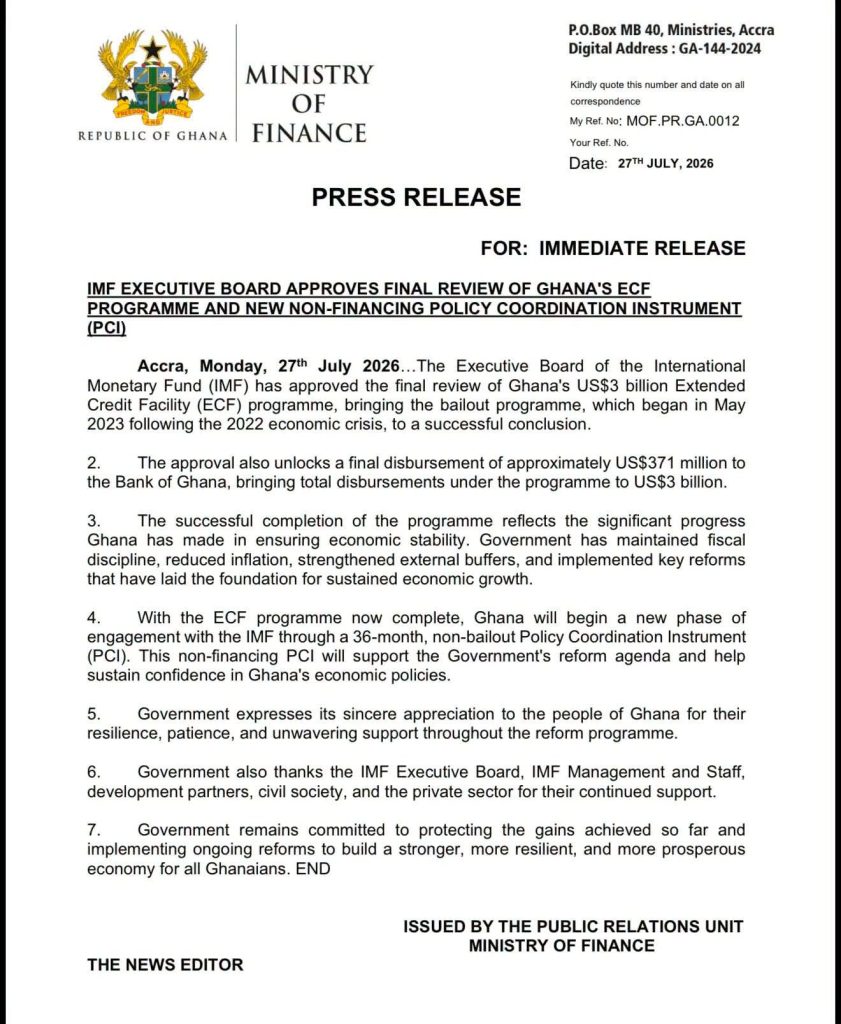
The approval also unlocks a final disbursement of approximately US$371 million to the Bank of Ghana, bringing total disbursements under the programme to the full US$3 billion, according to a statement issued by the Ministry of Finance on Monday, July 27, 2026.
The ECF programme, which commenced in May 2023, was introduced to restore macroeconomic stability following Ghana’s severe economic downturn, characterised by soaring inflation, debt distress and a sharp depreciation of the cedi.
The Ministry of Finance described the successful completion of the programme as a major milestone, saying it reflects Ghana’s progress in restoring economic stability through fiscal discipline, inflation control, stronger external reserves and the implementation of wide-ranging structural reforms.
Although the bailout programme has ended, Ghana will continue working with the IMF under a new 36-month Policy Coordination Instrument (PCI), a non-financing arrangement designed to support policy reforms without providing additional financial assistance.
According to the Ministry, the new programme will help sustain investor confidence, reinforce macroeconomic stability and support government’s ongoing economic reform agenda.
The government expressed gratitude to Ghanaians for what it described as their resilience, patience and support throughout the implementation of the IMF-supported reforms.
It also acknowledged the contributions of the IMF Executive Board, IMF Management and staff, development partners, civil society organisations and the private sector for supporting Ghana’s economic recovery efforts.
The Ministry reaffirmed government’s commitment to protecting the gains achieved under the programme, stating that reforms would continue to strengthen the economy, enhance resilience and create a more prosperous future for all Ghanaians.
The IMF’s decision marks the formal conclusion of one of Ghana’s most significant economic recovery programmes in recent history, while ushering in a new phase of policy engagement focused on sustaining macroeconomic stability without further bailout financing.