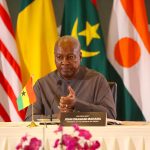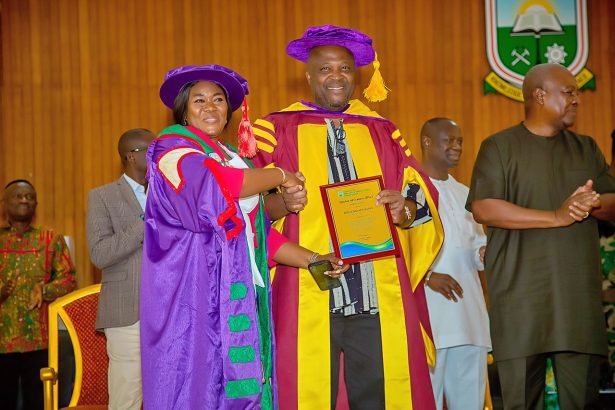
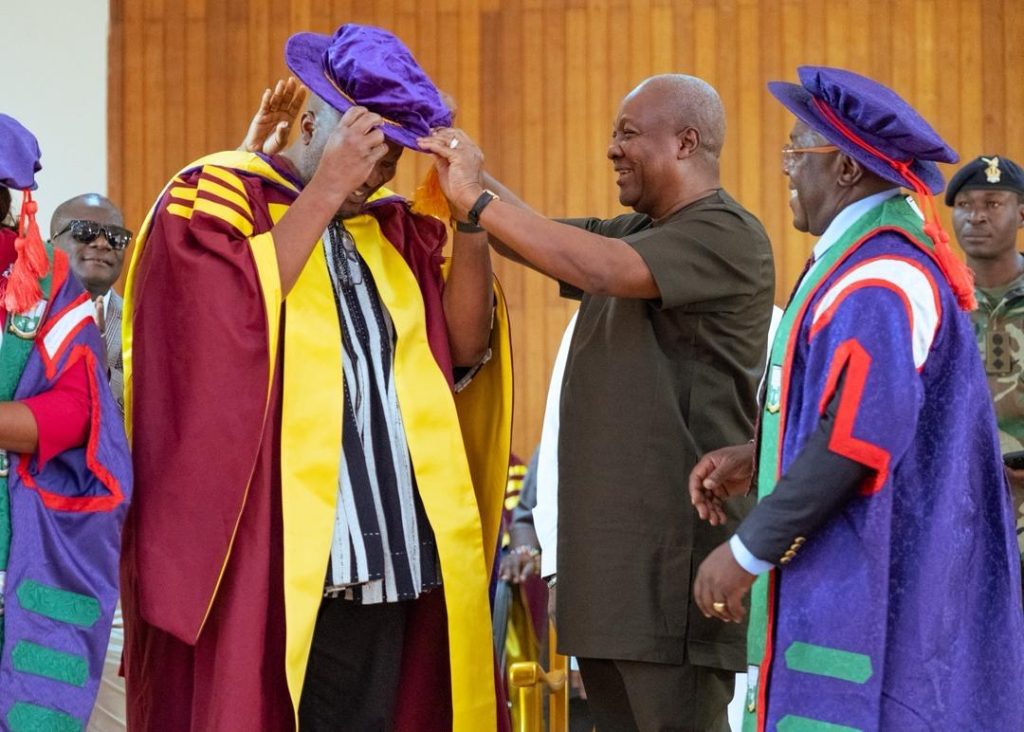
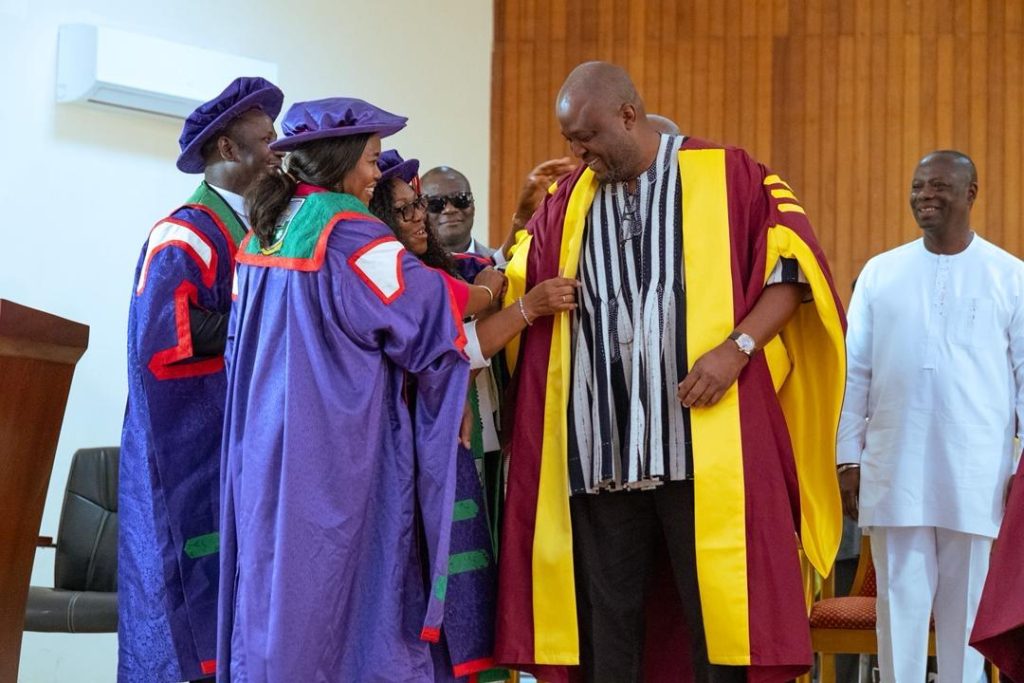
The University of Mines and Technology (UMaT) has conferred an honorary doctorate on Ghanaian businessman and philanthropist Ibrahim Mahama in recognition of his contributions to mining, construction, indigenous enterprise development, and national service.
The university also established an institute in his name for his achievements in the mining industry.
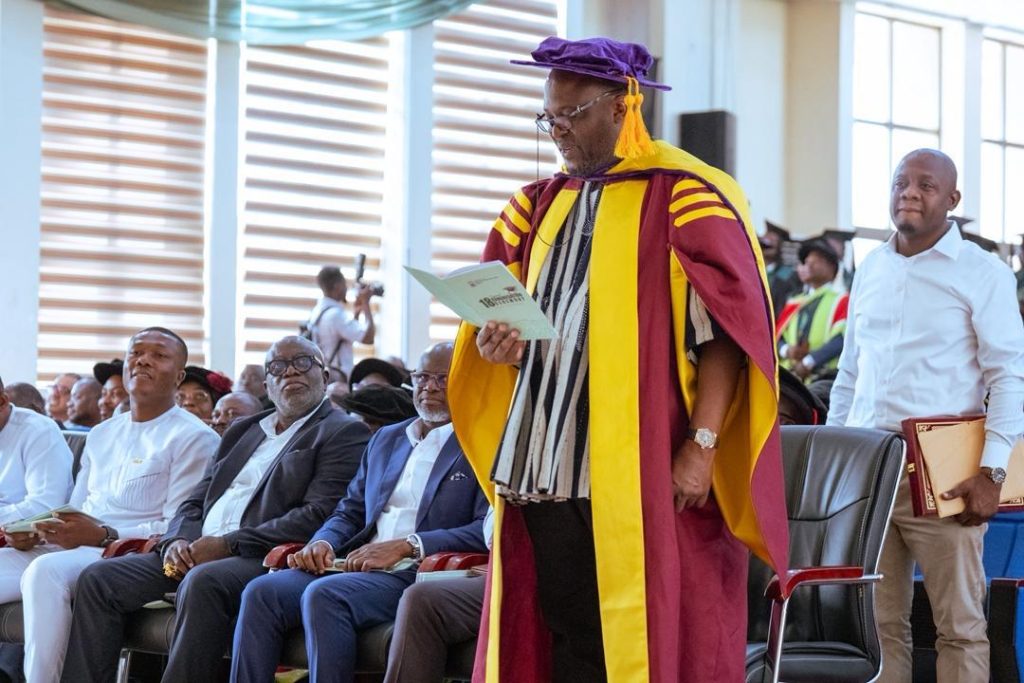
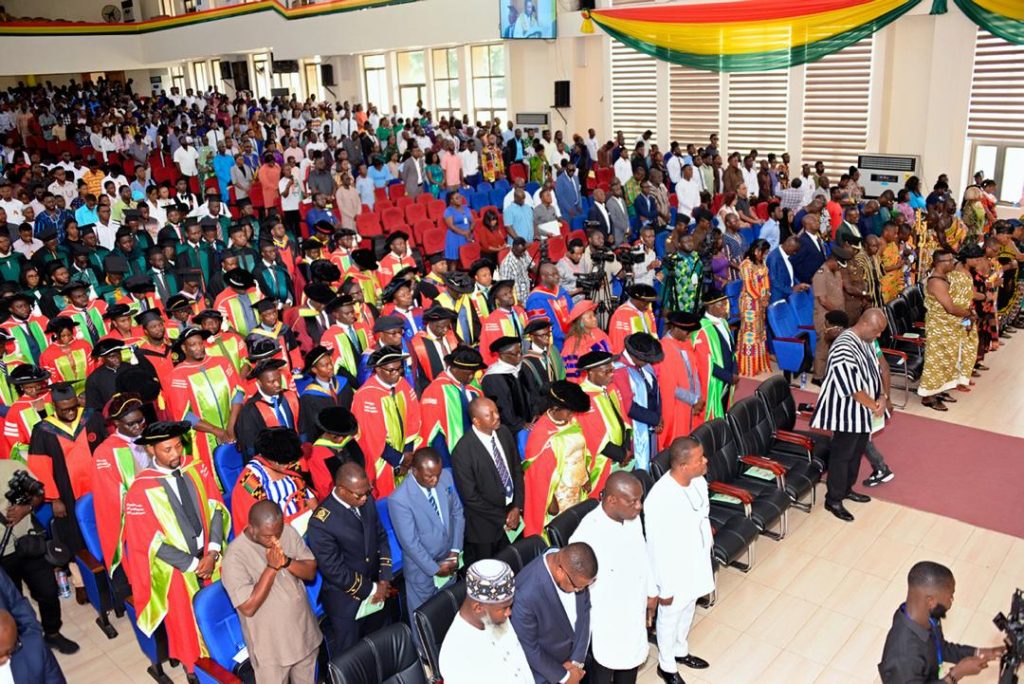
The degree was awarded at UMaT’s 18th Special Congregation Ceremony, held on Saturday, 31 January 2026, in Tarkwa, Western Region. The event was attended by university officials, faculty members, graduands, and invited guests, with President John Dramani Mahama serving as the Guest of Honour.
In his acceptance address, Ibrahim Mahama described the award as a testament to what determination, discipline, and opportunity can achieve beyond conventional academic pathways.
“To be conferred with this honorary doctorate degree is not merely a personal honour; it is a recognition of what is possible when determination meets opportunity, when vision is pursued with unwavering discipline, and when success is shared with those who need it most,” he said.

He paid tribute to UMaT’s role in strengthening Ghana’s mining sector, noting that the institution has produced a significant proportion of professionals managing mines across the continent.
“UMaT has long been a beacon of excellence in mining education, producing the majority of the men and women who manage mines not only in Ghana but across Africa,” he stated.
Touching on global technological shifts, Ibrahim Mahama identified artificial intelligence (AI) as both a challenge and an opportunity for the mining industry.
“AI presents profound challenges, but it also unlocks extraordinary opportunities, enhancing safety, improving efficiency, and even helping to combat illegal mining,” he said.
He commended the University for establishing an AI Robotics Centre in partnership with the Ghana Chamber of Mines, describing it as a strategic step towards positioning Ghana for an AI-driven mining future.
Reflecting on his entrepreneurial journey, Ibrahim Mahama recounted founding Engineers & Planners in 1997, which has since grown into the largest solely Ghanaian-owned mining and construction firm in West Africa.
“What began as a small indigenous company has, through hard work and the dedication of Ghanaians, grown into a business that employs thousands and contributes significantly to national development,” he said.
He highlighted the Black Volta Gold Project as a landmark achievement in Ghana’s mining history.
“For the first time, a large-scale gold mining asset in Ghana is 100 per cent owned and controlled by Ghanaians. This is a statement that we can lead in capital-intensive industries once dominated by others,” he stressed.
Beyond business, Ibrahim Mahama reaffirmed his commitment to philanthropy, attributing his motivation to the influence of his late mother, Joyce Tamakloe.
“True wealth is measured by what we give away, by the lives we touch, and the opportunities we create for others,” he noted.
He urged young people and graduates to embrace discipline, innovation, and integrity, while rejecting narrow definitions of success.
“Do not let anyone tell you that formal education is the only path to greatness. Vision, focus, and hard work are what turn dreams into reality,” he said.
Ibrahim Mahama dedicated the honorary doctorate to Ghanaian workers, business partners, and communities who have supported his journey.
In his remarks, President Mahama congratulated the awardee and praised his junior brother’s entrepreneurial instincts, recalling that these qualities were evident from childhood.
“Even as children, Ibrahim displayed remarkable entrepreneurial instincts, always thinking of ways to create, build, and provide. I, on the other hand, have always been drawn to politics. It is inspiring to see how Ibrahim has turned his early entrepreneurial spark into a force for national development,” the President said.
In recognition of Mr Mahama’s contributions, UMaT announced the establishment of the Ibrahim Mahama Institute for Sustainable Processing of Precious, Critical and Green Minerals, aimed at promoting sustainable mining practices, environmental stewardship, and the development of Ghana’s minerals and green economy sectors.
UMaT was established as the Tarkwa Technical Institute (TTI) on 3rd November 1952, and was officially commissioned by the Government of Ghana, specifically by the then Governor of the Gold Coast, Sir Charles Noble Arden Clarke, on 7th October 1953. In 1961, at the Ghana Chamber of Mines’ prompting, the government redefined TTI’s mission to include training mining technicians and other middle-level personnel for the country’s mining and related industries.
That same year, it was reorganised into the Tarkwa School of Mines (TSM), designed to supply the manpower needed for Ghana’s mining and allied sectors. Recognising TSM’s strategic location in Tarkwa, at the heart of the nation’s mining activities, the government, in 1976, affiliated TSM with the Kwame Nkrumah University of Science and Technology (KNUST) as a faculty, enabling it to offer degree, diploma, and certificate programmes in mining and related disciplines.
Subsequently, TSM was renamed KNUST School of Mines (KNUSTSM), Tarkwa. It later merged with the Kumasi School of Mines to form the Institute of Mining and Mineral Engineering (IMME).
In 1988, a University Rationalisation Committee (URC), appointed by the Ministry of Education, recommended that the School be developed into a university. In 2000, Louis Berger Inc., in partnership with Kwame Asante and Associates, strongly advocated converting KNUSTSM into a full university in a report on the partial commercialisation of KNUST.
In 2001, the KNUST Council approved the Academic Board’s proposals to merge the School of Mines at Kumasi and Tarkwa into the Western University College of KNUST, Tarkwa.
On 3rd November 2004, Ghana’s Parliament passed the bill establishing the University of Mines and Technology. The following day, the President of Ghana gave the Presidential Assent, and on 12th November 2004, the University of Mines and Technology, Tarkwa Act 2004 (Act 677), was gazetted and became law.