Ghana Water Limited has officially inaugurated its Revenue Enhancement Teams in a nationwide drive aimed at improving revenue collection, reducing commercial losses, and ensuring sustainable delivery of safe, potable water across the country.
The inauguration took place on Wednesday, 4th February 2026, with senior management, regional staff, partner agencies, and members of the media in attendance.
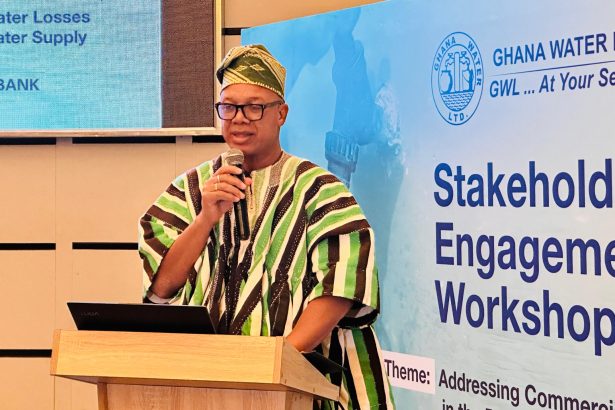
Speaking at the event, the Managing Director of Ghana Water Limited, Mr. Adam Mutawakilu described the occasion as a “decisive turning point” in the company’s history, highlighting the critical role of revenue in sustaining operations. He emphasised that while water is a public good essential for life, health, and economic productivity, producing and delivering it is a capital-intensive process that requires chemicals, electricity, infrastructure, skilled personnel, and continuous investment.
Mr. Mutawakilu outlined several operational and financial pressures confronting the utility. Escalating costs for treatment chemicals, electricity, fuel, and maintenance have increased the operational burden, while aging pipelines and equipment, some decades old are prone to bursts and leakages, leading to both wasted resources and revenue losses.
Ghana Water also faces production constraints. National daily water demand stands at approximately 350 million gallons, but treatment facilities currently supply only 220 million gallons, creating a deficit of 130 million gallons daily. In the Accra–Tema Metropolitan Area, demand is 210 million gallons, with supply at 137 million gallons, leaving a shortfall of 73 million gallons per day. The gap, he noted, continues to affect service reliability and equitable distribution.
Another major concern is customer indebtedness, with outstanding bills running into billions of cedis nationwide. These unpaid bills directly limit Ghana Water’s ability to procure inputs, maintain infrastructure, and expand services, translating into reduced service delivery for law-abiding customers.
Mr. Mutawakilu highlighted Non-Revenue Water (NRW) as a significant threat to sustainability. As of December 2024, 52% of treated water supplied nationally could not be accounted for. In practical terms, out of 220 million gallons supplied daily, 114 million gallons are lost due to technical and commercial inefficiencies. In the Accra–Tema area, 71 million gallons of 137 million gallons supplied daily were unaccounted for.
Technical losses, largely from leakages and bursts, account for 22%, while 78% of losses are commercial, including illegal connections, meter bypassing, billing errors, and water theft. Every illegal connection represents lost revenue, wasted chemicals, and energy, undermining the company’s ability to serve all customers fairly.
The Managing Director emphasised that enforcement alone is not sufficient. Compliance must also be convenient and transparent. Over the past decade, Ghana Water has digitalised billing and payment systems, enabling customers to pay via mobile money, bank apps, USSD, or online platforms.
Bills are delivered through SMS and email, while the company’s customer app provides real-time account access. Call centres and social media channels support prompt customer engagement, and flexible payment plans are available for genuine hardship cases.
“Our message is simple: paying your water bill should be convenient, transparent, and stress-free,” he said.
The inauguration expands on the work of three pilot Revenue Enhancement Teams established in August 2025, which uncovered 239 illegal connections, levied GHC8.6 million in charges, and recovered GHC2.1 million. The teams operate nationwide, undertaking inspections, meter audits, regularisation of illegal connections, and data-driven monitoring.
Mr. Mutawakilu announced that the programme will now operate with ten fully operational teams, up from three, reinforcing Ghana Water’s commitment to protecting revenue and promoting sustainability.
“These teams are not punitive; they are corrective, protective, and supportive. We seek compliance, not confrontation; fairness, not hardship; and sustainability, for the benefit of all,” he said.
Revenue collection, he stressed, is essential for the company to continue operations effectively, including the procurement of treatment chemicals, powering pumps, maintaining plants, replacing pipes, expanding networks, and upgrading technology. Customers were urged to pay bills promptly and to engage with Ghana Water proactively if they face difficulties.
“Ghana Water Limited belongs to all of us. Its sustainability is our shared responsibility,” he said, urging collaboration between staff, customers, and management.