
Ghana has secured a temporary but critical boost in its trade relations with the United States following Washington’s decision to extend the African Growth and Opportunity Act (AGOA) by one year, easing pressure on exporters hit by recent tariff hikes.
The development was confirmed by the Ministry of Trade, Agribusiness and Industry, with sector Minister Elizabeth Ofosu-Adjare describing the extension as a timely intervention that will protect jobs and restore confidence across key export sectors.
According to the Ministry, the AGOA extension—signed by the Donald Trump administration on Tuesday, February 3, 2026—will “safeguard thousands of Ghanaian jobs,” particularly in garments, agro-processing, cocoa derivatives and light manufacturing, while reinforcing Ghana’s reputation as “a reliable trading partner in the U.S market.”
The statement frames the decision as the product of sustained diplomatic engagement by the Mahama administration, following escalating tariff measures that had threatened to disrupt trade flows and unsettle investment decisions.
“It would be recalled that since the imposition of the 10% universal tariff, the Government of His Excellency John Dramani Mahama… through the Minister… engaged the US counterparts through both diplomatic and direct engagement to mitigate the impact on Ghanaian businesses,” the statement said.
More Read
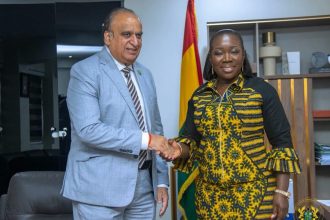
The Ministry disclosed that the Trade Minister held “a series of meetings including stakeholder engagements” to reassure exporters of government’s commitment to shielding businesses from adverse trade shocks.
The tariff pressures began in April 2025 when the United States introduced a “10% universal tariff,” effective April 5, 2025, on imports from all countries, including Ghana. The situation worsened on August 7, 2025, when Washington imposed an additional “15% tariff on Ghanaian exports” as part of a broader policy shift aimed at correcting trade imbalances.
Against this backdrop, the Ministry said the one-year AGOA extension offers vital breathing space for exporters whose operations depend heavily on preferential access to the U.S. market.
AGOA, enacted in 2000, remains a central pillar of U.S.–Africa trade relations. The Ministry described it as “a cornerstone of US-Africa trade,” providing duty-free access to the American market for 32 eligible African countries as of the end of 2024.
For Ghana, the agreement continues to support value-added exports. The Ministry noted that “most of the Ghanaian exports to the US market enjoy the duty-free quota-free market access through the AGOA,” describing it as “a non-reciprocal preferential trade agreement between the USA and eligible African countries, including Ghana.”
Beyond bilateral engagement, the Ministry credited broader regional and multilateral cooperation for the outcome. The Minister commended the Ministry of Foreign Affairs, the World Trade Organisation (WTO), and other West African countries for what she termed “their collective effort and unwavering support to attain this feat.”
She also praised Ghanaian exporters for their resilience during a challenging period and urged them to maximise the opportunity created by the extension.
She “further appreciates the exporters for their resilience over the period and encourages them to leverage the Accelerated Export Development Programme to boost Ghana’s exports to the US market.”
While the extension is temporary, the Ministry made clear that it provides a strategic window for Ghana to consolidate its position in the U.S. market, expand export volumes, and strengthen value chains in sectors heavily reliant on AGOA’s duty-free access.
For government, the announcement serves as a signal to businesses that sustained diplomatic engagement can still deliver concrete economic gains, even in an increasingly restrictive global trade environment.