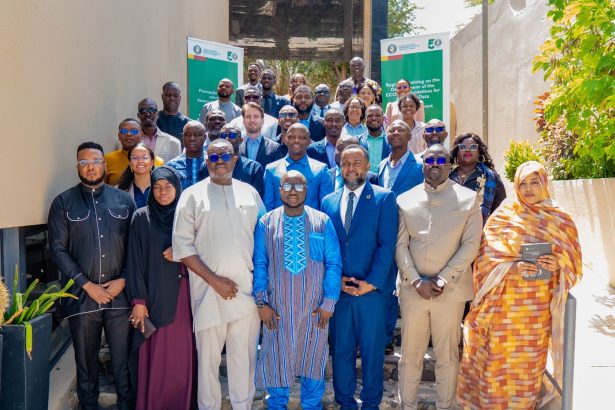
A delegation from the ECOWAS Commission, led by the Commissioner for Political Affairs, Peace and Security, Abdel-Fatau Musah, has visited the Multinational Maritime Coordination Centre (MMCC) Zone E in Cotonou, underscoring both progress and ongoing challenges in regional maritime security efforts.
The working visit, which took place on 13 April 2026, forms part of ECOWAS’s efforts to strengthen cooperation and coordination in securing the Gulf of Guinea, a region long affected by piracy, illegal fishing and other maritime crimes.
The delegation was received by the Director of the Centre, Captain Abdulraheem Tunde Olaniyan, who delivered a detailed operational briefing on the Centre’s activities. He highlighted the strategic role of MMCC Zone E in coordinating maritime security operations among member states within the zone, as well as key achievements recorded in recent years.
Olaniyan noted that enhanced information sharing and joint operational planning among countries in Zone E have contributed to improved surveillance and response to maritime threats.
However, he also pointed to persistent operational constraints, including limited logistical capacity, inadequate assets and challenges in sustaining rapid response mechanisms across the sub-region.
More Read

The visit provided an opportunity for the ECOWAS delegation to assess ongoing operations and engage with officials on ways to address identified gaps in maritime security architecture.
Musah reaffirmed ECOWAS’s commitment to supporting member states in strengthening maritime governance and security, stressing the importance of collective action in tackling transnational threats in the Gulf of Guinea.
The MMCC Zone E is one of several coordination centres established under the ECOWAS Integrated Maritime Strategy to enhance regional cooperation, improve information sharing and facilitate joint responses to maritime insecurity.
Despite recent gains, stakeholders continue to emphasise the need for sustained investment in capacity building, equipment and institutional support to ensure long-term effectiveness of the region’s maritime security framework.