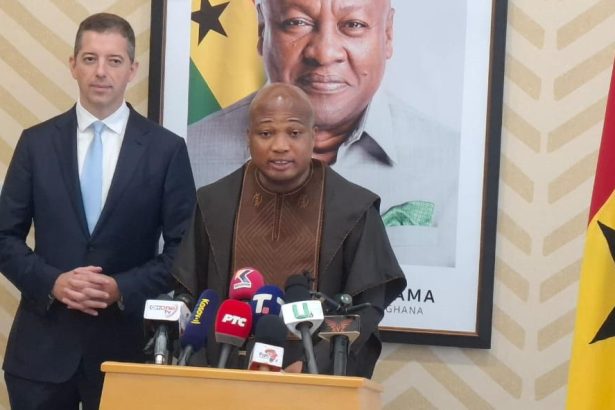
Foreign Affairs Minister Samuel Okudzeto Ablakwa has confirmed that Cabinet has approved Ghana’s participation in a third-country deportation arrangement with the United States, under which Ghana will temporarily accept some West African deportees.
Speaking at the Government Accountability Series on Monday, 15 September, Mr. Ablakwa explained that the arrangement is a Memorandum of Understanding (MoU) and not a binding treaty.
“Let me emphasise that under this understanding with the United States, Ghana must first independently vet the background of those the U.S. intends to deport, to satisfy ourselves that they do not pose any threat to the security of our country and that they cannot harm our citizens,” he said.
The Minister stressed that strict safeguards are in place to ensure that hardened criminals are not admitted.
“The Mahama administration would never compromise the safety and well-being of Ghanaians,” he added.
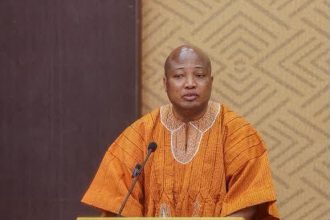
Mr. Ablakwa said the decision was thoroughly discussed by Cabinet and vetted by the Attorney General before receiving approval.
“By established convention, MoUs are not sent to Parliament for ratification. I have inherited hundreds of MoUs from the previous administration, which were not sent to Parliament for ratification. May I assure the nation that if this initial understanding is elevated into a full-blown agreement, we shall not hesitate to comply with Article 75 of the 1992 Constitution by proceeding to Parliament for ratification,” he clarified.
His comments follow concerns raised by the Minority in Parliament, which at the weekend demanded suspension of what it described as an unconstitutional deal.
President John Dramani Mahama earlier confirmed that Ghana had already accepted a limited number of West African nationals deported from the U.S., citing humanitarian considerations and Pan-African values.
“The government of Ghana took the principled and humanitarian decision to accept the limited number of West African nationals deported from the United States under exceptional circumstances, in line with Ghana’s long-standing Pan-African ideals and unwavering commitment to regional solidarity,” President Mahama stated.
He revealed that the first batch of 14 deportees, including Nigerians and Gambians, had arrived in Accra and were later assisted to return to their home countries.
Mr. Ablakwa emphasised that Ghana had not received and would not seek any financial or material benefit for its cooperation.
“Our decision is grounded purely on humanitarian principles and Pan-African solidarity to offer temporary refuge where needed, to prevent further human suffering, and to maintain our credibility as a responsible regional actor. Ghana’s decision must be understood as an act of Pan-African empathy. It is not transactional like Rwanda, Eswatini, Uganda, or South Sudan,” he said.
He added that the arrangement should not be viewed as an endorsement of US immigration policies under President Donald Trump.
“Since the days of our forebears, Ghana has hosted freedom fighters, welcomed Africans in the diaspora, offered them safe haven, resources, citizenship, and even passports. That is why we are seen as the maker of Pan-Africanism. We shall not depart from that inspiring track record,” Mr. Ablakwa said.
On other matters, the Minister highlighted progress under the Operation Retrieve and Account for Lands (ORAL) initiative at the Foreign Affairs Ministry.
He reported that the policy has reclaimed state lands at the Airport Residential Area, halted the illegal sale of diplomatic properties in Lagos and Lusaka, and cancelled improperly awarded contracts, including a $3.5 million renovation deal in Abidjan.
“Every single contract has gone through a competitive, credible process — from passport courier services to cleaning contracts. Competitive procurement is now the mainstay,” he said.
Mr. Ablakwa noted that ORAL had gained international support, pointing to President Mahama’s recent visit to Singapore, where a bilateral framework was agreed to strengthen Ghana’s anti-corruption institutions, including EOCO, CHRAJ, the Office of the Special Prosecutor, and the Police CID.