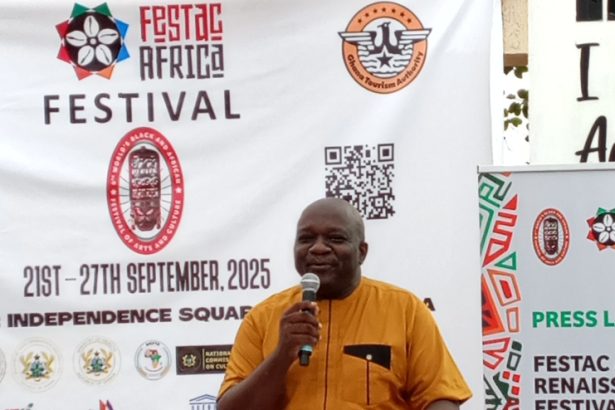
The Chairman of FESTAC Africa, Engr. Yinka Abioye, has called on Africans across the continent and the diaspora to take charge of the continent’s economic future, warning that Africa cannot afford to fall behind in technology, trade and innovation.
Speaking at a press briefing in Accra ahead of the FESTAC Africa Festival 2025, Abioye stated that, “Africa is not the future. Africa is now.”
He said the time had come for African countries to stop waiting for external validation and to build economic links directly with each other.
“We are the ones with the youth, we are the ones with the brain, we are the ones with the minerals,” Abioye told journalists. “If we let this pass us, we’re already falling behind on AI, and AI will push us further back. We must use what we have in our pockets to grow and catch up.”
Abioye criticised the low level of trade between African countries, noting that intra-Africa trade has remained at around 15 percent for decades.
More Read
“When we need to buy things, a broker in Europe is brokering you and me. If you and I talk directly, even if you take fifteen and I take five, the numbers stay in Africa,” he said.
He urged African businesses and creatives to look beyond national borders. “Your audience is not the 30 million people in your country; your audience is 1.2 billion Africans,” he said, challenging filmmakers, musicians and entrepreneurs to think on a continental scale.
While FESTAC Africa 2025 will showcase music, fashion and food, Abioye emphasised that culture is also a serious economic force.
“Our fashion is a power force. Our music, Afrobeats to hiplife must reach the world. We need to do a better job of pushing what belongs to us,” he said.
He encouraged collaboration in the film industry. “Don’t worry about Nollywood’s dominance,” he added. “Work together, leverage one another, and reach the 1.2 billion people across Africa.”
Abioye highlighted the need to empower women and young people, pointing out that women make up more than half of Africa’s population but remain underutilised. He called for stronger action on gender equity, climate issues, health care and trade.
“We need to ride our strengths as high as possible,” he said. “If we fail to act boldly now, we risk being left behind.”
He said FESTAC Africa will include health screenings, youth summits, sports events, technology showcases and business networking sessions, all aimed at increasing intra-African trade and strengthening links between entrepreneurs and investors.
Abioye said the festival is designed to bring the global African diaspora back to the continent. Recalling the first FESTAC event held in Lagos in 1977, which drew participants from more than 70 countries, he stressed the importance of reconnecting Africans worldwide.
“Believe it or not, there are black people in China, in Japan, in Germany, in Turkey people who have been there for hundreds of years and are longing to come back home. This festival is more than an event. It is a movement, a rallying point, a legacy to bring all of them back,” he said.
Abioye described Ghana as the “heart and soul of Africa” and said the country provides the perfect stage for the event. He noted that September is a month of reflection and renewal for Ghana and the continent, framed by 21 September, the birthday of Ghana’s first president, Kwame Nkrumah, and 27 September, World Tourism Day.
“This marks the return of the diaspora to the homeland,” he said. “It embodies Ghana’s place as the heart and soul of Africa. In September, the Black Star will shine brighter than ever.”
The FESTAC Africa Festival 2025 will run from 21 to 27 September at Independence Square in Accra, featuring cultural performances, trade exhibitions, youth and investor summits, sports tournaments and free health screenings.
Abioye concluded with a challenge to Africans everywhere, “Let Ghana be our stage, let Africa be our story, let the world be our audience. Together, let’s write history.”
He said the festival would be “a Pan-African platform that will change lives, spark industries and cement Africa’s legacies for generations.”