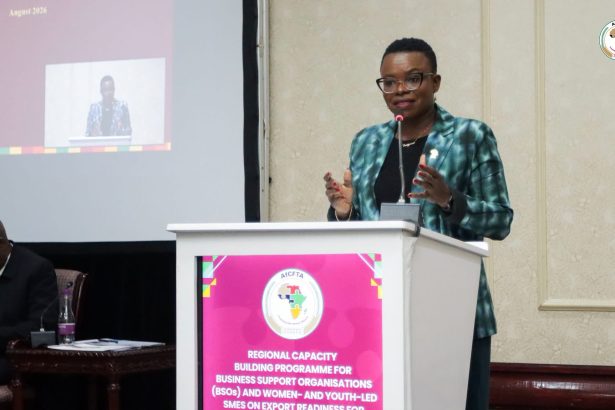
The African Continental Free Trade Area (AfCFTA) Secretariat has called for stronger support systems to help small and medium-sized enterprises (SMEs) move beyond training and successfully participate in intra-African trade.
The Director of Private Sector Engagement and Communications at the AfCFTA Secretariat, Cynthia E. Gnassingbe-Essonam, said training programmes alone would not be enough to make African businesses competitive.
“Training alone is not enough. Businesses need continued access to buyers, market intelligence, finance, logistics providers and commercial partners if they are to succeed beyond the workshop room,” she said.
Ms Gnassingbe-Essonam was speaking at the opening of the AfCFTA SME Booster Initiative – Southern Africa Regional Cohort in Gaborone, Botswana.
She stressed the need to connect SMEs with the resources, markets and partnerships required to scale their operations and take advantage of opportunities created by the AfCFTA.

According to her, the broader objective is to create a pipeline of export-ready African businesses while strengthening Business Support Organisations to facilitate trade across the continent.
She said the success of AfCFTA implementation should ultimately be judged by tangible economic activity rather than policies and frameworks alone.
“AfCFTA implementation must ultimately be measured not only in policies and frameworks, but in businesses trading, partnerships being formed and transactions taking place,” she said.
The SME Booster Initiative is designed to strengthen the capacity of businesses and support organisations to navigate opportunities under the continental free trade agreement.
The Southern Africa regional cohort is being implemented with support from the European Commission, Better Than Cash Alliance, the United Nations Development Programme (UNDP) and the International Trade Centre.
The initiative forms part of broader efforts to increase intra-African trade by ensuring that SMEs, which form a significant part of Africa’s private sector, are equipped not only with knowledge but also with access to the commercial networks and resources needed to trade across borders.
The AfCFTA Secretariat says stronger links between SMEs, buyers, financiers, logistics providers and other commercial partners will be critical to turning the promise of the continental market into actual business transactions.