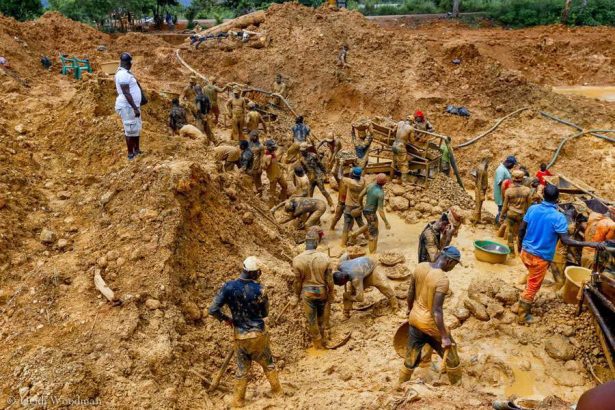
Illegal mining has destroyed about 8,900 hectares of Ghana’s forest reserves, prompting government to tighten regulations on mining equipment, licensing and enforcement as it steps up efforts to curb the environmental crisis.
The figures were disclosed by the Ministry of Lands and Natural Resources during a policy dialogue with the IMANI Centre for Policy and Education in Accra.
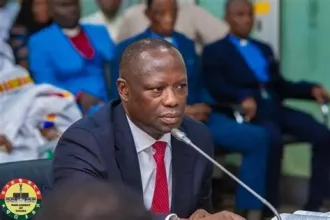
Lands and Natural Resources Minister Emmanuel Armah-Kofi Buah said the degraded forest area is roughly equivalent to 12,500 football pitches, describing the devastation as one of the country’s most pressing environmental challenges.
Displaying images of the affected sites, Buah said, “What you are looking at is not an earthquake. It is a forest reserve.”
The minister disclosed that nine of Ghana’s 288 forest reserves have been severely impacted by illegal mining, making enforcement increasingly difficult for Forestry Commission personnel operating in those areas.
Data presented by the ministry, covering operations up to July 2026, show that 258 people have been arrested in anti-illegal mining operations. Authorities have also seized or immobilised 234 excavators, 2,728 pumping machines, 1,724 changfan machines, as well as 461 motorbikes and tricycles used in illegal mining activities.
Buah said more than 4,000 excavators are currently being held at the country’s ports under a stricter documentation and clearance system intended to prevent heavy equipment from finding its way into illegal mining operations.
Despite the arrests, the minister said successful prosecutions remain a major obstacle in the fight against illegal mining.
“The challenge we are having is not the arrest. It is the prosecution,” he said, adding that the ministry is working with the Attorney-General’s Department to improve the prosecution of suspects.
The government is also preparing reforms to Ghana’s mining licence regime. Under the proposals, the maximum initial duration of large-scale mining leases will be reduced from 30 years to 20 years, while companies holding exploration and prospecting licences will face tougher requirements to prove they are actively developing their concessions.
Buah criticised concession holders who retain mining rights for decades without carrying out exploration or production.
“People are just sitting on concessions for 30, 40 years. They are not doing anything. They are waiting for the next big investor to come so they can cash out,” he said.
As part of broader enforcement measures, government has recruited and trained about 2,000 Blue Water Guards to monitor and protect rivers and other water bodies threatened by illegal mining.
While acknowledging reports of misconduct involving some personnel, the minister said the initiative has provided valuable intelligence to support ongoing enforcement operations.
The ministry said its latest measures are intended to tackle illegal mining through stricter control of mining equipment, licensing reforms, stronger enforcement and greater community participation in decisions on mining concessions.