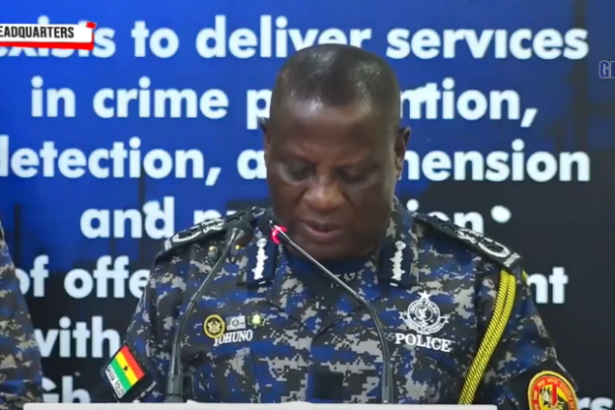
Inspector-General of Police (IGP) Christian Tetteh Yohunu has called on Christian and Muslim leaders to take a stronger stand against religious tensions, warning that their words and actions could determine whether conflict is contained or allowed to spread.
The IGP made the call on Friday, August 14, 2026, when he met religious leaders at the National Police Headquarters as part of efforts to strengthen cooperation between the police and faith communities in protecting Ghana’s peace.
According to Mr Yohunu, religious leaders wield enormous influence over their congregations, particularly young people, and must therefore use their platforms to promote restraint, tolerance and respect for the law.
He warned that Ghana’s peace could easily be undermined if individuals or groups respond to alleged offences through retaliation rather than established legal channels.
“No civilised society can survive when individuals take the law into their own hands,” he said, urging anyone who believes an offence has been committed to report it to the appropriate statutory authorities.
The IGP maintained that protecting religious freedom must go hand in hand with protecting the rights and safety of others.
He said every person has the right to practise their faith without fear of violence, but stressed that freedom of religion and freedom of expression cannot be used as justification for unlawful attacks.
Mr Yohunu also drew attention to the restrictions on speech that incites religious hatred under Article 20 of the International Covenant on Civil and Political Rights (ICCPR).
However, he emphasised that allegations of wrongdoing must still be addressed through due process, insisting that no suspect should be subjected to torture, cruel treatment or assault, whether in state custody or in public.
‘Your words can either be water or petrol’
The IGP placed particular responsibility on religious leaders to prevent inflammatory rhetoric from turning disagreements into violence.
He reminded Christian and Islamic leaders that their followers listen to their sermons, follow their social media activity and closely observe their conduct.
“At this fragile moment, your words can either act as water upon an emerging fire or as petrol upon dying embers,” Mr Yohunu cautioned.
He urged Muslim leaders to dedicate their Friday sermons and Christian leaders their Sunday sermons to messages promoting interfaith harmony, self-control and the dangers of religious conflict.
Beyond their sermons, the IGP asked religious leaders to make the consequences of violence clear to their congregations, stressing that the damage caused by conflict extends far beyond those directly involved.
“Remind your congregations that an attack on the peace of Ghana is an attack on the future of their own children,” he said.
IGP wants Christian-Muslim unity made visible
Mr Yohunu further challenged Christian and Muslim leaders to demonstrate their unity publicly rather than merely speaking about peaceful coexistence.
He called for joint activities, including shared meals, joint statements and public appearances, as a way of showing Ghanaians that religious differences do not have to become sources of division.
“Let the public see Christians and Islamic leaders standing together, sharing meals, issuing joint statements, and walking through our communities hand-in-hand,” he urged.
According to the IGP, such visible cooperation would be particularly important in countering messages that seek to exploit religious differences, especially among young people.
He urged religious leaders to reinforce the message that alleged crimes must be reported to the appropriate institutions and dealt with through the justice system rather than through personal or communal retaliation.
Mr Yohunu’s appeal comes against the backdrop of growing concerns over the ability of inflammatory speech and social media messages to intensify tensions, placing renewed focus on the responsibility of influential religious figures to protect Ghana’s longstanding tradition of peaceful coexistence.