…He disowns responsibility for party’s defeat and chaotic state
As if declaring that, “salvation is personal,” former Vice-President and one-time flagbearer of the New Patriotic Party (NPP), Dr Mahamudu Bawumia, has, in the spirit of the biblical admonitions in Romans and John, appealed to Ghanaians to forgive the party for its mistakes in government.
But in doing so, he notably excluded his former boss, ex-President Nana Addo Dankwa Akufo-Addo, from those he held accountable.
Party insiders suggest President Akufo-Addo himself does not believe he bears responsibility for the NPP’s current state, its loss of the presidency, the reduced parliamentary majority and the party’s declining appeal among voters.
Speaking at Kumasi during a meeting with all constituency executive in the Ashanti Region last week, Dr Bawumia acknowledged that the NPP had failed to deliver on many of its promises during its time in office. Like a “born-again” Christian seeking the kingdom of God, he sought personal forgiveness from the Ghanaian electorate, as well as on behalf of appointees of the former administration.
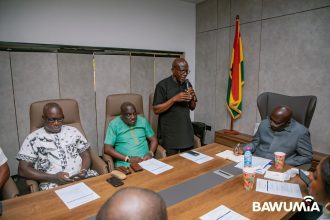
Following the voting and internal party research, “we have identified that the government and party have made mistakes, including in governance. There are things we [NPP] should have done, but never did. In hindsight, there are also things we shouldn’t have done, but did. We are very sorry, Ghanaians should forgive us”, Dr. Bawumia, who is hoping to lead the NPP in the 2028 general election as flagbearer, stated while speaking to delegates in the Ashanti Region.
In his plea, Dr Bawumia named himself, former appointees, including ministers, board chairman, Members of Parliament (MPs) and board members, as those who shared responsibility for the administration’s shortcomings.
However, he carefully avoided mentioning President Akufo-Addo, under whose leadership he served as Vice-President for two terms.
This omission has prompted speculation that Dr Bawumia is deliberately distancing himself from the Akufo-Addo presidency, which has faced heavy criticism over economic mismanagement, corruption allegations and governance lapses.
“On behalf of former appointees, including the Vice-President, ministers, MPs and board members, I admit that we all made mistakes, we wronged you, and for that, I ask for forgiveness. Please, we are sorry. We have truly learned our lessons,” Dr Bawumia stressed, before pledging that, if given another opportunity as flagbearer and eventually President, those errors would not be repeated.
“By God’s grace, if I get the opportunity to lead this party again and become President, what happened will not repeat itself. It won’t happen again, it would happen again, because we have learned our lessons; please forgive us, it won’t happen again”, the ex-Vice President pledged.
While his remarks were intended to rebuild public trust, they have already stirred debate within the NPP and beyond, with critics questioning his conspicuous silence on Akufo-Addo’s role in the party’s failings.
The NPP’s crushing defeat in the 2024 presidential election has been attributed to a combination of economic hardship, governance concerns, internal party fractures and a failure to connect with younger voters, according to post-election analyses.
Foremost among the reasons was the economic crisis that gripped Ghana in the lead-up to the polls. High inflation, spiralling prices of essential goods such as food and fuel, and escalating transport costs placed immense pressure on households.
The depreciation of the cedi further eroded purchasing power, while stubbornly high unemployment, particularly among the youth, fostered widespread discontent. Many felt that the government’s flagship job-creation programmes had failed to deliver meaningful opportunities.
Allegations of mismanagement and corruption also undermined public trust in the NPP administration. Controversies surrounding COVID-19 expenditure, procurement lapses, and the “Presidential Jet” saga reinforced perceptions of poor governance and a political class increasingly disconnected from citizens’ everyday struggles.
The government’s decision to turn to the International Monetary Fund (IMF) for support brought with it painful austerity measures. Tax increases, subsidy cuts and strict fiscal controls were viewed by many as disproportionately hurting vulnerable groups. This deepened resentment among sections of the electorate who felt abandoned in the face of economic hardship.
Within the NPP, discontent also brewed. The party’s delegate system for selecting parliamentary candidates was criticised for marginalising grassroots voices, fostering apathy among the rank and file. Compounding this was the difficulty faced by presidential candidate Dr Bawumia, who, despite attempts to carve his own identity, remained closely associated with outgoing President Akufo-Addo and the administration’s record.
Disillusionment extended to some of the party’s traditional strongholds, notably the Ashanti Region, where voters complained of neglect in infrastructure development.
Poor roads, unmet promises and delays in public service delivery contributed to lower enthusiasm and reduced turnout, eroding the NPP’s margins in areas it once dominated.
The youth vote proved particularly damaging. Policies such as the Electronic Transactions Levy (E-Levy) and taxes on betting winnings were deeply unpopular among young people, who already felt shut out of economic opportunities. Rising inequality and perceptions that government programmes benefitted only a few exacerbated the sense of frustration.
Finally, analysts point to shortcomings in the NPP’s campaign strategy. The party struggled to convince voters of its economic recovery plan, while the opposition National Democratic Congress (NDC) successfully positioned itself as a credible alternative, promising stability and relief from hardship. Internal divisions, delayed ministerial reshuffles and what some critics described as arrogance among government officials further alienated swing voters.
The US$400 million National Cathedral project, which has left a massive hole in the centre of Accra, has also been cited many times as one of the reasons why Akufo-Addo’s chosen successor was rejected.
Taken together, these factors created a perfect storm that swept the NPP out of power in 2024. While economic challenges were the most immediate driver, the party’s defeat reflected a deeper erosion of public trust, one fuelled by governance controversies, weak party cohesion and a failure to capture the aspirations of Ghana’s youth.