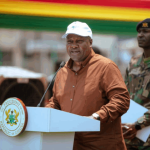
The Minister for Local Government, Chieftaincy and Religious Affairs, Ahmed Ibrahim, has issued a blunt call to action at the launch of the reintroduced National Sanitation Day (NSD), declaring that the government will no longer tolerate the “menace of filth” and its devastating impact on health, infrastructure, and the economy.
Delivering his speech at the relaunch of the National Sanitation Day at the Institute of Local Government Studies in Accra, the Minister said the return of the monthly clean-up exercise represents a renewed social contract between citizens and government, anchored on discipline, accountability, and sustainability.
“We are here to rekindle a national movement with a collective aim at restoring cleanliness, discipline and dignity to our communities, cities and towns. It is a bold declaration that we, as a nation, will no longer tolerate the menace of filth, environmental pollution and disease outbreaks,” he said.
The Minister underscored the grim toll of Ghana’s sanitation failures. He listed outbreaks of cholera, malaria, and typhoid as recurring consequences of poor waste management, indiscriminate dumping, and weak enforcement of sanitation by-laws.
Beyond public health, he warned, unsanitary conditions have fuelled flooding, destroyed infrastructure, diminished tourism, damaged natural resources, and stalled economic progress.
More Read

“Environmental sanitation has long posed a formidable challenge in Ghana. Improper waste disposal, poor drainage management, indiscriminate littering, and weak enforcement of sanitation by-laws have led to grave consequences including outbreaks of cholera, malaria, typhoid and other sanitation-related diseases and even led to unfortunate tragic loss of lives. Beyond the health hazards, flooding, destruction of infrastructure, the decline in tourism potential, damage to our natural resources and economic setbacks cannot be overstated,” he stated.
Ahmed Ibrahim traced the origins of NSD back to September 2014, when then-President Mahama and his Local Government Minister Julius Debrah spearheaded its creation. The campaign initially mobilised communities and assemblies in large numbers, showing the power of collective action.
“The National Sanitation Day, demonstrated that when citizens, assemblies, traditional leaders, and civil society come together, we can make our communities cleaner and healthier. However, as we know, enthusiasm waned over time and the gains were not sustained,
“The re-introduction of the NSD is therefore a renewed social contract between government and citizens, anchored on accountability, enforcement, and sustainability,” he added..
The Minister explained that the new National Sanitation Day is designed to restore discipline and national pride in public spaces, empower local government structures by making sanitation a key performance indicator for Metropolitan, Municipal and District Chief Executives (MMDCEs), and foster citizen participation and accountability through the active involvement of households, communities, civil society, the private sector, and the media.
Like the President earlier announced, the Minister confirmed that NSD will be observed on the first Saturday of every month across all 16 regions and 261 districts. He added that this time, sustainability measures will include a dedicated sanitation hotline for citizens to report nuisances directly to the Ministry, a central dashboard to track complaints and assembly performance, and mandatory monthly sanitation reports from assemblies to Regional Coordinating Councils and the Ministry.
“This initiative emphasizes collaboration, accountability and sustained efforts to tackle the mounting sanitation challenges that confront our nation. environmental sanitation is a shared responsibility that requires consistent and collective action from individuals, households, communities and institutions. It Is therefore important for every Ghanaian to take responsibility for cleaning their environment. The success of the re-introduced National Sanitation Day hinges on the active participation of all and sundry,” he said.
Ibrahim appealed to traditional and religious leaders to use their influence to mobilise their communities, describing them as moral custodians with the ability to inspire change.
He challenged the youth to lead the charge, saying their energy and creativity are essential in driving the change Ghana needs.
The Minister also underlined the role of the media, describing journalists and broadcasters as critical allies in educating the public, exposing sanitation lapses, and celebrating positive community efforts.
In a stern reminder to local authorities, the Minister said MMDCEs and assemblies have “no excuse” but to enforce sanitation by-laws and provide logistics for clean-up. With KPIs now tied to sanitation, poor performers risk being exposed through the new accountability framework.
“As a Ministry, we count on our traditional authorities and religious leaders to impress upon their subjects and followers to actively participate in this all-important national activity. Your leadership in mobilizing communities for sanitation activities will inspire our collective efforts,” he added.