



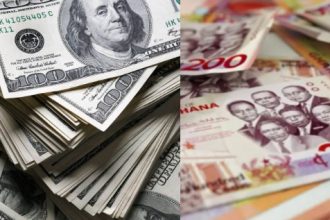
The Ghana cedi, has ramped up in value against the dollar after appreciating by more than 20percent in less than two weeks, but this is yet to be felt in the price of goods and services as witnessed when the local currency was fast depreciating.
A dollar is currently selling between ¢11.50 and ¢12.00 in some forex bureaus and commercial banks, however, even fuel prices determined by National Petroleum Authority (NPA) and Oil Marketing companies, have not seen any decrease.
It is most likely, the excuse of old stock, is holding sway over the cedis’ significant improvement; the longest period this year in the month of December 2022.
The Interbank forex rates from the Bank of Ghana yesterday, December 13, 2022, saw the Ghana Cedi trading against the dollar at a buying price of 11.4943 and a selling price of 11.5058.
As compared to Monday’s trading price of 12.5517 and a selling price of 12.5643. At a forex bureau in Accra, the dollar is being bought at a rate of 12.10 and sold at a rate of 13.15.
Against the Pound Sterling, the Cedi is trading at a buying price of 14.1264 and a selling price of 14.1417 as compared to Friday’s trading of a buying price of 15.3872 and a selling price of 15.4038.
At a forex bureau in Accra, the pound sterling is being bought at a rate of 14.80 and sold at a rate of 16.30.
The Euro is trading at a buying price of 12.1319 and a selling price of 12.1440 as compared to yesterday’s trading of a buying price of 13.2192 and a selling price of 13.2324.
At a forex bureau in Accra, Euro is being bought at a rate of 12.70 and sold at a rate of 13.60.
The South African Rand is trading at a buying price of 0.6540 and a selling price of 0.6546 as compared to yesterday’s trading of a buying price of 0.7234 and a selling price of 0.7241.
At a forex bureau in Accra, South African Rand is being bought at a rate of 0.45 and sold at a rate of 0.90.
The Nigerian Naira is trading at a buying price of 38.5774 and a selling price of 38.7487, as compared to yesterday’s trading at a buying price of 35.3767 and a selling price of 35.4993.
At a forex bureau in Accra, Nigerian Naira is being bought at a rate of 15.00 Naira for every 1 Cedi and sold at a rate of 19.00.
The cedi slumped by more than 54percent against the dollar this year. However, it has strengthened by more than 20percent since the start of December after Finance Minister, Ken Ofori-Atta, disclosed the government’s domestic debt exchange programme, followed by the latest IMF visit and the announcement of the Fund’s staff-level agreement of a bailout package worth some $3 billion.
After more than four months of negotiations, Ghana finally sealed a $3 billion programme with the Bretton Wood institution, pending the approval of its Executive Board.
According to Stéphane Roudet, Mission Chief for Ghana, his team “reached staff-level agreement with the Ghanaian authorities on a three-year programme supported by an arrangement under the Extended Credit Facility (ECF) in the amount of SDR 2.242 billion or about $3 billion”.
“The economic programme aims to restore macroeconomic stability and debt sustainability while laying the foundation for stronger and more inclusive growth. The staff-level agreement is subject to IMF Management and Executive Board approval and receipt of the necessary financing assurances by Ghana’s partners and creditors.”
What is an Extended Credit Facility (EFC)?
The Extended Credit Facility (ECF) provides financial assistance to countries with protracted balance of payments problems. The ECF was created under the Poverty Reduction and Growth Trust (PRGT) as part of a broader reform to make the Fund’s financial support more flexible and better tailored to the diverse needs of low-income countries (LICs), including in times of crisis. The ECF is the Fund’s main tool for providing medium-term support to LICs.
Purpose. The ECF supports countries’ economic programs aimed at moving toward a stable and sustainable macroeconomic position consistent with strong and durable poverty reduction and growth. The ECF may also help catalyze additional foreign aid.
Eligibility. The ECF is available to all PRGT-eligible member countries that face a protracted balance of payments problem, i.e. when the resolution of the underlying macroeconomic imbalances would be expected to extend over the medium or longer term.
Duration and repeated use. Assistance under an ECF arrangement is provided for an initial duration from three to up to five years, with an overall maximum duration of five years. Following the expiration, cancellation, or termination of an ECF arrangement, additional ECF arrangements may be approved.
Access. Access to ECF financing is determined on a case-by-case basis, taking into account the country’s balance of payments need, the strength of its economic program and capacity to repay the Fund, the amount of outstanding Fund credit and the member’s record of past use of Fund credit, and is guided by access norms. The IMF’s Executive Board approved new access limits and norms in July 2021 as part of the Fund’s review of concessional financing and policies. Normal access to concessional financing under the PRGT is now limited to 145 percent of quota per year, and total outstanding concessional credit to 435 percent of quota. These limits can be exceeded in exceptional circumstances, with no hard caps on annual or cumulative access, provided the PRGT exceptional access criteria are satisfied.
Focused conditionality
Under the ECF, member countries agree to implement a set of policies that will help them make progress toward a stable and sustainable macroeconomic position over the medium term. These commitments, including specific conditions, are described in the country’s letter of intent.
The IMF’s program conditionality should be parsimonious and focused on policy actions that are critical to achieving the program’s objectives. ECF-supported programs should be aligned with the country’s own development strategy and aim to advance the country’s poverty reduction and growth objectives. The development strategy should be laid out in a Poverty Reduction and Growth Strategy document.
Quantitative conditions are used to monitor macroeconomic policy variables such as monetary aggregates, international reserves, fiscal balances, and external borrowing, reflecting the country’s program objectives. ECF-supported programs aim to safeguard social and other priority spending, including through explicit quantitative targets where possible.
Structural benchmarks help monitor macro-critical reforms to achieve program goals. These benchmarks vary across programs but could, for example, include measures to improve financial sector operations, build up social safety nets, or strengthen public financial management.
Program reviews by the Board play a critical role in assessing performance under the program and allowing the program to adapt to economic developments. Progress of the program, in particular against quantitative conditions and structural benchmarks, is assessed in the context of reviews. Reviews are scheduled at most six months
apart.
Poverty Reduction and Growth Strategy (PRGS). For the ECF (as well as SCF arrangements and Policy Support Instruments-with initial durations of more than two years), a PRGS is required to be issued to the Board for completion of the second and subsequent reviews. In cases where the country has limited institutional capacity that prevents meeting the PRGS requirements by the second ECF review, such as in cases of fragility, the country may request Board approval of an extension. The PRGS describes countries’ macroeconomic, structural, and social policies in support of growth and poverty reduction, as well as associated external financing needs and major sources of financing.
Highly concessional lending terms
Financing under the ECF carries a zero interest rate with a grace period of 5½ years, and a final maturity of 10 years. The Fund reviews the level of interest rates for concessional facilities under the PRGT every two years based on the PRGT interest rate mechanism, with the next review expected to be completed no later than end-July 2023.
After more than four months of negotiations, Ghana finally sealed a $3 billion programme with the Bretton Wood institution, pending the approval of its Executive Board.
According to Stéphane Roudet, Mission Chief for Ghana, his team “reached staff-level agreement with the Ghanaian authorities on a three-year program supported by an arrangement under the Extended Credit Facility (ECF) in the amount of SDR 2.242 billion or about $3 billion”.
“The economic programme aims to restore macroeconomic stability and debt sustainability while laying the foundation for stronger and more inclusive growth. The staff-level agreement is subject to IMF Management and Executive Board approval and receipt of the necessary financing assurances by Ghana’s partners and creditors.”






