Every day in Ghana, about eight women lose their lives while trying to give life. That means, on average, one woman dies every three hours from pregnancy or childbirth-related complications.
Over the past decade, the country has been reducing maternal deaths by about 2.9 per cent each year. Preliminary figures show that nearly 900 women died between January and November 2025 alone. In a full year, maternal deaths are estimated at around 2,766.
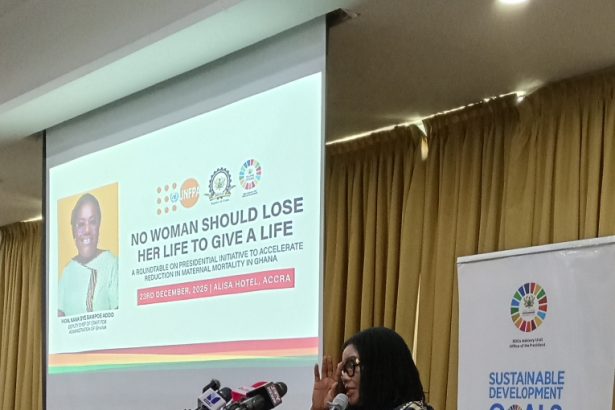
These figures were highlighted at a High-Level Dialogue on Maternal Mortality Reduction in Ghana, organised by the SDGs Advisory Unit at the Office of the President, together with the United Nations Population Fund (UNFPA) and the National Development Planning Commission (NDPC).
The roundtable, held on Tuesday, 23 December 2025 at the Alisa Hotel in Accra, was under the theme: “No Woman Should Lose Her Life To Give Life.”
Speaking at the event, the Minister for Gender, Children and Social Protection, Agnes Naa Momo Lartey, said maternal deaths should not be seen as just a health issue.
More Read

According to her, women are dying not only because of medical problems, but because of social and systemic failures that continue to affect especially poor and rural communities.
“Women are dying not only from medical complications but from delayed decision-making at household level, poverty, weak emergency transport and referral systems, harmful cultural practices and the silencing of women’s voices, particularly in rural and hard-to-reach communities,” she said.
At the moment, Ghana’s maternal mortality ratio stands at 301 deaths per 100,000 live births. This is only a slight improvement from 316 deaths recorded in 2010.
Mrs. Lartey explained that when a mother dies, the damage goes far beyond the hospital ward. Children are more likely to suffer malnutrition, drop out of school or grow up without proper care. Families sink deeper into poverty, and communities lose people who play vital roles as caregivers, workers and leaders.
“When a woman dies in childbirth, the consequences extend far beyond the delivery room. Ultimately, the nation bears the cost,” the minister added.
Mrs. Lartey stated that Ghana’s high antenatal attendance, about 88 per cent and facility-based deliveries over 86 per cent, should normally translate into fewer deaths. Yet, women continue to die because critical systems are failing when emergencies occur.
However, to meet the 2030 Sustainable Development Goal (SDG) target, Ghana would need to reduce maternal deaths by 16.7 per cent every year — more than five times faster than the current rate.
She pointed to delays in getting women to health facilities, shortages of blood for transfusions, poor supply of essential medicines, limited psychosocial support, and weak enforcement of maternal and newborn death review systems.
This worrying reality puts Ghana at serious risk of missing the global target of reducing maternal deaths to 70 per 100,000 live births by 2030, even though most pregnant women attend antenatal clinics and give birth in health facilities.
To address these gaps, the minister said her ministry will focus on working closely with communities, changing harmful social behaviours, encouraging men to take responsibility for maternal health decisions, and strengthening social protection programmes like the Livelihood Empowerment Against Poverty (LEAP) scheme to help families afford emergency care and transport.
She called on traditional and religious leaders, families, men, local authorities, civil society organisations, the media, development partners and the private sector to all play their part.
“Saving women’s lives is not charity. It is justice. When women survive childbirth, families thrive, communities prosper, and the nation grows,” she said.
Also speaking at the dialogue, UNFPA Country Representative Wilfred Ochan described maternal deaths in Ghana as something the country already knows how to prevent.
“This is not an invisible problem because it is rare. It is invisible because the deaths are scattered and silent,” he said.
He explained that many women die within minutes when complications arise, especially when help does not arrive on time.
“A woman can bleed to death in 20 minutes. Without transport, blood or supplies, that golden hour is lost,” Mr. Ochan said.
According to him, health workers across the country understand what needs to be done to save women’s lives, but they are held back by weak systems and lack of basic resources.
“We are failing to provide the basic interventions that are already known and requested by Ghanaian health workers,” he said.
Mr. Ochan called for strong political leadership and faster action, including support for the Presidential Initiative on Maternal Emergency Response, to improve coordination and accountability across sectors.
He also stressed the need for sustainable funding, proposing the creation of a maternal health trust fund and better procurement systems to ensure hospitals always have essential maternal health supplies.
Warning against treating the situation as routine, he said maternal deaths must be handled with urgency.
“This is a long-term development issue, but it is also an ongoing emergency unfolding every day in delivery wards and rural communities,” he said.
He urged government, development partners and all stakeholders to invest in better data, stronger maternal death surveillance systems and practical solutions that ensure every woman survives childbirth.