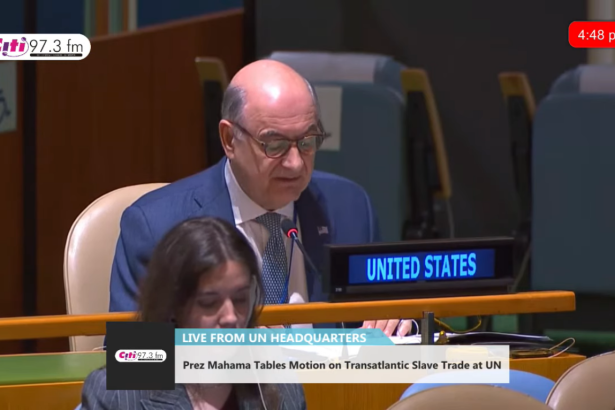
The United States has taken a swipe at President John Dramani Mahama’s push for slavery reparations at the United Nations, rejecting a motion championed by Ghana and describing it as politically motivated and legally flawed.
Explaining its decision to vote against the resolution at the UN General Assembly, Jonathan Shrier said the proposal raises serious concerns about how historical injustices are framed and prioritised.
He warned that the motion risks trivialising other global atrocities by creating what he suggested could be a hierarchy of suffering.
According to the US representative, attempts to single out particular historical crimes in a way that appears to elevate them above others could undermine the broader understanding of human rights violations across history.
The United States also challenged the historical basis of the resolution, arguing that the timeline referenced in the document was selective and politically driven.
Shrier maintained that the transatlantic slave trade did not neatly fit within the period outlined in the motion, insisting that the trafficking of Africans began earlier and extended beyond the dates captured in the resolution.
He said such framing distorts historical reality and weakens the legal grounding of the proposal.
Despite its strong opposition, the US reiterated its longstanding condemnation of slavery and acknowledged it as a grave historical injustice.
However, Washington insisted that the resolution in its current form is deeply problematic and cannot be supported.
The US further cautioned against what it described as attempts to use the United Nations platform to advance narrow agendas, urging the global body to remain focused on its core mandate rather than expanding into politically sensitive initiatives.