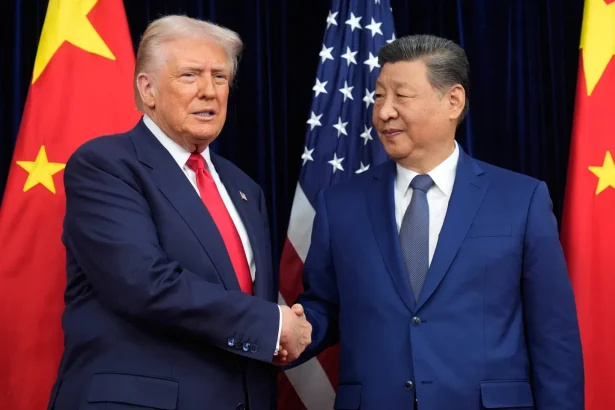
United States President Donald Trump arrived in Beijing on Wednesday evening, stepping off Air Force One to a ceremonial red-carpet welcome ahead of a closely watched summit with Chinese President Xi Jinping.
The two-day visit is expected to centre on escalating trade disputes, global technology competition, the war in Iran, and Washington’s increasingly complex relationship with Taiwan, as tensions between the world’s two largest economies continue to shape global markets.
Trump’s arrival marks his return to a more assertive China compared to his 2017 visit, with analysts noting a shift in the balance of geopolitical influence as Beijing strengthens its global economic and technological position.
The trip, initially scheduled for March, was postponed following the US and Israel’s military engagement in Iran, a conflict that has contributed to ongoing instability in global energy markets and supply chains.
He was received by Chinese Vice-President Han Zheng on the red carpet, a gesture interpreted by observers as a sign of diplomatic recognition and respect for the US president, contrasting with a lower-level reception during his previous visit.
More Read
A military brass band and flag-waving ceremonial guards lined the arrival area, chanting welcome messages as Trump acknowledged the reception with his signature fist pump.
The US president was accompanied by his son, Eric Trump, alongside a number of prominent American business leaders, including Tesla CEO Elon Musk and Nvidia chief executive Jensen Huang.
Other top executives expected to participate in discussions include Apple’s Tim Cook, BlackRock’s Larry Fink, and Boeing’s Kelly Ortberg, underscoring the commercial weight attached to the diplomatic visit.
Ahead of his arrival, Trump signalled that opening up China’s markets to American firms would be his primary objective in talks with Xi Jinping.
“I will be asking President Xi, a Leader of extraordinary distinction, to ‘open up’ China so that these brilliant people can work their magic, and help bring the People’s Republic to an even higher level,” he said in a social media post.
He added that market access would be his “very first request” during the meeting, as Washington continues to push for improved trade conditions for US companies operating in China.
Trade relations between the two countries have weakened in recent years amid tariff escalations and regulatory restrictions affecting technology and manufacturing sectors.
Bilateral trade stood at $414.7 billion last year, a significant drop from $690.4 billion recorded in 2022, reflecting the impact of ongoing economic tensions.
The United States continues to grapple with a widening trade deficit with China, importing more than $200 billion worth of goods than it exported last year.
At the same time, China is positioning itself as a dominant player in the global artificial intelligence race, increasing demand for advanced US semiconductor technology while facing tighter export restrictions from Washington.
Beijing, however, retains leverage in critical supply chains, particularly rare earth minerals, which are essential for high-tech manufacturing and have previously been used as a pressure tool in trade disputes.
As negotiations approach, Washington is expected to push for increased Chinese purchases of American agricultural products, while Beijing is likely to demand relief from US tariffs on Chinese exports.
The outcome of the summit is expected to have significant implications for global trade stability, technology flows, and geopolitical alignment in an increasingly fragmented international system.