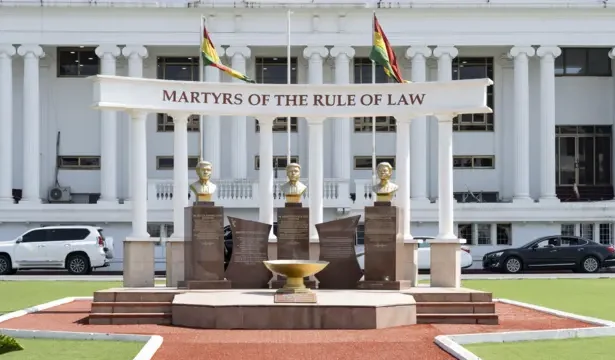
The Supreme Court has granted an application allowing 14 Civil Society Organisations (CSOs) to join proceedings in a constitutional case challenging the legal foundation and structure of the Office of the Special Prosecutor (OSP).
The decision was taken by a seven-member panel of the apex court, presided over by Chief Justice Paul Baffoe-Bonnie, after the organisations successfully applied to be heard as interested parties in the matter.
The case, Adamtey v Attorney-General, raises constitutional questions about whether the establishment, powers and operational framework of the OSP comply with the 1992 Constitution.
The Office of the Special Prosecutor, created under the Office of the Special Prosecutor Act, 2017 (Act 959), was designed as an independent anti-corruption body mandated to investigate and prosecute corruption and corruption-related offences, particularly within public institutions and among politically exposed persons.
Arguing for the applicants, counsel Kizito Beyuo told the court that the CSOs possess relevant technical knowledge and long-standing experience in governance, accountability and anti-corruption advocacy, which would assist the court in determining the issues before it.
More Read
He contended that their participation would strengthen the court’s understanding of the broader public governance implications of the case.
The organisations admitted to the proceedings include CDD-Ghana, Transparency International Ghana, Ghana Anti-Corruption Coalition, IMANI Africa, Democracy Hub, STAR-Ghana Foundation, NORSAAC, Penplusbytes, Africa Centre for Energy Policy (ACEP), Odekro, A Rocha Ghana, Parliamentary Network Africa, One Ghana Movement and Africa Education Watch.
Counsel for the applicants further argued that the CSOs have, over the years, been actively involved in shaping transparency and anti-corruption reforms, making their input relevant in a matter of significant national importance.
The court’s ruling effectively expands the scope of the case, introducing stronger civil society participation into proceedings that many observers say could redefine the future of Ghana’s anti-corruption architecture.
The outcome of the case is expected to have major implications for the mandate, independence and operational direction of the Office of the Special Prosecutor.