
By Dr Mohammed Ibn Mukhtar
Introduction
- Inserting the Government Position Paper (28 July 2026, Dr. Dominic Akuritinga Ayine) document responding to the Constitutional Review Committee’s [CRC’s] Transforming Ghana report into the 1992 Constitution of Ghana creates Ghana’s next long term vision document – the proposed constitution of Ghana. From the Mills’ government to date, this review exercise has demonstrated a lot of inertia and apathy. At this opportune period, critical and systematic exercise is, therefore, a necessity, especially for semantics. A constitutional language must have two parts, namely, soft and hard. The proposed Constitution of Ghana has been scanned for some nine [9] critical terms and their usage or context. This paper shares the documentary analysis and findings for attention and further action.
Constitutional Semantics
- In constitutional semantics, the “hard” part refers to the fixed, textual meaning of constitutional provisions, while the “soft” part refers to the flexible, evolving interpretation shaped by context, precedent, and societal values. Together, they balance stability with adaptability in constitutional law. Semantically, the 9 critical words studied here are listed as “Independent/Independence”, “Impartial”, “Management/Manage”, “Governance”, “Secular” and “Neutral/Neutrality”. For example, secularism is a well-known practice in Ghana but finds no room in the constitution.
- Here’s the recap of the word occurrences and page references of the 1992 Constitution of Ghana, table 1:
Table 1. Word occurrences and page references
| Word | Count | Pages (Examples) | Context |
| Independent | 12 | Pages 21, 45–46, 67–68, 72–73, 75, 77–78, 80–81, 83–84, 86–87, 89–90, 92–93 | Judiciary, Electoral Commission, CHRAJ, NCCE, Lands Commission, Media Commission |
| Independence | 4 | Pages 67, 72, 73, 75 | Judiciary & Media autonomy |
| Impartial | 1 | Page 21 | Article 19(13): fair trial clause |
| Management | 6 | Pages 83–88 | Lands Commission duties (“management of public/stool lands”) |
| Manage | 2 | Pages 84, 87 | Articles 258(1)(a), 267(2) |
| Governance | 3 | Pages 3, 5, 7 | Preamble & Directive Principles (“democratic governance,” “good governance”) |
| Secular | 0 | — | Not used |
| Neutral | 0 | — | Not used |
| Neutrality | 0 | — | Not used |
From table 1, a) the counts it clear that the Constitution emphasizes independence and management (although very narrowly), avoids “secular” and “neutrality,” and uses “governance” sparingly in conceptual framing. Government Position Paper (28 July 2026, Dr. Dominic Akuritinga Ayine) — This is a newer document responding to the CRC’s Transforming Ghana report.
4. The Keyword Occurrences in the Government Position Paper (2026)
The Constitution emphasizes “independence” and “management,” while the Position Paper uses governance-related terms more frequently and both avoid “secular” and or “neutrality.” Below is a structured comparison. Based on the retrieved text of the Position Paper and press briefing the following were compiled in table 2:

Table 2: Government Position Paper (2026)
| Word | Count | Pages/Sections (Examples) | Context |
| Independent | 5 | Sections on Electoral Commission, Judiciary | Government affirms but sometimes qualifies independence of institutions |
| Independence | 3 | Presidency & Judiciary sections | Used in relation to separation of powers |
| Impartial | 2 | CRC methodology & judiciary | Stress on impartiality in dispute resolution |
| Management | 4 | Public finance & land administration | Government response to CRC proposals |
| Manage | 1 | Land/resource management | Administrative duties |
| Governance | 9 | Intro, methodology, recommendations | Strong emphasis on “good governance” and “developmental governance” |
| Secular | 0 | — | Not used |
| Neutral | 0 | — | Not used |
| Neutrality | 1 | Section on security services | Reference to neutrality of armed forces |
Key Insights from tabulations are listed below.
- Constitution (1992): Anchors independence of commissions and judiciary; “management” is tied to land administration; governance is mentioned sparingly.
- Government Position Paper (2026): Shifts emphasis toward governance and developmental democracy; acknowledges independence but frames it within executive oversight; introduces neutrality once in relation to security forces.
- Absent Terms: Both documents avoid “secular” and “neutral” in broader constitutional discourse.
Side‑by‑side Thematic Analysis of 1992 Constitution & Government Position Paper 2026
- Addressing the issue in the form of a side‑by‑side thematic analysis (how each document frames “independence,” “governance,” and “neutrality”), or keep it strictly at the quantitative scan level goes beyond raw counts to show how the Constitution and the Government Position Paper frame the same concepts differently as follows.
- Independence & Impartiality
- 1992 Constitution:
- Strongly entrenches independence of commissions (Electoral Commission, CHRAJ, NCCE, Media Commission).
- Judicial independence is emphasized as a safeguard for impartial justice.
- “Impartial” appears once, tied to fair trial rights.
Government Position Paper (2026):
- Affirms independence but often qualifies it with executive oversight or accountability.
- Uses “impartial” in relation to both CRC methodology and judicial dispute resolution, showing a broader application.
- Independence is framed as necessary but not absolute – balanced against efficiency and governance.
- Governance
- 1992 Constitution:
- Mentions governance sparingly, mostly in the Preamble and Directive Principles.
- Framed as “democratic governance” and “good governance” in aspirational terms.
- Government Position Paper (2026):
- Governance is central—appears nine times.
- Framed as developmental governance, shifting from electoral democracy to developmental democracy.
- Positions governance as the bridge between constitutional ideals and practical socio‑economic transformation.
- Management & Administration
- 1992 Constitution:
- “Management” and “manage” are tied almost exclusively to land administration (Lands Commission, stool lands).
- Government Position Paper (2026):
- Extends “management” to public finance, resources, and administration.
- Reflects a broader scope of state responsibility beyond land.
- Neutrality
- 1992 Constitution:
- No mention of “neutral” or “neutrality.”
- Government Position Paper (2026):
- Introduces “neutrality” once, in relation to security services.
- Suggests an evolving concern with institutional neutrality, especially in politically sensitive areas.
- Secularism
- Both documents avoid the word “secular.”
- The Constitution implicitly guarantees freedom of religion but does not frame Ghana as a secular state.
- The Position Paper maintains this silence, focusing instead on governance and institutional independence.
- Big Picture
- Constitution (1992): Anchors independence and impartiality as constitutional safeguards; governance is aspirational.
- Position Paper (2026): Reframes governance as developmental, independence as conditional, and introduces neutrality in security contexts.
Now, visualize this comparison in a matrix or organogram style chart as in chart 1, 1992 Constitution vs. Position Paper across themes discussed earlier.
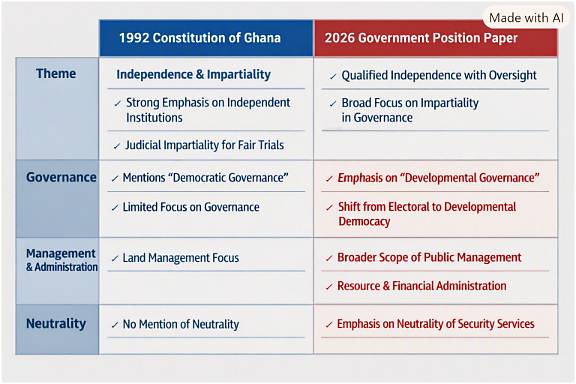
Chart 1: 1992 Constitution vs. Position Paper 2026
This visualization matrix comparison lays out the 1992 Constitution of Ghana against the 2026 Government Position Paper across the four themes discussed: Independence & Impartiality, Governance, Management & Administration, and Neutrality. This gives a clear side‑by‑side snapshot capturing the essence of both documents beautifully as while:
- Blue column → Constitution’s emphasis on entrenched independence and land management.
- Red column → Position Paper’s focus on developmental governance, qualified independence, and neutrality in security services.
From the top row, Independence & Impartiality show how Ghana’s constitutional philosophy evolved from entrenched autonomy to conditional independence. While Governance shift from democratic ideals to developmental pragmatism, Neutrality introduces a modern concern for institutional balance, especially in security contexts. This matrix works perfectly as a briefing chart—clear, structured, and visually balanced.
- Narrative Summary
The comparative matrix illustrates Ghana’s constitutional evolution from institutional independence to developmental governance. The 1992 Constitution entrenched autonomy for commissions and the judiciary, emphasizing impartiality and land management as pillars of democratic stability. In contrast, the 2026 Government Position Paper reframes these principles within a pragmatic governance model that balances independence with oversight and expands management to include public finance and administrative efficiency. From whichever modelling one views the analysis and synthesis of the data semantic vacuum pops up with deficit in the soft aspects as found in contextual usages especially in the 1992 Constitution.
Again, while the Constitution remains silent on neutrality, the Position Paper introduces it in the context of security services, signaling a modern concern for institutional balance. More importantly, both documents avoid explicit secular framing, maintaining Ghana’s pluralistic yet non‑secular constitutional identity. Yet colloquially, Ghana is viewed as such. In addition, civil servants receive neutrality allowance as a protection against politicisation. Together, the documents mark a shift from foundational independence to functional governance, reflecting Ghana’s journey from electoral democracy toward a developmental state as themed by the CRC.
Conclusion
7) From the above documentary analysis and synthesis of this 9-words study of the proposed constitution of Ghana, it is conclusive to hold that critical semantic challenges exist such as from nought [secular, neutrality] through marginal [Governance found in preamble and not in the chapters], to narrow [management in chapters] usages that calls for thorough relook to enhance the evolving and developmental soft issues.
About the author
Dr Mohammed Ibn Mukhtar is a Public Management & Policy Expert and Former Lecturer, Methodist University Ghana Accra
He can be reached via email: ibnmukta@gmail.com