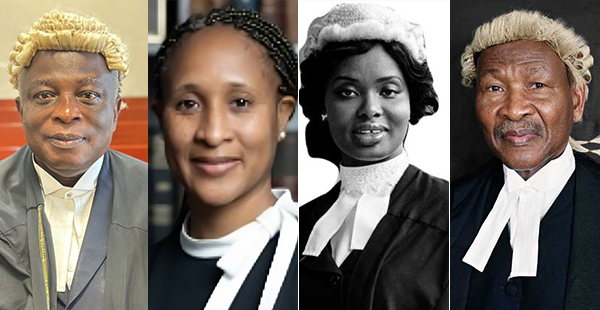
The Court of Appeal has granted an application for a stay of proceedings in the case involving Peter Kweku Okudzeto and Sam Okudzeto, the law firm of Sam Okudzeto and Associate, Sam’s daughter, Esine Okudzeto, Eric Akwetey-Siaw Sappor and Charles Norble Doe Acolatse.
The ruling was delivered on Tuesday, 10 February 2025, when the court, sitting in Accra, upheld a motion to file additional grounds challenging Justice Akosua Dansoa Asiama Christopher’s decision to strike out Sam Okudzeto and the two others from the high-profile family property feud.
The vast estates are located in prime areas across the country, especially in Accra, including the imposing NCR Building on Kwame Nkrumah Avenue. This particular building, according to Peter and his direct siblings, was unduly devalued to the extent that the state would lose revenue.
Peter disagrees with the court’s decision to strike out Sam Okudzeto, 90, who is his half-brother, his law firm, as well as his daughter Esine, from the lawsuit in which he insisted they are answerable to the allegations of forgery and fraud committed in an attempt to seize properties belonging to his (Sam) late stepmother, Christina Aku Siaw Sappor; a woman to whom he had no blood relation.
Peter insists that Sam, with whom he shares the same father, has no blood relationship with the late Baby Angelina Mamle Siaw Sappor, the original owner of the properties, or with Christiana. Neither is he related to Dr Daniel Narh Siaw, their deceased brother.
More Read
Charles Norble Doe Acolatse, the fifth defendant, also has no relationship with Christina, Daniel, or Baby Angelina Mamle and is not recognised as a beneficiary of their estate.
The Court of Appeal panel was presided over by Justice Emmanuel Ankamah, with Justices Barima Yaw Kordie Oppong and Mariam Sammo sitting as members.
Peter argued that the activities of the former Council of State Member and the two other defendants constituted unlawful interference with the estate of Baby Angelina Mamle Siaw Sappor, an aunt of Peter, whom his mother, Christiana, partly inherited.
While Peter was present in court, Sam, Esine and their law firm were absent.
Peter insists that extensive facts have been pleaded connecting the 1st, 2nd, and 3rd respondents, in their personal capacities, directly to the alleged acts of fraud to which they must answer.
Andreas Fiadorme of Kpatsa & Associates, who was assisted by Eli Ahu, appeared on behalf of Peter.
The Court of Appeal noted that although Sam Okudzeto and the three others had been duly served, they had failed to file any affidavit in opposition to the motion for a stay of proceedings.
In its ruling, the court stated that it had examined the pleadings and the earlier decision striking out the names of the first to third defendants on the grounds that they were not proper persons to be sued.
The panel further held that, as no affidavit in opposition had been filed by the respondents, they were deemed to have admitted the averments contained in the applicant’s affidavit in support of the motion. Accordingly, the court granted the application for a stay of proceedings as prayed to enable him file a Supplementary Affidavit.
“We have read the pleadings and the ruling of the Court striking out names of the 1st-3rd Defendants as not being proper persons to be sued The Respondent not filing any affidavit in opposition to this motion, they are deemed to have admitted the averments contained in the affidavit in support of the motion on notice for stay of proceedings Accordingly, the application for stay of proceedings is granted as prayed”.
Peter, deemed the Supplementary Affidavit as “imperatively necessary to specifically respond to certain matters raised in the Ruling and to provide this Honourable Court with a comprehensive, definitive exposition of the compelling legal grounds warranting the grant of a Stay of Proceedings pending appeal”.
“That this Supplementary Affidavit is necessitated to provide this Honourable Court with a definitive legal and factual demonstration that the Ruling of Her Ladyship Justice Akosua Dansoa Asiama Christopher delivered on 18 November 2025 (herein: “The Ruling”) is infected with structural errors of law that necessitate the immediate intervention of this Honourable Court by way of Staying Proceedings pending Appeal”.
Peter, a lawyer residing at Community 18, Lashibi, near Tema, filed a supplementary affidavit in support of his application for a stay of proceedings pending the determination of an appeal against the High Court ruling striking out the three defendants from the estate dispute.
Peter had stated that on the 25th day of November, 2025, he duly filed a Notice of Appeal against the Ruling of the High Court, presided by Justice Christopher, and followed this with a Motion on Notice for Stay of Proceedings pending the final determination of the said Appeal.
He disclosed that at the material time of filing these processes, he had not yet been formally furnished with the Certified True Copy of the Ruling of Justice Christopher delivered on November 18, 2025, that struck out Sam Okudzeto and other respondents from the suit.
After receiving the certified copy, Peter stated that he deemed it necessary to submit a supplementary affidavit to address issues raised in the decision and to provide what he describes as a comprehensive explanation of the legal grounds justifying a stay.
Peter contends that Justice Christopher’s ruling is “infected with structural errors of law” requiring the intervention of the Court of Appeal.
He argues that the trial judge erred in law and procedure by determining the necessity of Sam Okudzeto, Sam Okudzeto and Associates and Esine Okudzeto solely on the basis of conflicting affidavit evidence, rather than recognising their indispensable joinder for the complete and effectual determination of the dispute.
He further maintains that the judge wrongly relied on Order 66 Rule 32 of C.I. 47 to classify the matter as a purely probate action, thereby concluding that only the administrators of the estate, Eric Akwetey Siaw Sapppor and Charles Noble Doe Acolatse, the 4th and 5th defendants, were proper parties.
According to Peter, the suit goes beyond administrative probate issues and is grounded in alleged acts of fraud and conspiracy said to have been perpetrated by the 1st, 2nd and 3rd Defendants, whose conduct forms the factual basis for the principal relief of revocation.
The applicant asserts that the three defendants are principal actors rather than ancillary parties and that their presence is necessary to ensure that any final judgment binds all alleged perpetrators.
He also argues that binding decisions of the Supreme Court of Ghana, which confirm the legal standing of beneficiaries to sue or be sued in respect of an estate, were cited to the trial judge but not applied.
Mr Okudzeto further contends that the trial judge committed a jurisdictional error by attempting to determine the necessity of the parties through what he describes as a premature evaluation of disputed fraud allegations based solely on interlocutory affidavit evidence.
He argues that questions of conspiracy and mala fides should be determined only after a full trial, with oral evidence and cross-examination.
On the issue of remedies, he maintains that a subpoena would be inadequate to secure the relief sought against Sam Okudzeto and his law firm, the 1st and 2nd Defendants, including a perpetual injunction and an order for the surrender of documents.
He argues that such coercive and equitable remedies require the court to exercise in personam jurisdiction over them as parties, not merely as witnesses.
The affidavit also challenges the striking out of the 3rd Defendant, Esine Okudzeto, on the grounds that she is allegedly implicated in independent actionable misconduct and that her dual role as legal counsel and beneficiary creates what he describes as a conflict of interest.
He alleges that acts such as the gross undervaluation of properties, purportedly to evade tax, constitute fraud against both the estate and the State and fall outside the scope of protected professional duties.
Peter further argues that Order 66 Rule 3 of the High Court (Civil Procedure) Rules, 2004 (C.I. 47) brings persons who intermeddle with an estate within the court’s jurisdiction in estate matters, and that the trial judge erred in failing to apply that provision.
The applicant also contends that the ruling contradicts binding Supreme Court authority and offends the doctrine of stare decisis entrenched under Article 11(2) of the 1992 Constitution.
In his view, proceeding with the trial against only Eric Akwetey Siaw Sapppor and Charles Noble Doe Acolatse, the 4th and 5th Defendants, respectively, would occasion judicial prejudice and undermine the integrity of the process, as any findings of fraud would not bind the struck-out parties.
Peter maintains that allowing Sam Okudzeto, his law firm and Esine Okudzeto to evade joinder on the basis of professional immunity would deprive the court of jurisdiction to compel them to answer the allegations and to grant effective relief.
He, therefore, argues that a stay of proceedings is a “mandatory necessity” to ensure that any ultimate findings on the issue of fraud are conclusive and binding on all alleged perpetrators, thereby safeguarding the integrity of the judicial process pending the outcome of the appeal.